
An ideal Husband
Théâtre (1895)
Musique :
Paroles :
Livret : Oscar Wilde i •
Production à la création :
In the summer of 1893, Oscar Wilde began writing An Ideal Husband, and he completed it later that winter. His work began at Goring-on-Thames, after which he named the character Lord Goring, and concluded at St. James Place. He initially sent the completed play to the Garrick Theatre, where the manager rejected it, but it was soon accepted by the Haymarket Theatre, where Lewis Waller had temporarily taken control. Waller was an excellent actor and cast himself as Sir Robert Chiltern. The play gave the Haymarket the success it desperately needed.
After opening on 3 January 1895, it continued for 124 performances. In April of that year, Wilde was arrested for 'gross indecency' and his name was publicly taken off the play. On 6 April, soon after Wilde's arrest, the play moved to the Criterion Theatre where it ran from 13–27 April. The play was published in 1899, although Wilde was not listed as the author. This published version differs slightly from the performed play, for Wilde added many passages and cut others. Prominent additions included written stage directions and character descriptions. Wilde was a leader in the effort to make plays accessible to the reading public.
The play proved extremely popular in its original run, lasting over a hundred performances. Critics also lauded Wilde's balance of a multitude of theatrical elements within the play. George Bernard Shaw praised the play saying "Mr. Wilde is to me our only thorough Playwright. He plays with everything; with wit, with philosophy, with drama, with actors and audience, with the whole theatre."[
Mrs Cheveley menace de révéler que Sir Robert Chiltern doit sa fortune à la vente d’un secret d’État. Elle veut ainsi obtenir son appui à une spéculation. Lord Goring retourne le chantage en exigeant la lettre compromettante. Lady Chiltern accepte que son mari puisse avoir un passé et le couple se réconcilie. Goring épouse Mabel.
Afficher le synopsis détaillé
Synopsis détaillé:
An Ideal Husband opens during a dinner party at the home of Sir Robert Chiltern in London's fashionable Grosvenor Square. Sir Robert, a prestigious member of the House of Commons, and his wife, Lady Chiltern, are hosting a gathering that includes his friend Lord Goring, a dandified bachelor and close friend to the Chilterns, his sister Mabel Chiltern, and other genteel guests. During the party, Mrs. Cheveley, an enemy of Lady Chiltern's from their school days, attempts to blackmail Sir Robert into supporting a fraudulent scheme to build a canal in Argentina. Apparently, Mrs. Cheveley's dead mentor and lover, the Austro-Hungarian Baron Arnheim, convinced the young Sir Robert many years ago to sell him a Cabinet secret, a secret that suggested he buy stocks in the Suez Canal three days before the British government announced its purchase. Sir Robert made his fortune with that illicit money, and Mrs. Cheveley has the letter to prove his crime. Fearing the ruin of both career and marriage, Sir Robert submits to her demands.
When Mrs. Cheveley pointedly informs Lady Chiltern of Sir Robert's change of heart regarding the canal scheme, the morally inflexible Lady, unaware of both her husband's past and the blackmail plot, insists that Sir Robert renege on his promise. For Lady Chiltern, their marriage is predicated on her having an "ideal husband"—that is, a model spouse in both private and public life that she can worship: thus Sir Robert must remain unimpeachable in all his decisions. Sir Robert complies with the lady's wishes and apparently seals his doom. Also toward the end of Act I, Mabel and Lord Goring come upon a diamond brooch that Lord Goring gave someone many years ago. Goring takes the brooch and asks that Mabel inform him if anyone comes to retrieve it.
In the second act, which also takes place at Sir Robert's house, Lord Goring urges Sir Robert to fight Mrs. Cheveley and admit his guilt to his wife. He also reveals that he and Mrs. Cheveley were formerly engaged. After finishing his conversation with Sir Robert, Goring engages in flirtatious banter with Mabel. He also takes Lady Chiltern aside and obliquely urges her to be less morally inflexible and more forgiving. Once Goring leaves, Mrs. Cheveley appears, unexpected, in search of a brooch she lost the previous evening. Incensed at Sir Robert's reneging on his promise, she ultimately exposes Sir Robert to his wife once they are both in the room. Unable to accept a Sir Robert now unmasked, Lady Chiltern then denounces her husband and refuses to forgive him.
In the third act, set in Lord Goring's home, Goring receives a pink letter from Lady Chiltern asking for his help, a letter that might be read as a compromising love note. Just as Goring receives this note, however, his father, Lord Caversham, drops in and demands to know when his son will marry. A visit from Sir Robert, who seeks further counsel from Goring, follows. Meanwhile, Mrs. Cheveley arrives unexpectedly and, misrecognized by the butler as the woman Goring awaits, is ushered into Lord Goring's drawing room. While she waits, she finds Lady Chiltern's letter. Ultimately, Sir Robert discovers Mrs. Cheveley in the drawing room and, convinced of an affair between these two former loves, angrily storms out of the house.
When she and Lord Goring confront each other, Mrs. Cheveley makes a proposal. Claiming to still love Goring from their early days of courtship, she offers to exchange Sir Robert's letter for her old beau's hand in marriage. Lord Goring declines, accusing her of defiling love by reducing courtship to a vulgar transaction and ruining the Chilterns' marriage. He then springs his trap. Removing the diamond brooch from his desk drawer, he binds it to Cheveley's wrist with a hidden device. Goring then reveals how the item came into her possession. Apparently Mrs. Cheveley stole it from his cousin years ago. To avoid arrest, Cheveley must trade the incriminating letter for her release from the bejewelled handcuff. After Goring obtains and burns the letter, however, Mrs. Cheveley steals Lady Chiltern's note from his desk. Vengefully she plans to send it to Sir Robert misconstrued as a love letter addressed to the dandified lord. Mrs. Cheveley exits the house in triumph.
The final act, which returns to Grosvenor Square, resolves the many plot complications sketched above with a decidedly happy ending. Lord Goring proposes to and is accepted by Mabel. Lord Caversham informs his son that Sir Robert has denounced the Argentine canal scheme before the House. Lady Chiltern then appears, and Lord Goring informs her that Sir Robert's letter has been destroyed but that Mrs. Cheveley has stolen her letter and plans to use it to destroy her marriage. At that moment, Sir Robert enters while reading Lady Chiltern's letter, but as the letter does not have the name of the addressee, he assumes it is meant for him, and reads it as a letter of forgiveness. The two reconcile. Lady Chiltern initially agrees to support Sir Robert's decision to renounce his career in politics, but Lord Goring dissuades her from allowing her husband to resign. When Sir Robert refuses Lord Goring his sister's hand in marriage, still believing he has taken up with Mrs. Cheveley, Lady Chiltern is forced to explain last night's events and the true nature of the letter. Sir Robert relents, and Lord Goring and Mabel are permitted to wed.
Principales productions de l'oeuvre
Création au Haymarket en janvier 1895 et transfert au Criterion en avril. La mise en scène de James Roose-Evans, jouée au Strand en 1965, est reprise au Garrick en 1966 avec une distribution partiellement renouvelée.
Période(s) à laquelle se déroule l'intrigue
Londres à la fin de l’époque victorienne.
Lieu(x) où se déroule l'intrigue
Les salons des Chiltern et de Lord Goring à Londres.
Thèmes principaux de l'oeuvre
Chantage, corruption politique, loyauté entre époux, morale publique et jugement privé.
Structure dramaturgique
Le chantage rapproche deux intrigues sentimentales. Des lettres passent d’un personnage à l’autre, changent de sens selon leur lecteur et rendent possible le dénouement.
Contexte historique de la création
La comédie transpose dans les salons et le Parlement de la fin du XIXe siècle les débats sur le devoir public et les fortunes privées.
Réception et presse à la création
The Times distingue l’art de l’épigramme de Wilde. The Saturday Review apprécie sa liberté de jeu avec les idées et les conventions dramatiques.
Importance dans l'histoire des musicals
Comédie de mœurs qui associe une intrigue de chantage politique à une mise à l’épreuve de l’idéal conjugal.
Caractéristiques stylistiques
Épigrammes, réparties de salon, retournements et accessoires compromettants.
The Earl of Caversham, K.G.
Lord Goring, his son. His Christian name is Arthur.
Sir Robert Chiltern, Bart., Under-Secretary for Foreign Affairs
Vicomte De Nanjac, Attaché at the French Embassy In London
Mr. Montford, secretary to Sir Robert
Mason, butler to Sir Robert Chiltern
Phipps, butler to Lord Goring
James, footman to the Chilterns
Harold, footman to the Chilterns
Lady Chiltern, wife to Sir Robert Chiltern
Lady Markby, a friend of the Chilterns'
The Countess of Basildon, a friend of the Chilterns'
Mrs. Marchmont, a friend of the Chilterns'
Miss Mabel Chiltern, Sir Robert Chiltern's sister
Mrs. Cheveley, blackmailer, Lady Chiltern's former schoolmate
Aucun dossier informatif complémentaire concernant An ideal Husband
Aucun dossier informatif complémentaire concernant An ideal Husband
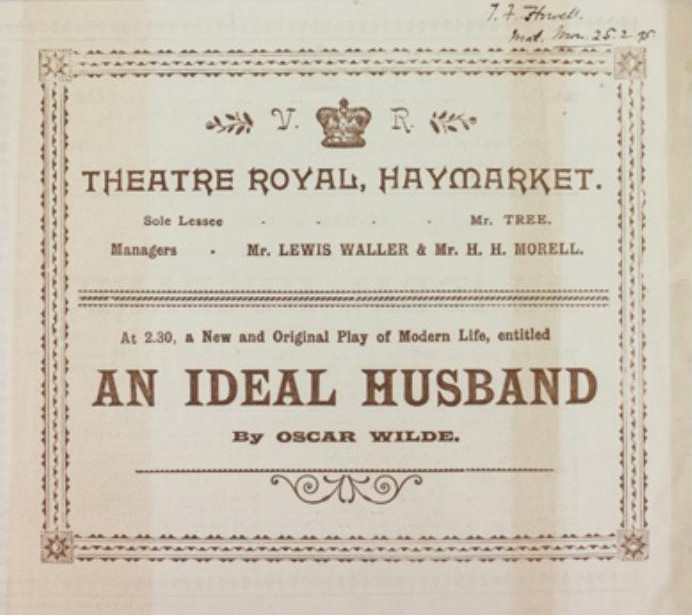
Théâtre: Haymarket Theatre (Londres - Angleterre) Durée : 3 mois Nombre : 108 représentationsPremière Preview : Inconnu
Première: 03 January 1895
Dernière: 06 April 1895Mise en scène : Chorégraphie : Producteur : Star(s) : Avec: Lewis Waller (sir Robert Chiltern), Julia Neilson (lady Chiltern), Florence West (Mrs Cheveley), Charles H. Hawtrey (lord Goring), Alfred Bishop puis Charles Goodhart (comte de Caversham), Cosmo Stuart (vicomte de Nanjac), Henry Stanford (Montford), Charles H. E. Brookfield (Phipps), H. Deane (Mason), Charles Meyrick et Charles Goodhart (les domestiques), Fanny Brough et Vane Featherston (lady Markby), Vane Featherston et Enid Spencer Brunton (lady Basildon), Helen Forsyth (Mrs Marchmont), Maude Millett puis Sydney Fairbrother (Mabel Chiltern).Commentaires : La production
Lewis Waller et H. H. Morell dirigent le Haymarket pendant la tournée américaine de Tree et y créent la comédie de Wilde. Les décors sont de Walter Hann et William Harford. Une matinée à 17 h est essayée le 19 février. Dans les derniers jours, l’affaire Queensberry entraîne le retrait du nom de Wilde de certaines annonces. La production est transférée au Criterion du 13 au 27 avril. Le calendrier détaillé de l’Oscar Wilde Society recense 108 représentations au Haymarket, dont 28 matinées.Presse : The Times, 4 janvier 1895. Le quotidien apprécie la force des épigrammes avec lesquelles Wilde renouvelle, à ses yeux, des situations familières. Saturday Review, 12 janvier 1895, George Bernard Shaw. Il loue la liberté de Wilde dans le maniement du dialogue, des conventions dramatiques et du public. The Theatrical World of 1895, William Archer. Il trouve la comédie habile et divertissante, et le jeu satisfaisant sans éclat particulier.

Théâtre: Criterion Theatre (Londres - Angleterre) Durée : 2 semaines Nombre : Première Preview : Inconnu
Première: 13 April 1895
Dernière: 27 April 1895Mise en scène : Chorégraphie : Producteur : Star(s) : Avec: Lewis Waller (Sir Robert Chiltern), Julia Neilson (Lady Chiltern), Charles H. Hawtrey (Lord Goring), Florence West (Mrs Cheveley), Alfred Bishop et Charles Goodhart (le comte de Caversham), Cosmo Stuart (le vicomte de Nanjac), Henry Stanford (Mr Montford), Charles H. E. Brookfield (Phipps), H. Deane (Mason), Fanny Brough et Vane Featherston (Lady Markby), Vane Featherston et Enid Spencer Brunton (Lady Basildon), Helen Forsyth (Mrs Marchmont), Maude Millett et Sydney Fairbrother (Mabel Chiltern), Charles Meyrick et Charles Goodhart (les valets)Commentaires : La production
La production créée le 3 janvier au Haymarket passe au Criterion après sa dernière du 6 avril. Lewis Waller et Julia Neilson demeurent les époux Chiltern et Charles H. Hawtrey, Lord Goring. Lorsque le théâtre annonce le transfert, le nom d’Oscar Wilde a disparu de la publicité, au moment où les poursuites contre lui font événement.Presse : Lors de la création au Haymarket, The Times (4 janvier 1895) trouve que Wilde donne de l’éclat au propos ordinaire par ses épigrammes. The Saturday Review (12 janvier) admire sa liberté avec les idées, les acteurs et le public. Les annonces d’avril signalent ensuite le passage au Criterion.
Théâtre: Garrick Theatre (Londres - Angleterre) Durée : Nombre : Première Preview : Inconnu
Première: 13 December 1966
Dernière: InconnuMise en scène : James Roose-Evans i • Chorégraphie : Producteur : Star(s) : Avec: Margaret Lockwood (Mme Cheveley), Richard Todd (lord Goring), Michael Goodliffe (sir Robert Chiltern), Rachel Gurney (lady Chiltern), Perlita Neilson (Mabel), Joyce Carey (lady Markby), Raymond Huntley (comte de Caversham), Richard Dennis (vicomte de Nanjac), Yvette Rees (Mme Marchmont), Anne Cameron (lady Basildon), Leader Hawkins (Mason), Keith Bowles (James et M. Montford), Cyril Wheeler (Phipps), Martin Fowler (Harold) et Lesley Lee (la domestique).Commentaires : La reprise au Garrick
James Roose-Evans reprend le spectacle présenté au Strand en 1965. Margaret Lockwood conserve le rôle de Mme Cheveley et Richard Todd celui de lord Goring. Rachel Gurney et Michael Goodliffe forment désormais le couple Chiltern.

Théâtre: Gielgud Theatre (Londres - Angleterre) Durée : 7 mois Nombre : Première Preview : 04 November 1992
Première: 11 November 1992
Dernière: 12 June 1993Mise en scène : Peter Hall i • Chorégraphie : Producteur : Star(s) : Avec: David Yelland (Sir Robert Chiltern), Hannah Gordon (Lady Chiltern), Martin Shaw (Lord Goring), Anna Carteret (Mrs Cheveley), Michael Denison (Lord Caversham), Dulcie Gray (Lady Markby), Victoria Hasted (Mabel), Dominic Hawksley, Deborah Makepeace, Kate Isitt, Peter Gordon, Robin Browne, Roderick Nicolson, Diana Van Proosdy et Teresa Forsyth.Commentaires : La production
Peter Hall fait surgir une grande pièce à l’effigie de Victoria pour évoquer à la fois la respectabilité publique et l’argent qui a permis à Sir Robert de faire carrière. Martin Shaw donne à Lord Goring une allure qui rappelle Oscar Wilde. La mise en scène, présentée par Bill Kenwright, sera reprise dans plusieurs autres salles londoniennes puis à Broadway avec une distribution renouvelée.Presse : Ian Shuttleworth (City Limits) souligne la pertinence du décor de Carl Toms pour relier le chantage politique à la fortune de Sir Robert. Le New Yorker (5 avril 1993) relève la volonté de Peter Hall de faire de Lord Goring un double théâtral de Wilde, jusque dans l’allure donnée à Martin Shaw.
Théâtre: Haymarket Theatre (Londres - Angleterre) Durée : 3 mois Nombre : Première Preview : 11 January 1996
Première: 17 January 1996
Dernière: 20 April 1996Mise en scène : Peter Hall i • Chorégraphie : Producteur : Star(s) : Avec: Martin Shaw (Lord Goring), David Yelland (Sir Robert Chiltern), Anna Carteret (Mrs Cheveley), Penny Downie (Lady Chiltern), Victoria Hasted (Mabel Chiltern), Michael Denison, Dulcie Gray, Dominic Hawksley, Kate Gielgud, Giles Foreman, Diana Van Proosdy, Amanda Wilde.Commentaires : Peter Hall remonte sa production du début de la décennie au théâtre où la pièce a été créée en 1895. Martin Shaw reprend Lord Goring, avec David Yelland et Anna Carteret dans la distribution. L’élégance de la comédie accompagne ici un conflit politique très concret. La complicité de Goring avec le public fait passer l’action du plaisir du mot d’esprit aux compromissions qui ont rendu possible une carrière exemplaire en apparence. Le rapport du théâtre relève des recettes proches de 1,2 million de livres après douze semaines. Le spectacle passe ensuite à l’Old Vic.Presse : Le 19 janvier 1996, Paul Taylor estime dans The Independent que Martin Shaw a encore affiné son Lord Goring depuis la première présentation de la mise en scène de Peter Hall. En février, Felix rapproche le chantage de Mrs Cheveley de la question de la double vie et rappelle que la reprise se joue au Haymarket, le théâtre de la création.
Théâtre: Haymarket Theatre (Londres - Angleterre) Durée : 2 mois 1 semaine Nombre : Première Preview : Inconnu
Première: 30 July 1997
Dernière: 11 October 1997Mise en scène : Peter Hall i • Chorégraphie : Producteur : Star(s) : Avec: Martin Shaw (Lord Goring), Michael Denison, Dulcie Gray.Commentaires : La mise en scène de Peter Hall revient au Haymarket après avoir circulé à Londres, en tournée et à Broadway. Martin Shaw reprend Lord Goring, et le couple Michael Denison et Dulcie Gray compte parmi les présences qui assurent la continuité de la production. La nouvelle distribution conserve la façon dont Shaw établit une relation directe avec la salle. Le rapport du théâtre distingue cette série de celle de 1996. Elle s’achève le 11 octobre avant l’arrivée d’A Delicate Balance.Presse : Dans The Spectator du 30 août, Sheridan Morley relève que l’équipe a changé depuis le premier état du spectacle. Il juge certains nouveaux interprètes moins convaincants, mais salue la maîtrise de Michael Denison et Dulcie Gray ainsi que la complicité de Martin Shaw avec le public.
Théâtre: Haymarket Theatre (Londres - Angleterre) Durée : 1 mois 1 semaine Nombre : Première Preview : Inconnu
Première: 22 August 1998
Dernière: October 1998Mise en scène : Peter Hall i • Chorégraphie : Producteur : Star(s) : Avec: Christopher Cazenove (Lord Goring), Susannah York (Mrs Cheveley), Oliver Cotton (Sir Robert Chiltern), Geraldine Fitzgerald (Lady Chiltern), Richard Todd (comte de Caversham), Barbara Murray (Lady Markby).Commentaires : La production de Peter Hall revient au Haymarket après le Gielgud et l’Albery. Avec Christopher Cazenove en Lord Goring et Susannah York en Mrs Cheveley, le retour de 1998 a une distribution qui le distingue des passages précédents avec Martin Shaw. Oliver Cotton et Geraldine Fitzgerald jouent les Chiltern. Richard Todd reprend la figure du père de Goring et Barbara Murray celle de Lady Markby. Le théâtre situe ce retour après une interruption de deux semaines, avant l’engagement de Jasper Carrott.Presse : La note de Whatsonstage documente le changement de distribution. Le compte rendu reproduit sur la même page évoque un état antérieur avec Martin Shaw et donne le contexte du succès de cette mise en scène à travers ses reprises.
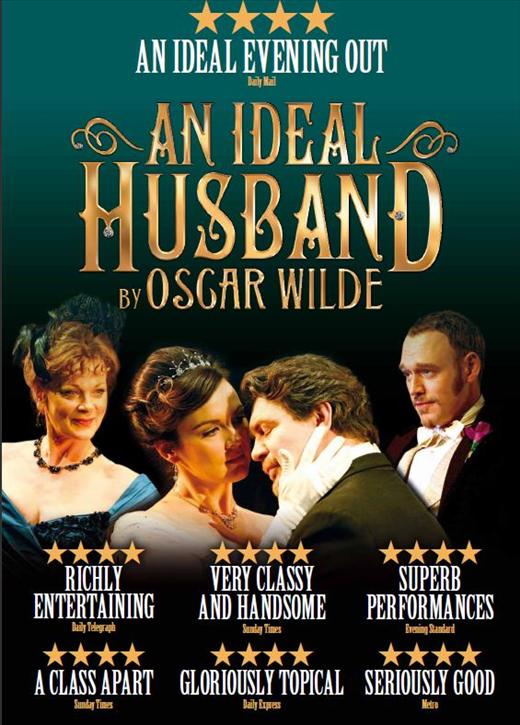
Théâtre: Vaudeville Theatre (Londres - Angleterre) Durée : 3 mois 2 semaines Nombre : Première Preview : 04 November 2010
Première: 10 November 2010
Dernière: 26 February 2011Mise en scène : Lindsay Posner i • Chorégraphie : Producteur : Star(s) : Avec: Alex Hanson (Sir Robert Chiltern), Rachael Stirling (Mrs Chiltern), Samantha Bond (Mrs Cheveley), Elliot Cowan (Lord Goring), Charles Kay , Fiona Button, Caroline Blakiston
Pas encore de vidéo disponible pour ce spectacle