
Adelphi Theatre
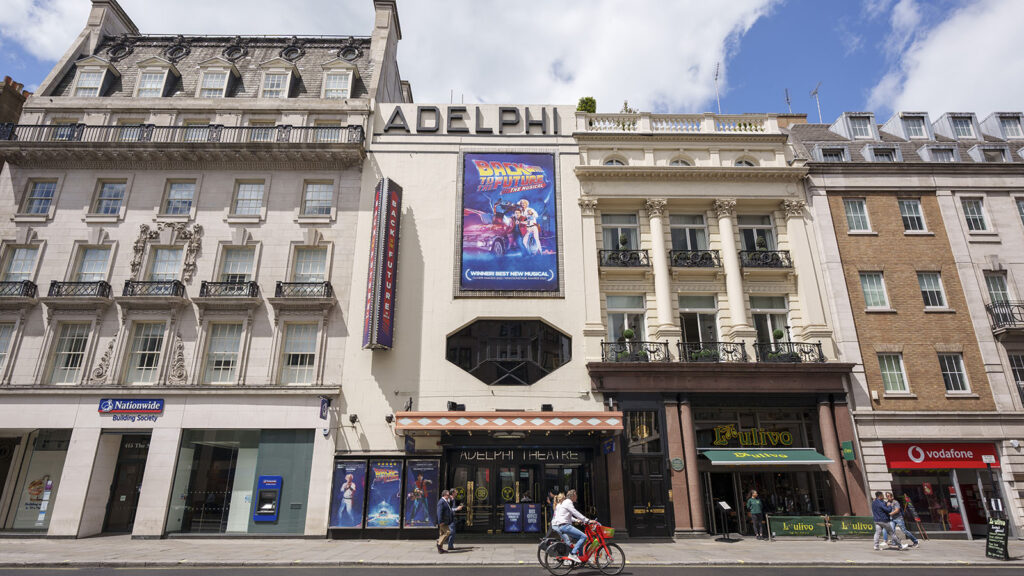
Ville : Londres
Pays : Royaume-Uni
Adresse : 409–412 Strand, London WC2R 0NS
Localisation du théâtre
Infos complémentaires
① Historique du théâtre
L’Adelphi Theatre, plus de deux siècles d’histoire au cœur du Strand
L’Adelphi Theatre est l’un des plus anciens théâtres du West End londonien, avec une histoire qui remonte à 1806, lorsque John Scott et sa fille Jane ouvrent le Sans Pareil. D’abord consacré aux divertissements populaires, le théâtre se forge progressivement une solide réputation, notamment grâce aux mélodrames qui passionnent le public victorien. Au fil des décennies, il change plusieurs fois de nom, de direction et même de bâtiment, tout en conservant une place importante dans la vie théâtrale londonienne. Les frères Gatti contribuent à son rayonnement à la fin du XIXème siècle, avant que de nouvelles reconstructions ne lui donnent, en 1930, son visage Art déco actuel. Au XXème siècle, l’Adelphi accueille de grandes comédies, des revues et, de plus en plus, des musicals. Parmi les succès qui ont marqué son histoire figurent notamment Me and My Girl, Chicago, Evita et Kinky Boots. Plus de deux siècles après son ouverture, l’Adelphi demeure l’une de ces salles où l’histoire du théâtre londonien continue de s’écrire, soir après soir.
Afficher l’historique détaillé
Quand le Strand n’était encore qu’un chemin au bord de la Tamise
Pour comprendre l’histoire de l’Adelphi Theatre, il faut d’abord remonter bien avant sa naissance, à une époque où le Strand ne ressemblait en rien à la grande artère londonienne que nous connaissons aujourd’hui.
Jusqu’au milieu du XVIe siècle, il s’agissait encore d’un chemin non pavé longeant la Tamise, alors plus large qu’aujourd’hui et dépourvue des quais qui en fixent désormais les limites. D’un côté s’étendait le fleuve ; de l’autre, les jardins des somptueuses demeures aristocratiques qui bordaient cette voie reliant la City à Westminster.
Au fil des siècles, les grandes résidences cédèrent progressivement la place à des maisons plus modestes, à des commerces et à des établissements accueillant une population toujours plus nombreuse. Au début du XIXe siècle, l’architecte John Nash participa à la transformation de la partie occidentale du Strand. Mais c’est surtout dans la seconde moitié du siècle, puis au début du XXe, que le quartier connut ses bouleversements les plus spectaculaires.
La percée de Shaftesbury Avenue et de Charing Cross Road, la disparition d’îlots entiers de vieux bâtiments et la construction de nouvelles salles contribuèrent à façonner ce qui allait devenir le West End théâtral.
Cette transformation représentait une formidable occasion pour les entrepreneurs du spectacle : des terrains se libéraient, de nouvelles rues accueillaient un public toujours plus nombreux et les théâtres se multipliaient.
Mais l’Adelphi avait pris une longueur d’avance : lorsque cette grande fièvre immobilière s’empara du West End, il accueillait déjà des spectateurs depuis plusieurs décennies.
1806 — Un commerçant, sa fille et une aventure théâtrale
L’histoire commence avec un personnage plutôt inattendu : John Scott, un commerçant du Strand qui avait fait fortune grâce à une invention domestique, une poudre bleue destinée à blanchir le linge, commercialisée sous le nom d’Old True Blue. Dans sa boutique, il vendait également des lanternes magiques, ces instruments de projection qui fascinaient le public bien avant l’apparition du cinéma.
Mais la véritable passion théâtrale de la famille venait surtout de sa fille, Jane Margaret Scott.
Douée pour la scène, ambitieuse, créative et passionnée de spectacle, Jane convainquit son père d’aménager une véritable petite salle à l’arrière de son commerce. Le projet était loin d’être modeste : il s’agissait de créer un établissement suffisamment confortable et bien équipé pour attirer un public disposé à payer sa place.
Le 27 novembre 1806, le Sans Pareil ouvrait ses portes.
Les tarifs initiaux témoignaient d’ailleurs de cette ambition : cinq shillings pour une place en loge et trois shillings au parterre, des montants qui furent ensuite réduits d’un shilling.
Le succès fut suffisamment rapide pour encourager John Scott à agrandir son établissement. Dès 1813–1814, il acquit des parcelles voisines, augmenta la capacité de la salle et fit construire un portique à colonnes donnant sur le Strand.
Jane Scott ne se contenta pas d’être à l’origine du projet. Elle participa activement à sa vie artistique comme interprète, autrice et directrice. Elle écrivit plusieurs dizaines de pièces et de divertissements pour son théâtre, contribuant à lui donner une identité résolument populaire.
Cette origine est particulièrement attachante : l’un des grands théâtres historiques de Londres est né non pas d’un projet aristocratique, mais de l’enthousiasme d’une jeune femme et de la confiance que lui accordait son père.
1819–1858 — L’Adelphi devient un temple du mélodrame
En 1819, John Scott céda l’établissement à T. Willis Jones et au dramaturge J. T. G. Rodwell. Rebaptisé Adelphi Theatre, il poursuivit son développement en diversifiant sa programmation.
Le public venait y applaudir des burlettas, des pantomimes, des comédies et surtout des mélodrames, un genre alors extrêmement populaire, mêlant passions dévorantes, crimes, intrigues, péripéties spectaculaires et personnages fortement contrastés.
L’Adelphi allait progressivement s’imposer comme l’une des grandes maisons londoniennes de ce théâtre populaire.
Les adaptations littéraires occupèrent une place importante dans son répertoire. Dès les années 1830, les œuvres de Charles Dickens inspirèrent plusieurs spectacles, parfois alors même que les romans paraissaient encore en feuilleton. L’univers de Dickens, avec ses personnages hauts en couleur, ses contrastes sociaux et son sens aigu du drame, se prêtait merveilleusement aux exigences de la scène.
En 1867, No Thoroughfare, écrit conjointement par Dickens et Wilkie Collins, remporta notamment un grand succès à l’Adelphi.
Parallèlement à cette évolution artistique, le bâtiment se transformait.
En 1834, les propriétaires Frederick Yates et Daniel Terry firent notamment l’acquisition d’une maison ancienne située au 18 Maiden Lane, afin d’agrandir la scène et les installations du théâtre. De nouvelles loges furent également ajoutées.
En 1840, l’architecte Samuel Beazley, déjà associé à plusieurs grands théâtres londoniens, conçut une nouvelle façade particulièrement monumentale. Colonnes, grandes ouvertures et ornements sculptés donnaient désormais à l’établissement une présence architecturale à la hauteur de ses ambitions.
L’histoire de l’Adelphi illustre ainsi une réalité essentielle du théâtre du XIXe siècle : pour survivre et prospérer, il ne suffisait pas de programmer de bons spectacles. Il fallait sans cesse agrandir, moderniser et embellir les lieux afin de répondre aux attentes d’un public toujours plus nombreux.
1858 — Une nouvelle salle pour un nouveau siècle
En 1858, l’Adelphi franchit une étape beaucoup plus radicale.
Sous l’impulsion de Benjamin Webster, l’ancien théâtre fut démoli et remplacé par une salle plus vaste et plus élégante, conçue par l’architecte Thomas Henry Wyatt.
Le nouveau bâtiment, inauguré le 27 décembre 1858, possédait trois niveaux de galeries et pouvait accueillir environ 1 500 spectateurs assis, auxquels pouvaient s’ajouter des places debout.
Les architectes exploitèrent également les possibilités offertes par les nouvelles techniques de construction. La toiture reposait sur une structure métallique, tandis que de fines colonnes en fer soutenaient les différents niveaux de la salle. Le parterre fut abaissé sous le niveau de la rue afin de gagner de l’espace pour les galeries.
L’éclairage constituait lui aussi un élément spectaculaire, avec un grand lustre de verre et un dispositif d’éclairage au gaz particulièrement élaboré.
L’Adelphi n’était plus seulement une salle appréciée pour ses productions : il devenait un véritable exemple de modernisation de l’architecture théâtrale victorienne.
Les frères Gatti, un restaurant prestigieux et un assassinat
À la fin du XIXe siècle, l’histoire du théâtre se confond avec celle de deux entrepreneurs d’origine suisse, Agostino et Stefano Gatti.
Déjà actifs dans la restauration et le monde des spectacles, les frères Gatti reprirent le bail de l’Adelphi en 1878. Ils comprirent rapidement l’intérêt de réunir, autour d’un même établissement, plusieurs activités susceptibles d’attirer et de fidéliser le public londonien.
En 1885, ils acquirent les immeubles voisins des 409 et 410 Strand, où l’architecte Spencer Chadwick construisit un établissement de restauration élégant, l’Adelphi Theatre Restaurant, achevé en 1886–1887.
Cette opération participait au développement commercial du complexe théâtral : on pouvait désormais associer une soirée de spectacle à un dîner dans un cadre prestigieux.
Mais l’histoire de l’Adelphi comporte aussi l’un des épisodes les plus tragiques du théâtre londonien.
Le 16 décembre 1897, le célèbre acteur William Terriss fut assassiné à proximité de l’entrée des artistes du théâtre, dans Maiden Lane, par Richard Archer Prince, un comédien en difficulté.
Terriss était alors une personnalité particulièrement appréciée du public. Sa mort provoqua une vive émotion dans le monde théâtral britannique.
Une plaque commémorative rappelle encore aujourd’hui ce drame. Quant à la légende, elle s’est naturellement emparée de l’événement : selon une tradition tenace, le fantôme de Terriss hanterait toujours l’Adelphi.
L’histoire d’un théâtre se nourrit aussi de ces drames, de ces souvenirs et de ces récits qui se transmettent d’une génération à l’autre.
1901 — L’arrivée de la comédie musicale moderne
À l’aube du XXe siècle, l’Adelphi entama une nouvelle transformation majeure.
Le bail passa à George Edwardes, grande figure du théâtre musical londonien, notamment associé au Gaiety Theatre. Avec l’architecte Ernest Runtz, le bâtiment fut profondément remanié afin de mieux répondre aux exigences de la comédie musicale de l’époque.
L’accès depuis le Strand fut notamment élargi et les installations modernisées.
En septembre 1901, le théâtre rouvrit sous un nouveau nom : Century Theatre. Cette appellation ne dura toutefois que quelques années avant le retour au nom Adelphi.
Ce tournant architectural correspondait également à une évolution du répertoire.
Le théâtre musical britannique connaissait alors un formidable essor, porté par des œuvres plus légères et modernes que les opérettes traditionnelles, mêlant comédie, chansons, élégance des costumes et spectacles chorégraphiques.
L’Adelphi s’inscrivit naturellement dans ce mouvement, sans pour autant abandonner les pièces et les divertissements qui avaient fait sa réputation.
1930 — La naissance de l’Adelphi Art déco
La reconstruction de 1930 constitue sans doute le chapitre architectural le plus important pour le visiteur contemporain, puisqu’elle donna au théâtre l’essentiel de son apparence actuelle.
L’architecte Ernest Schaufelberg conçut un établissement résolument moderne, rompant avec les formes et les ornements qui avaient caractérisé les versions précédentes de l’Adelphi.
Le nouveau théâtre, inauguré le 3 décembre 1930, adoptait les lignes géométriques caractéristiques de l’Art déco, alors à son apogée.
La façade sur le Strand privilégiait les surfaces planes, les angles nets et une composition géométrique affirmée.
À l’intérieur, le foyer associait marbre, métal chromé et plafonds anguleux. La salle, dont les côtés étaient presque rectilignes, possédait deux balcons en porte-à-faux reposant sur des structures de béton, ce qui limitait les obstacles visuels traditionnels des théâtres anciens.
Le bois poli, le marbre et le chrome participaient à une décoration particulièrement soignée, rehaussée à l’origine de tons or, orange, vert et rose sombre.
Tout semblait conçu pour afficher une modernité assumée.
Schaufelberg ne rasa cependant pas absolument toutes les traces du passé. Certains murs latéraux et arrière furent conservés, de même que des éléments des bâtiments de Maiden Lane.
Des vestiges plus anciens subsistent encore dans certains espaces techniques et recoins peu visibles du théâtre.
L’établissement reçut également une cabine de projection cinématographique et, à l’initiative du producteur C. B. Cochran, un plateau tournant, qui allait rester en place pendant plusieurs décennies avant d’être retiré en 1993.
L’Adelphi témoigne ainsi d’un moment où l’architecture des théâtres et celle des grandes salles de cinéma s’influençaient mutuellement.
Le bâtiment actuel constitue aujourd’hui un exemple particulièrement intéressant de cette modernité théâtrale de l’entre-deux-guerres.
Un théâtre qui a failli disparaître
Le fait que l’Adelphi existe toujours n’a pourtant rien d’évident.
Dans les années 1950 et au début des années 1960, alors que Londres connaissait une nouvelle vague de transformations immobilières, son emplacement particulièrement recherché attira la convoitise de promoteurs.
En 1955, une opération immobilière liée à la société F. W. Woolworth & Co. envisagea notamment de remplacer le théâtre par un établissement commercial.
Quelques années plus tard, en 1960, une nouvelle proposition de démolition fut présentée par City Centre Properties.
Dans les deux cas, les autorités londoniennes refusèrent les projets.
Ces décisions contribuèrent à préserver l’un des plus anciens sites théâtraux encore en activité dans le West End.
Le bâtiment bénéficie aujourd’hui d’une protection patrimoniale britannique de Grade II, reconnaissance de son importance architecturale et historique.
Du théâtre populaire aux grands musicals du West End
Mais l’Adelphi ne se résume évidemment pas à son architecture.
Depuis plus de deux siècles, il accompagne les transformations des goûts du public britannique, passant des divertissements du Sans Pareil aux mélodrames victoriens, puis aux comédies, revues et grands musicals.
En 1940, la légendaire Marie Tempest y donna sa dernière prestation londonienne dans Dear Octopus.
Après la Seconde Guerre mondiale, le théâtre accueillit notamment des spectacles et des revues faisant appel à de grandes personnalités du divertissement.
En 1950, Jack Hylton reprit le bail de l’établissement. L’Adelphi poursuivit alors une programmation variée, avant de s’orienter toujours plus nettement vers le théâtre musical.
En 1965, Charlie Girl y remporta un succès considérable, dépassant les 2 000 représentations.
Puis vinrent les reprises de Show Boat, The King and I et My Fair Lady, témoignant de la place croissante des grands classiques américains dans le West End.
Mais un véritable tournant se produisit en 1985, avec Me and My Girl. Cette nouvelle version du musical de Noël Gay, adaptée notamment par Stephen Fry, allait rester à l’affiche pendant près de huit années, totalisant plus de 3 300 représentations.
La salle était devenue l’un des lieux majeurs du musical londonien.
Des grands succès internationaux à l’Adelphi contemporain
Les années 1990 confirmèrent cette orientation.
En 1993, l’Adelphi accueillit la création londonienne de Sunset Boulevard, le grand musical d’Andrew Lloyd Webber, avec Patti LuPone dans le rôle de Norma Desmond.
La même période fut marquée par d’importants travaux destinés à redonner au bâtiment son éclat Art déco d’origine.
En 1997, une nouvelle production de Chicago s’installa à l’Adelphi. Le spectacle y demeura près de neuf années, devenant l’un des plus grands succès de l’histoire de la salle.
Au cours des décennies suivantes, le théâtre accueillit des productions aussi différentes qu’Evita, Joseph and the Amazing Technicolor Dreamcoat, Love Never Dies, Sweeney Todd, The Bodyguard, Made in Dagenham, Kinky Boots ou Waitress.
L’Adelphi prouva également qu’il pouvait retrouver le théâtre parlé, notamment avec One Man, Two Guvnors, production issue du National Theatre, présentée dans le West End en 2011.
À partir de 2021, Back to the Future: The Musical y connut une longue série londonienne, utilisant toutes les possibilités techniques d’une scène moderne pour faire revivre l’univers du célèbre film.
Cette diversité rappelle qu’un théâtre ne doit jamais être réduit à un seul genre, même lorsqu’une période de son histoire semble particulièrement favorable au musical.
Plus de deux siècles d’histoire… et le spectacle continue
Il y a quelque chose de fascinant à imaginer ce que représente aujourd’hui l’Adelphi Theatre.
En franchissant ses portes, le spectateur entre dans un bâtiment Art déco de 1930. Mais derrière cette architecture, il retrouve aussi les traces d’un petit théâtre installé en 1806 à l’arrière d’une boutique, de l’ambition d’une jeune femme passionnée, des grandes heures du mélodrame victorien, des entrepreneurs qui ont façonné le West End et des générations d’artistes venus y faire vivre leurs créations.
L’Adelphi a été agrandi, transformé, démoli, reconstruit, rebaptisé et menacé de disparition. Il a traversé les évolutions de Londres, les changements de goûts du public, deux guerres mondiales et les bouleversements techniques qui ont transformé le spectacle vivant.
Et pourtant, il continue à remplir la mission imaginée par John Scott et sa fille Jane plus de deux siècles auparavant : rassembler des spectateurs devant une scène pour leur raconter des histoires.
C’est peut-être cela, finalement, la plus belle continuité de l’Adelphi Theatre.
② Topologie du lieu
③ Évolution architecturale
1806
Ouverture du Sans Pareil
Le Sans Pareil ouvre le 27 novembre 1806, fondé par John Scott et sa fille Jane Scott.
1840
Nouvelle façade
Samuel Beazley conçoit une nouvelle façade monumentale pour le théâtre.
1858
Reconstruction complète
L’ancien théâtre est démoli et remplacé par un bâtiment plus vaste, conçu par Thomas Henry Wyatt. Le New Adelphi ouvre le 27 décembre 1858.
1887
Agrandissement et transformation du théâtre
Sous l’impulsion des frères Gatti, le théâtre connaît d’importants travaux de transformation, confiés à l’architecte Spencer Chadwick, avec notamment un agrandissement et une modification de sa façade.
1901
Reconstruction et modernisation
Ernest Runtz remanie profondément le théâtre. Il rouvre le 11 septembre 1901 sous le nom de Century Theatre.
1930
Reconstruction Art déco
Ernest Schaufelberg conçoit le bâtiment actuel dans un style Art déco aux lignes géométriques. Le théâtre rouvre le 3 décembre 1930.
④ Les différentes dénominations
1806
Sans Pareil
1819
Adelphi Theatre
1829
Theatre Royal, Adelphi
1858
Theatre Royal, New Adelphi
1901
Century Theatre
1904
Royal Adelphi Theatre
1940
Adelphi Theatre
⑤ Plan de salle et commentaires
⑥ Quelques points à souligner
Les spectacles que j'ai vus dans ce théâtre
1 spectacle vu- 🎶 « Bloedbroeders » — 14/04/2018 9/10
Prochainement
1 production
Lives of Others (The)
Type : Original London
Première preview : jeudi 14 octobre 2027
Première : lundi 22 novembre 2027
Dernière : dimanche 09 janvier 2028
Metteur en scène : Robert Icke
Avec : Keira Knightley (Christa-Maria Sieland), Stephen Dillane (Gerd Wiesler), Luke Thompson (Georg Dreyman), Jamie Ankrah (Udo), Jake Benson (Hessentein), Matt Ray Brown (Prisoner / Schwalber / Official), Lucy Doyle (Actress / Couple), Calum Finlay (Hauser), Josh Gordon (Lehmann / Hempf Bodyman / Waiter / Director), Paul Higgins (Grubitz), Leda Hodgson (Frau Meineke / Shopkeeper), Nick Holder (Jerska / Uncle H), Sibylla Meienberg (Graphologist / Border Crossing Voice), Irfan Shamji (Wallner), Richard Sutton (Meier), Andrew Woodall (Hempf)
Commentaire : Essai
Actuellement à l’affiche
1 production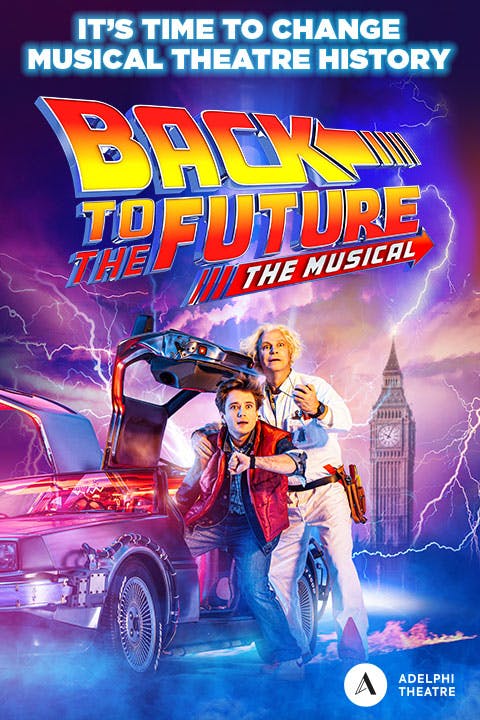
Back to the Future: The Musical
Type : Original London
À l’affiche depuis 5 ans 2 mois
Première preview : vendredi 20 août 2021
Première : vendredi 20 août 2021
Dernière : Open end
Compositeur : Alan Silvestri
Parolier : Alan Silvestri
Librettiste : Bob Gale
Metteur en scène : John Rando
Chorégraphe : Chris Bailey
Avec : Roger Bart (Dr Emmett Brown), Olly Dobson (Marty McFly), Hugh Coles (George McFly), Rosanna Hyland (Lorraine Baines), Cedric Neal (Goldie Wilson), Aidan Cutler (Biff Tannen), Courtney-Mae Briggs (Jennifer Parker), Will Haswell (Dave McFly), Emma Lloyd (Linda McFly), Mark Oxtoby (Strickland), Rhianne Alleyne, Amy Barker, Matt Barrow, Joshua Clemetson, Jamal Crawford, Bessy Ewa, Ryan Heenan, Cameron McAllister, Alessia McDermott, Laura Mullowney, Nic Myers, Shane O'Riordan, Katharine Pearson, Oliver Tester, Justin Thomas, Tavio Wright, Melissa Rose, Morgan Gregory
Commentaire : Essai
Presse : Essai 2
Passé — Chronologie des productions
110 productions
110) Hello, Dolly!
Type : Revival
Nombre de représentations : 0
Première preview : mardi 11 août 2020
Première : mardi 11 août 2020
Dernière : mardi 11 août 2020
Compositeur : Jerry Herman
Parolier : Jerry Herman
Librettiste : Michael Stewart
Avec : Imelda Staunton
109) Fermeture COVID
Type : Original
Joué durant 1 an 4 mois
Première preview : lundi 16 mars 2020
Première : lundi 16 mars 2020
Dernière : lundi 19 juillet 2021
Commentaire : Tous les théâtres anglais ont dû fermer dès le 16 mars 2020 suite à la pandémide de COVID…
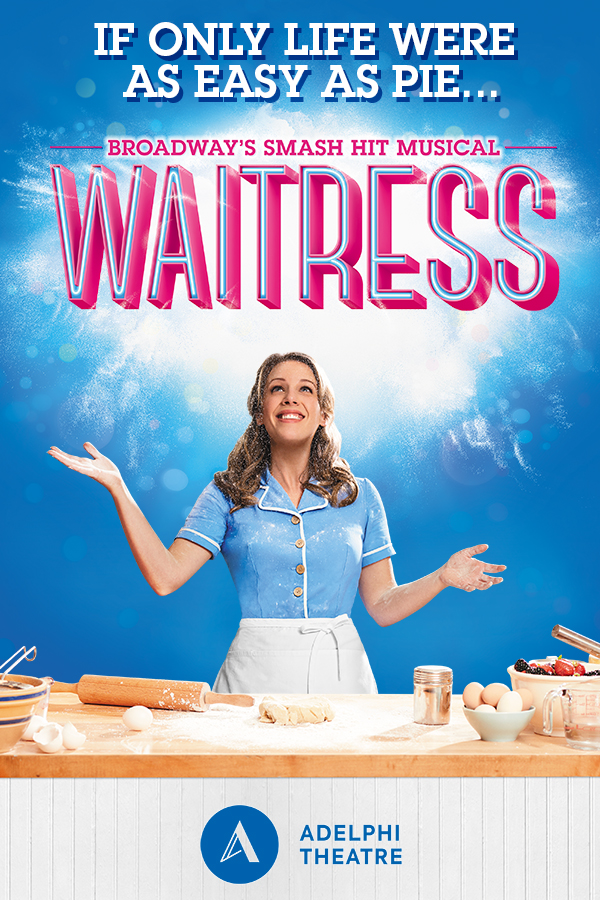
108) Waitress
Type : Original London
Joué durant 1 an 1 semaine
Première preview : vendredi 08 février 2019
Première : mercredi 06 mars 2019
Dernière : lundi 16 mars 2020
Compositeur : Sara Bareilles
Parolier : Sara Bareilles
Librettiste : Jessie Nelson
Metteur en scène : Diane Paulus
Chorégraphe : Lorin Latarro
Avec : Lucie Jones (Jenna Hunterson), Sandra Marvin (Becky), Laura Baldwin (Dawn), Tamlyn Henderson (Earl), David Hunter (Dr Pomatter), Joe Sugg (Ogie), Andrew Boyer (Old Joe), Kelly Agbowu (Nurse Norma), Piers Bate (Ensemble), Cindy Belliot (Ensemble), Nathanial Morrison (Ensemble), Leanne Pinder (Swing/Dance Captain), Michael Hamway (Swing), Stephen Leask (Cal), Chris McGuigan (Ensemble), Olivia Moore (Ensemble), Sarah O'Connor (Swing), Charlotte Riby (Ensemble), Mark Willshire (Swing), Juliette Clemens-Lary (Lulu - certain performances), Annabelle Jones (Lulu - certain performances)
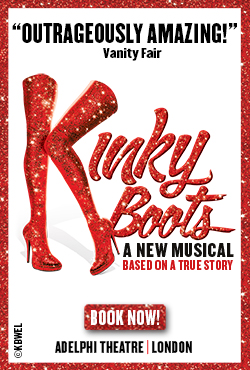
107) Kinky Boots
Type : Original London
Joué durant 3 ans 4 mois
Première preview : vendredi 21 août 2015
Première : mardi 15 septembre 2015
Dernière : samedi 12 janvier 2019
Compositeur : Cindy Lauper
Parolier : Cindy Lauper
Librettiste : Harvey Fierstein
Metteur en scène : Jerry Mitchell
Chorégraphe : Jerry Mitchell
Avec : Killian Donnelly (Charlie) Matt Henry (Lola) , Amy Lennox (Lauren), Jamie Baughan (Don), Amy Ross (Nicola) and Michael Hobbs (George), Gemma Atkins, Paul Ayers, Jeremy Batt, Arun Blair-Mangat, Marcus Collins, Emma Crossley, Jordan Fox, Callum Francis, Robert Grose, Gillian Hardie, Chloe Hart, Sophie Isaacs, Luke Jackson, Robert Jones, Adam Lake, Catherine Millsom, Sean Needham, Tim Prottey-Jones, Verity Quade, Javier Santos, Dominic Tribuzio, Alan Vicary, Michael Vinsen and Bleu Woodward.
Presse : "You could make a case against the musical as a piece of preachy uplift about sexual tolerance. But it won me over through the quality of the lead performances, the verve of its staging and its conviction, in its fetishistic worship of thigh-high boots, that there’s no business like shoe business."
Michael Billington for The Guardian
"It may at times look as colourful as a pride carnival parade, but you can hear the creak of the production-line...it might seem ungracious to give it a kicking. But a kicking I feel obliged to give it."
Dominic Cavendish for The Telegraph
"It's good fun but, in my view, a bit too formulaic to induce rapture. You can't deny, though, that it brings a dynamic new dimension to the idea of dragging your heels."
Paul Taylor for The Independent
"The score by Cyndi Lauper is middling US rock, by-the-yard fare. Harvey Fierstein’s script has a few jolly moments but as many cliches."
Quentin Letts for The Daily Mail
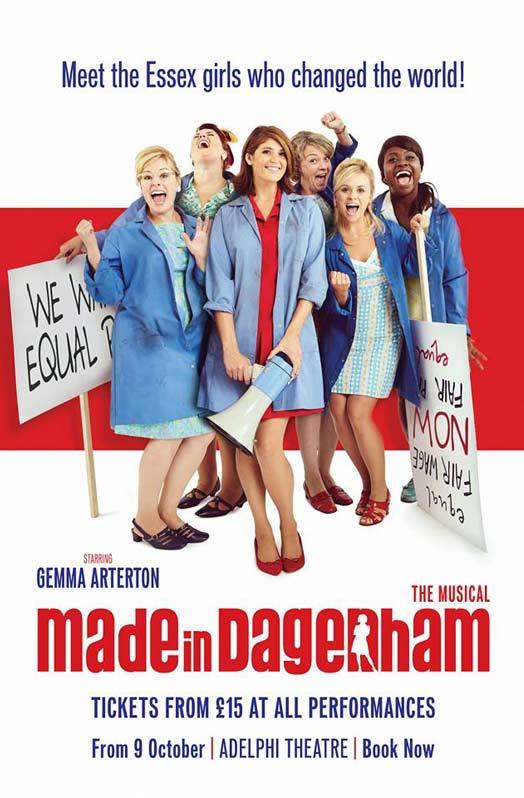
106) Made in Dagenham
Type : Original
Joué durant 5 mois 1 semaine
Première preview : jeudi 09 octobre 2014
Première : mercredi 05 novembre 2014
Dernière : samedi 11 avril 2015
Compositeur : David Arnold
Parolier : Richard Thomas
Librettiste : Richard Bean
Metteur en scène : Rupert Goold
Chorégraphe : Aletta Collins
Avec : Gemma Arterton (Rita O’Grady), Adrian Der Gregorian (Eddie), Steve Furst (Mr Tooley), Mark Hadfield (Harold Wilson), Sophie-Louise Dann (Barbara Castle), Sophie Stanton (Beryl), Heather Craney (Clare), Sophie Isaacs (Sandra), Julius D'Silva (Mr Hopkins), Naomi Frederick (Lisa), Isla Blair, David Cardy, Naana Agyei-Ampadu, Thomas Aldridge, Kate Coysten, Christopher Howell, Scott Garnham, Ian Jervis, Paul Kemble, Emma Lindars, Jo Napthine, Tracey Penn, Gemma Salter, Gareth Snook, Rachel Spurrell, Emily Squibb, Karli Vale, and Rene Zagger.
Commentaire : Essex 1968. Like millions of other working women, each morning Rita O’Grady is just trying to get her husband out of bed, get the kids off to school and get to work at the factory on time. But life is about to change forever when it’s announced that the girls in the sewing room of Ford’s Dagenham car plant will have their pay grade dropped to ‘unskilled’. Quickly drawing on a strength she never knew she had, Rita leads her friends in a battle against the might of Ford and the corruption of the Union supposed to protect them. As the girls’ inspiring journey gets bigger than anyone could have imagined, the pressure is too much for some, but can Rita keep up the fight and the happy home she’s worked so hard for?
Presse : "But like the cause of equal pay itself, there’s an air of unfinished business about it all. Despite celebrating how a bunch of workers found their voice, the evening lacks a truly compelling one of its own." Dominic Cavendish for The Telegraph
"This show – with its slick, catchy tunes ... infectiously demonstrates that it's a saga well worth making a song and dance about." Paul Taylor for The Independent
"Turned into a big, brassy musical, the show has mislaid the quality that made the film so good: a real heart." Michael Billington for The Guardian
"With its feel-good approach to a long-won battle for fairness, this show will win plenty of friends out for an evening’s easy entertainment." Quentin Letts for The Daily Mail
"... a funny, thoughtful and uplifting show that deserves to be seen." Simon Edge for The Daily Express
"Made in Dagenham is broad, occasionally crass and a little too manipulative (the final number is an especially brazen bid to get us on our feet). But it also manages to be robustly likeable — mixing passionate populism with bursts of big-budget flamboyance." Henry Hitchings for the Evening Standard
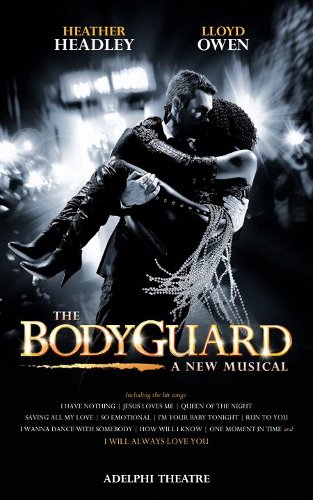
105) Bodyguard (The)
Type : Original
Joué durant 1 an 8 mois 3 semaines
Première preview : mardi 06 novembre 2012
Première : mercredi 05 décembre 2012
Dernière : vendredi 29 août 2014
Metteur en scène : Thea Sharrock
Chorégraphe : Arthur Pita
Avec : Beverley Knight (Rachel Marron - At Wednesday and Saturday matinee performances the role of Rachel Marron will be played by Joelle Moses), Tristan Gemmill (Frank Farmer ), Debbie Kurup (Nicki Marron), Richard Lloyd King (Bill Devaney), Stephen Marcus (Tony), Dominic Taylor (Sy Spector), Michael Rouse (Stalker) , Stuart Reid (Ray Court). Ensemble members are Gareth Andrews, Kimball Armes, Christopher Birch, Hannah Fairclough, Robert Gill, Nicky Griffiths, Ben Harrold, Jamie Hughes-Ward, Alex Jackson, Genesis Lynea, Fergal McGoff, Sara Morley, Joelle Moses, David O’Mahoney, Stuart Rogers, Kyle Seeley, Danielle Steers, Katy Stredder, Christopher Terry.
Commentaire : Former Secret Service agent turned bodyguard, Frank Farmer, is hired to protect superstar Rachel Marron from an unknown stalker. Each expects to be in charge; what they don’t expect is to fall in love. A romantic thriller, The Bodyguard features a multitude of Whitney Houston’s hits including Queen of the Night, So Emotional, One Moment in Time, Saving All My Love, I’m Your Baby Tonight, Run to You, I Have Nothing, How Will I Know, I Wanna Dance With Somebody and I Will Always Love You.
Presse : "It is performed...with such an infectious zest and wholehearted commitment that the evening is tremendously enjoyable."
Paul Taylor for The Independent
"Although the show is staged with enormous technical efficiency, it is one more example of the necrophiliac musical morbidly attracted to a cinematic corpse.."
Michael Billington for The Guardian
"Spectacularly and ingeniously designed by Tim Hatley, is far more enjoyable than the movie. And there is a thrilling star performance from the Trinidad-born, American-based singer and actress Heather Headley...But that is largely where the good news ends. Though Alexander Dinelaris has tweaked Lawrence Kasdan’s screenplay, the show remains trite and sentimental."
Charles Spencer for The Daily Telegraph
"Corny but entertaining."
Quentin Letts for The Daily Mail
"It’s spectacular, stylish and delivered with panache."
Ian Shuttleworth for The Financial Times
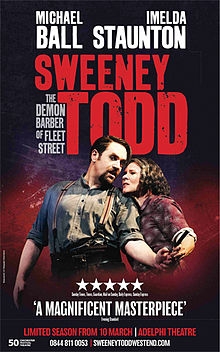
104) Sweeney Todd
Type : Revival
Joué durant 6 mois
Première preview : samedi 10 mars 2012
Première : mardi 20 mars 2012
Dernière : samedi 22 septembre 2012
Compositeur : Stephen Sondheim
Parolier : Stephen Sondheim
Librettiste : Hugh Wheeler
Metteur en scène : Jonathan Kent
Chorégraphe : Denis L. Sayers
Avec : Michael Ball (Sweeney Todd), Imelda Staunton (Mrs Lovett), Robert Burt (Pirelli) , John Bowe, Peter Polycarpou, Gillian Kirkpatrick, Lucy May Barker, Luke Brady, James McConville, and Simeon Truby. The ensemble includes: Valda Aviks, Will Barratt, Josie Benson, Emily Bull, John Coates, Daniel Graham, Robine Landi, Tim Morgan, Aoife Nally, Adam Pearce, Wendy Somerville, Kerry Washington and Annabelle Williams.
Presse : "Jonathan Kent's production, which has now transferred from Chichester, and which leaves me grasping for superlatives, has given the piece a fresh look without destroying its essential fabric."
Michael Billington for The Guardian
"Sondheim’s rich, pungent musical with glee, relishing its excesses yet still savouring its delicacy. It’s a dark, glinting treat."
Sarah Hemming for the Financial Times
"It is dark, nightmarish and thrilling, and packed with tremendous numbers, from the comic to the cruel (often simultaneously) and from the tender to the terrifying. Watching it, you have no doubt that this is masterpiece of nervous laughter and sudden jolting shocks."
Charles Spencer for the Daily Telegraph
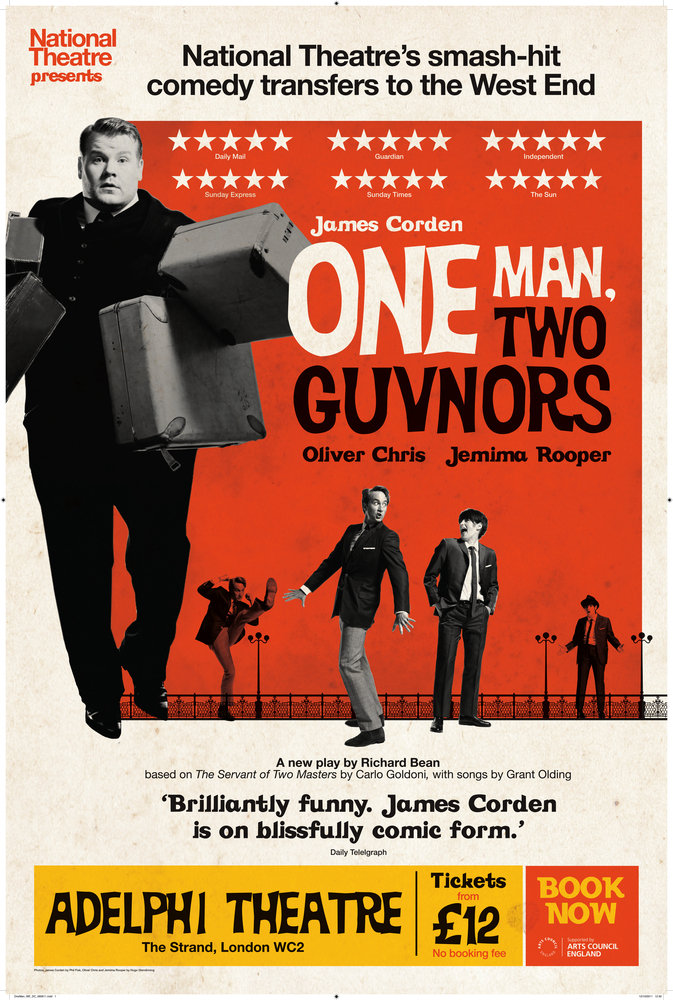
103) One Man, Two Guvnors
Type : West End Transfer
Joué durant 3 mois
Première preview : mardi 08 novembre 2011
Première : lundi 21 novembre 2011
Dernière : samedi 25 février 2012
Metteur en scène : Nicholas Hytner
Chorégraphe : Adam Penford
Avec : James Corden (Francis Henshall), Oliver Chris, Jemima Rooper, David Benson, Tom Edden, Martyn Ellis, Trevor Laird, Claire Lams, Fred Ridgeway, Daniel Rigby , Suzie Toase , Polly Conway, Derek Elroy, Paul Lancaster, Gareth Mason, Clare Thomson, Owain Arthur, David Hunter
Presse : "An evening of riotous delight"
Charles Spencer for The Daily Telegraph
"Bubbles over with humour. A surefire hit. "
Henry Hitchings for The Evening Standard
"One massive hit"
Paul Taylor for The Independent
"One of the funniest productions in the National's history."
Michael Billington for The Guardian
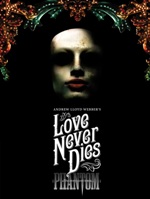
102) Love never dies
Type : Original
Joué durant 1 an 5 mois 3 semaines
Première preview : lundi 22 février 2010
Première : mardi 09 mars 2010
Dernière : samedi 27 août 2011
Compositeur : Andrew Lloyd Webber
Parolier : Glenn Slater
Librettiste : Glenn Slater
Metteur en scène : Jack O'Brien
Chorégraphe : Jerry Mitchell
Avec : Ramin Karimloo (Phantom ), Sierra Boggess (Christine Daaé), Joseph Millson (Raoul), Liz Robertson (Mme Giry), Summer Strallen (Meg), Niamh Perry (Fleck), Adam Pearce (Squelch), Jami Reid-Quarrell (Gangle)
Commentaire : The musical opened with previews on 22nd February 2010, originally directed by Jack O’Brien and with lyrics by Glenn Slater. Although it was praised for its lavish staging, and received a few excellent notices, it was generally felt to be clunky and exceptionally dark and gloomy. It was rapidly nicknamed “Paint Never Dries”. Later in the year a new version was rehearsed simultaneously with the evening performances and the show closed for four days in November 2010 for substantial re-writes. It re-opened with new direction from Bill Kenwright, new choreography from Bill Deamer, and some new lyrics by Charles Hart. The London production closed on 27 August 2011 after a disappointing run of fewer than eighteen months.
Presse : "There is much to enjoy in Andrew Lloyd Webber's new musical. The score is one of the composer's most seductive. Bob Crowley's design and Jack O'Brien's direction have a beautiful kaleidoscopic fluidity. And the performances are good. The problems lie within the book, chiefly credited to Lloyd Webber himself and Ben Elton, which lacks the weight to support the imaginative superstructure...In short, the show has much to commend it and the staging is a constant source of iridescent pleasure. But, as one of the lyrics reminds us, 'diamonds never sparkle bright unless they are set just right'. Although Lloyd Webber's score is full of gems, in the end a musical is only as good as its book. With a libretto to match the melodies, this might have been a stunner rather than simply a good night out."
Michael Billington for The Guardian
"Dismally implausible plot...The blogosphere has been teeming with views of Lloyd Webber’s long-awaited Phantom II. For some, Love Never Dies is 'Paint Never Dries', and for others the composer is at his musical best. I tend to agree with both factions....Bob Crowley (Designs] successfully evokes much of Phantasma, helped by projections of spooky horses on carousels. Yet that’s all rather cursory, as is the choreography, which doesn’t amount to a lot more than the inevitable bathing beauties bouncing about on the beach. "
Benedict Nightingale for The Times
"Lloyd Webber’s finest show since the original Phantom, with a score blessed with superbly haunting melodies and a yearning romanticism that sent shivers racing down my spine....The show may ultimately prove too strange, too dark, too tormented to become a massive popular hit, but I suspect its creepy allure will linger potently in the memory when frothier shows have been long forgotten. "
The Daily Telegraph
"What is in no doubt is the technical excellence of Jack O'Brien's seamlessly fluent, sumptuous (and sometimes subtle) production, or the splendour of the orchestra which pours forth Lloyd Webber's dark-hued, yearning melodies as if its life depended on them."
Paul Taylor for The Independent
"It doesn’t really smoke into life until the 20th minute and even then it splutters for a while. Finally, the singing and the ingenious staging combine to show the Lloyd Webber orchestration to its full glory, but, boy, it takes an age."
Quentin Letts for The Daily Mail
"While Lloyd Webber’s music is at times lavishly operatic, the tone is uneven. There are no more than a couple of songs that promise to live in the memory, the duets don’t soar, and the ending is insipid. Admirers of Phantom are likely to be disappointed, and there’s not enough here to entice a new generation of fans."
Henry Hitchings for The Evening Standard
"Sets and special effects cannot be faulted, the singing is terrific...a stunning ending. But phantastic? Afraid not."
Bill Hagerty for The Sun
"Musically, it is pleasing enough...Visually, the show is stunning in places."
Matthew Hemley for The Stage
"This is an elegant and clever sequel to Phantom...It is a great night out."
Paul Callan for The Daily Express
"While lushly orchestrated (by David Cullen with Mr. Lloyd Webber), the score is, for the most part, so slow that you have time to anticipate Mr. Slater’s next leaden rhyme. Each of the songs — which range from bathing-beauty frolics to power-chord operetta ballads — spins a single tune until it loses its tread."
Ben Brantley for The New York Times
"Frequently clunky and clumsy...Lloyd Webber's score, too, seems like a rehashed parade of pastiche and throbbing crashing-chord melodies."
Mark Shenton for Entertainment Weekly
"Watching the sequel only makes you appreciate the achievement of the original."
David Benedict for Variety
"The musical is impressive and enjoyable, even with its heavy hokum and creakiest of plots."
Warwick Thompson for Bloomberg News
101) Rat Pack (The)
Type : Revival
Joué durant 3 mois 1 semaine
Première preview : jeudi 24 septembre 2009
Première : jeudi 24 septembre 2009
Dernière : dimanche 03 janvier 2010
Metteur en scène : Mitch Sebastian
Chorégraphe : Mitch Sebastian
Avec : Louis Hoover, Stephen Rashbrook, Giles Terera, Darren Charles, Mark Adams, Nigel Casey, Sam Kane, Craig Els, Mark Haliday, Charlie Bull, Gracie Holdstock, Lizzy Hills, Lucy Holloway
Commentaire : Le thème du spectacle change à partir du 24 novembre 2009 pour devenir 'Christmas With The Rat Pack' …
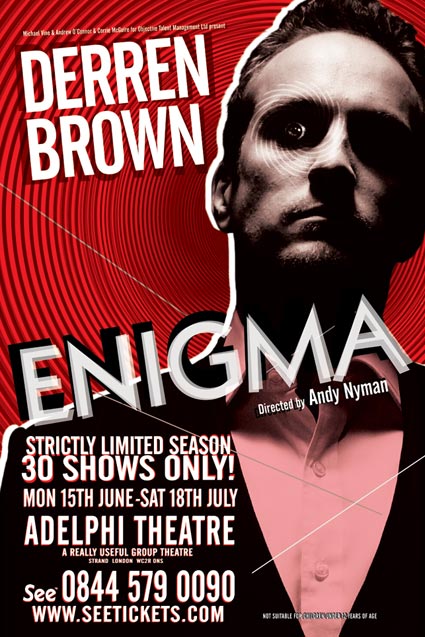
100) Derren Brown: Enigma
Type : Original London
Joué durant 1 mois 1 semaine
Première preview : lundi 15 juin 2009
Première : mercredi 17 juin 2009
Dernière : samedi 25 juillet 2009
Metteur en scène : Andy Nyman
Chorégraphe : Aucun
Avec : Derren Brown
Presse : “Unquestionably a magical mystery tour-de-force…packed with enough fantastic feats of mental and visual wizardry to blow even the most cynical of minds”
WHAT’S ON STAGE
“Utterly baffling and completely extraordinary”
SUNDAY EXPRESS
99) Joseph and the Amazing Technicolor Dreamcoat
Type : Revival
Joué durant 1 an 10 mois 2 semaines
Première preview : vendredi 06 juillet 2007
Première : mardi 17 juillet 2007
Dernière : samedi 30 mai 2009
Compositeur : Andrew Lloyd Webber
Parolier : Tim Rice
Metteur en scène : Steven Pimlott
Chorégraphe : Anthony Van Laast
Avec : Gareth Gates (Joseph), Jenna Lee-James (narrator not Mon/Thu eve), Fiona Reyes (narrator Mon/Thu eve), Dean Collinson (Pharaoh), Stephen Tate (Jacob/Potiphar/Guru), Stephen John Davis (Reuben), Charlotte May Davis (Reuben's Wife), Emma Harris (Reuben's Wife), Mark Oxtoby (Simeon), Sarah Meade (Simeon's Wife), Ricky Rojas (Levi), Jennifer Ashton (Levi's Wife), Nathaniel Morrison (Napthali), Charlene Ford (Napthali's Wife/Mrs Potiphar), Adam Pearce (Issachar/Baker), Emily Mascarenhas (Issacher's Wife), Derek Andrews (Asher), Fiona Reyes (Asher's Wife/Alternate Narrator), Michael Quinn (Dan), Zoe Smith (Dan's Wife), Craig Scott (Zebulun/Apache Dancer), Louise Madisoni (Zebulun's Wife/Apache Dancer), Sophia Hurdley (Zebulun's Wife/Apache Dancer), Russell Walker (Gad/Butler), Frankie Sibthorp (Gad's Wife), Tom Gillies (Benjamin), Danielle Young (Benjamin's Wife), Neal Wright (Judah), Tamlyn Platts (Judah's Wife)
Presse : NICHOLAS DE JONGH for THE EVENING STANDARD says, "It offers a seductive blend of camp, kitsch." RHODA KOENIG for THE INDEPENDENT says, "Lee Mead ...Lacking in character and with a tendency to give out towards the end of a line, his voice is not the world's greatest...But Mead more than fulfils the requirements, with a mop of dark curls, a wholesome, sweet manner, and a way of filling a pleated loincloth that will appeal to all sexes...A Joseph virgin, I enjoyed myself far more than I thought possible at a Lloyd Webber show." MICHAEL BILLINGTON for THE GUARDIAN says, "The late Steven Pimlott's 1991 Palladium production...had a heart and soul whereas everything about this revival seems either cutesy, camp or calculated." BENEDICT NIGHTINGALE for THE TIMES says, "Lee Mead...turns out to be both talented and enthusiastic...With spoofs of country music, calypso and even Piaf added to the mix, the show is a reminder of how splendidly versatile Lloyd Webber can be. Nor has Rice written jauntier lyrics." LISA MARTLAND for THE STAGE says, "Rice and Lloyd Webber’s score remains as infectious as ever." CHARLES SPENCER for THE DAILY TELEGRAPH says, "Lee Mead...looks good in a loin cloth, and has a powerful and expressive voice...By the end, however his vocals were beginning to sound a touch frayed."
98) Evita
Type : Revival
Joué durant 11 mois 1 semaine
Première preview : vendredi 02 juin 2006
Première : mercredi 21 juin 2006
Dernière : samedi 26 mai 2007
Compositeur : Andrew Lloyd Webber
Parolier : Tim Rice
Librettiste : Tim Rice
Metteur en scène : Harold Prince
Chorégraphe : Rob Ashford
Avec : Matt Rawle (Che), Elena Roger (Evita), Philip Quast (Peron), Lorna Want (Peron’s Mistress), Gary Milner (Magaldi), Jodie Jacobs, Jackie Marks, Gary Milner
Commentaire : This was an outstanding revival. Elena Roger (a genuine Argentinian) was acclaimed for a superb, dazzling performance; the Elena Roger tango-themed choreography was described as sizzingly erotic; the set design by Christopher Oram sumptuously re-created the architectural grandeur of Buenos Aires; Michael Grandage was hailed as one of the UK’s best directors; and, ultimately, the score was recognised as one of the very best by Andrew Lloyd Wber and Tim Rice. This was a triumph and hugely praised, and yet, for some reason, did not succeed at the box office. It closed in May 2007 after just eleven months eleven months.
Presse : NICHOLAS DE JONGH du THE EVENING STANDARD: "Dynamic production."
MICHAEL BILLINGTON du THE GUARDIAN : "Decent revival...the show is certainly a great vehicle and the Argentinian Elena Roger rides it in modest triumph...although the show is pleasing to watch, it never achieves the ecstasy one looks for in a musical."
CHARLES SPENCER du THE DAILY TELEGRAPH : "Outstanding revival...Almost every song is memorable."
BENEDICT NIGHTINGALE du THE TIMES: "Riveting show."
PAUL TAYLOR du THE INDEPENDENT: "Powerful production."
97) Chicago
Type : Revival
Joué durant 8 ans 5 mois 1 semaine
Première preview : lundi 27 octobre 1997
Première : mardi 18 novembre 1997
Dernière : samedi 22 avril 2006
Compositeur : John Kander
Parolier : Fred Ebb
Librettiste : Fred Ebb
Metteur en scène : Walter Bobbie
Chorégraphe : Ann Reinking
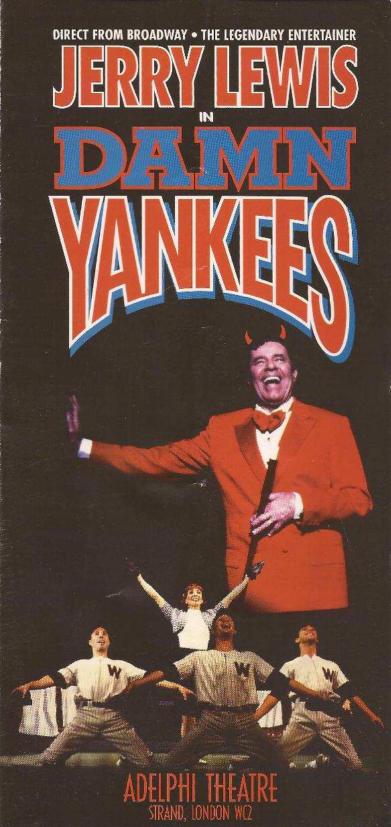
96) Damn Yankees
Type : Revival
Joué durant 2 mois
Nombre de représentations : 77
Première preview : jeudi 29 mai 1997
Première : mercredi 04 juin 1997
Dernière : samedi 09 août 1997
Compositeur : Richard Adler
Parolier : Jerry Ross
Librettiste : Douglas Wallop • George Abott
Metteur en scène : Jack O'Brien
Chorégraphe : Rob Marshall
Avec : Jerry Lewis (Mr Applegate), April Nixon (Lola), John-Michael Flate (Joe Hardy), Dennis Kelly (Joe Boyd), Louis D. Giovannetti, Joy Franz, Julie Prosser, Steven Seale, Mark Chmiel, Eric Leviton, Nigel Harman, Shaun Henson, Michael Duran, Ned Hannah, Bill Brassea, Christopher Windom, Richie Mastascusa, Jamie Ross, Ned Hannah, Ellen Grosso, Susan Taylor, Vickie Taylor, Karen Babcock, Julie Janney, Amelia Prentice, Karen Babcock, Susan Taylor, Vickie Taylor, Michael Duran, Julie Janney, Ned Hannah, Nigel Harman, Stephen Seale, Scott Robertson, April Nixon, Mel Allen, Ned Hannah, Mark Chmiel
Commentaire : The star of this show was the 71 year old American comedian Jerry Lewis. A 15 minute section of the Second Act was tailored to his presence, enabling him to hi-jack the show, breaking into his nutty-professor voice, tossing canes in the air and failing to catch them, telling joke after joke in his old vaudeville act, and then just as suddenly returning to the script and the plot. Jerry Lewis fans loved it. The show itself was much praised on its first return to London after some 40 years, but it ran for just over nine weeks.
An expected transfer to the Savoy Theatre from 16 October 1997 was cancelled.
Presse : NICK CURTIS of the EVENING STANDARD describes the show as making “ a modest start to its London season “ and going on to describe Jerry Lewis’s performance as “ sometimes good, sometimes bad, and sometimes just plain ugly”
MICHAEL BILLINGTON of THE GUARDIAN says , “not wildly exciting but harmlessly pleasant.”.
MICHAEL COVENEY of the DAILY MAIL enjoyed the show and particularly liked the leading actors performances, saying, “Lewis is a treat, Miss Nixon a black bombshell in pink underwear”
CHARLES SPENCER of THE DAILY TELEGRAPH says “Damn Yankees is the kind of musical they don't write any more. Emerging from the theatre with a fatuous smile on my face, I wished that they did.”
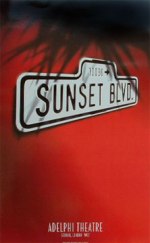
95) Sunset Boulevard
Type : Original
Joué durant 2 ans 11 mois 3 semaines
Première preview : mardi 19 avril 1994
Première : mardi 19 avril 1994
Dernière : samedi 05 avril 1997
Compositeur : Andrew Lloyd Webber
Parolier : Christopher Hampton • Don Black
Librettiste : Christopher Hampton • Don Black
Metteur en scène : Trevor Nunn
Chorégraphe : Bob Avian
Avec : <u>Betty Buckley</u>
19 avr 1994 - 14 mai 1995
(out du 29 nov 1994 - 7 jan 1995 remplacée par Elaine Page)
<u>Elaine Paige</u>
17 mai 1995 - 6 jan 1996
(out du 2 sept - 14 oct 1995, remplacée par Petula Clark)
<u>Petula Clarck</u>
9 jan 1996 - 5 avr 1997
(out du 9 sept - 2 nov 1996, remplacée par Rita Moreno)
Commentaire : Buckley then followed Glenn Close as Norma Desmond in the second year of the Broadway production. Elaine Paige, who had filled in when Buckley was ill in 1994, took over as Norma Desmond in the West End in May 1995 before joining the Broadway production for the end of its run between 1996 and 1997. Petula Clark filled in for Paige during her holiday in September/October 1995, before taking over the role in January 1996 when Paige departed for the United States. The last "star" to take on the role of Norma Desmond in London was Rita Moreno, who filled in for a vacationing Clark in September and October 1996. John Barrowman played Joe until 1995, when he was replaced by Alexander Hanson. Graham Bickley played the role for the final year of the London run.
The show closed on 5 April 1997, running for 1,530 performances.
Presse : The show closed for three weeks, re-opening on 19 April 1994, revamped to follow the Los Angeles production, with a second official "opening". The revamped musical had a new song, "Every Movie's A Circus", a new set, and new stars, Betty Buckley and John Barrowman. Michael Bauer, who had played DeMille in the original production replaced Benzali as Max, a role he played until the end of the London run (and subsequently on the UK tour and the BBC concert) and Anita Louise Combe (also from the original cast, understudying the role of Betty Shaeffer for the first nine months – and subsequently went on to play Betty Schaeffer in the Canadian Premiere with Diahann Carroll). Buckley and the production garnered rave reviews. David Lister of The Independent, for example wrote: "The show looked an improvement on the one that got decidedly mixed reviews last summer."
94) Sunset Boulevard
Type : Original
Joué durant 3 ans 8 mois 4 semaines
Nombre de représentations : 1529
Première : lundi 12 juillet 1993
Dernière : samedi 05 avril 1997
Compositeur : Andrew Lloyd Webber
Parolier : Christopher Hampton • Don Black
Librettiste : Christopher Hampton • Don Black
Metteur en scène : Trevor Nunn
Chorégraphe : Bob Avian
Avec : Version 1:
<u>Patti LuPone</u>
12 juil 1993 - 12 mars 1994
Version 2:
<u>Betty Buckley</u>
19 avr 1994 - 14 mai 1995
(out du 29 nov 1994 - 7 jan 1995 remplacée par Elaine Page)
<u>Elaine Paige</u>
17 mai 1995 - 6 jan 1996
(out du 2 sept - 14 oct 1995, remplacée par Petula Clark)
<u>Petula Clarck</u>
9 jan 1996 - 5 avr 1997
(out du 9 sept - 2 nov 1996, remplacée par Rita Moreno)
Commentaire : A londres, Norma Desmond sera jouée successivement par Patti LuPone, Betty Buckley, Elaine Paige, Petula Clark et Rita Moreno.
Les critiques ayant été mitigée à l'ouverture, le show va fermer trois semaines et rouvrir le 19 avril 1994 avec de nombreuses modifications rapprochant cette version de celle de Los Angeles (Glenn Close) qui avait elle été très bien accueillie.
Early in 1997, Andrew Lloyd Webber announced the immediate closure of both the West End and Broadway productions, claiming it was impossible to find cast replacements of sufficiently high quality. (Later it was disclosed the whole undertaking had lost an absolute fortune and was seriously impacting on the overall finances of Lloyd Webber’s Really Useful Company. The sum of money paid to Faye Dunaway for breach of contract when she was sacked from the USA version was never disclosed, but it was claimed that Patti LuPone, initially promised the Broadway run, sued Lloyd Webber and received a settlement reported to be $1 million.
According to Broadway critic Frank Rich in his book “The Hot Seat”, these lawsuits contributed to “Sunset Boulevard” setting the record for the biggest loss ever made on a musical show. The operating costs exceeded the income, and the touring companies also generated large financial losses. In spite of running for more than two years and selling over a million tickets on Broadway, Rich puts the final losses near or above $20 million.
93) Sunset Boulevard
Type : Original
Joué durant 8 mois
Première preview : lundi 12 juillet 1993
Première : lundi 12 juillet 1993
Dernière : samedi 12 mars 1994
Compositeur : Andrew Lloyd Webber
Parolier : Christopher Hampton • Don Black
Librettiste : Christopher Hampton • Don Black
Metteur en scène : Trevor Nunn
Chorégraphe : Bob Avian
Avec : Patti LuPone (Norma Desmond), Kevin Anderson (Joe Gillis), Meredith Braun (Betty Schaefer), Daniel Benzali (Norma's ex-husband, Max)
Commentaire : Billy Wilder and his wife Audrey were joined by Nancy Olson, who had played Betty Schaefer in the original film, at the opening night performance. Of it, Wilder observed, "The best thing they did was leave the script alone," and of Patti LuPone he exclaimed, "She's a star from the moment she walks on stage."
Reviews were mixed…
The show closed for three weeks, re-opening on 19 April 1994, revamped to follow the Los Angeles production, with a second official "opening".
Presse : the review by Michael Kuchwara for the AP: "Some reviewers felt Lloyd Webber took the sting out of a cynical tale. 'Wilder's bitter brew has been diluted,' wrote AP Drama Critic Michael Kuchwara. He added: 'When LuPone is off stage, the show sags.'"
Frank Rich wrote "Much of the film's plot, dialogue and horror-movie mood are preserved, not to mention clips used to illustrate those sequences in which the faded silent-film star, Norma Desmond ...and her kept young screenwriter, Joe Gillis ..., travel by car. The lyricist, Don Black ..., and the playwright, Christopher Hampton ..., smartly tailor their jokes to the original screenplay's style. At times even Lloyd Webber gets into the Wilder swing. Both acts open with joltingly angry diatribes about Hollywood, part exposition-packed recitative and part song, in which the surprisingly dark, jazz-accented music, the most interesting I've yet encountered from this composer, meshes perfectly with the cynical lyrics. Anderson makes the sardonic Wilder voice an almost physical presence in Sunset Boulevard. But that voice is too often drowned out by both LuPone's Broadway belt and by the mechanical efforts of Lloyd Webber and his director, Trevor Nunn, to stamp the proven formulas of Phantom and Les Miz on even an intimate tale. At odd moments the mammoth set advances like a glacier toward the audience or retreats or, most dramatically, rises partly up into the flies, actors in tow."
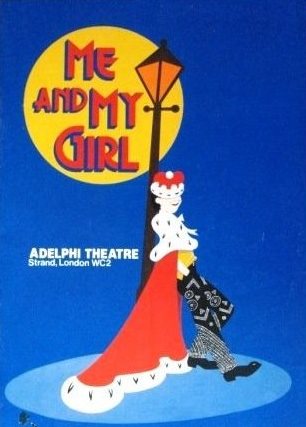
92) Me and My Girl
Type : UK Revival
Joué durant 7 ans 11 mois 1 semaine
Nombre de représentations : 3303
Première preview : mardi 12 février 1985
Première : mardi 12 février 1985
Dernière : samedi 16 janvier 1993
Compositeur : Noel Gay
Parolier : Arthur Rose • Douglas Furber
Librettiste : Arthur Rose • Douglas Furber
Metteur en scène : Mike Ockrent
Chorégraphe : Gillian Gregory
Avec : Robert Lindsay as Bill Snibson, Emma Thompson, and Frank Thornton. Cast changes included : Enn Reitel (as Bill Snibson) and Su Pollard (as Sally Smith) in 1986; Gary Wilmot (as Bill Snibson) and Jessica Martin (as Sally Smith) in 1989. Thornton was succeeded by Nicholas Smith.
Commentaire : The original 1937 production the Victoria Palace starred Lupino Lane and was a shorter show with just nine songs, playing twice-nightly. It was revived twice during the war, and was twice closed down because its theatres suffered bomb damage. This revival had a new book and incorporated additional Noel Gay songs. It transferred to New York in August 1986 (with Robert Lindsay) and ran for 1420 performances. Cast changes during the 8 year London run included Lorraine Chase, Karl Howman, Louise English, David Schofield, Bonnie Langford, Gary Wilmot, Jessica Martin, Patrick Cargill, Brian Conley, Su Pollard, Bernard Bresslaw, Les Dennis, Jonathan Morris, Andrew O'Connor and Joanna Riding.
91) Jungle Book
Joué durant 1 mois 1 semaine
Première preview : mardi 04 décembre 1984
Première : mardi 04 décembre 1984
Dernière : samedi 12 janvier 1985
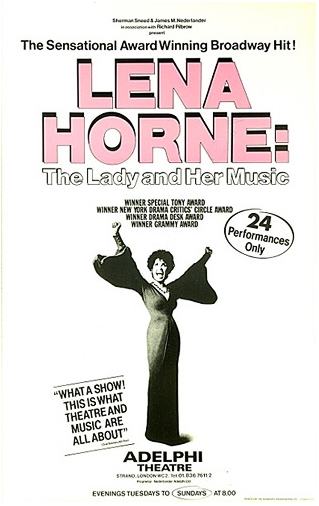
90) Lena Horne: The Lady and Her Music
Joué durant 1 mois 3 semaines
Première preview : lundi 06 août 1984
Première : lundi 06 août 1984
Dernière : samedi 29 septembre 1984
Avec : Lena Horne
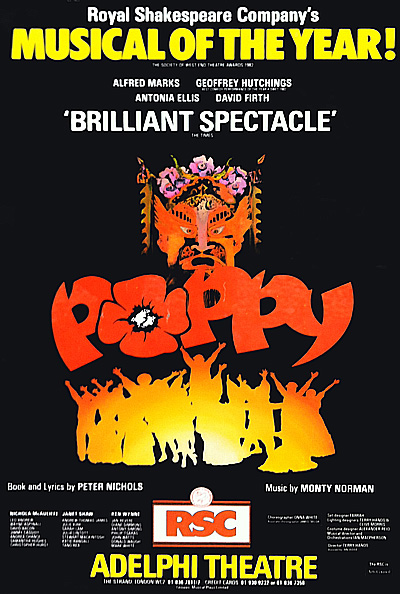
89) Poppy
Type : Revival
Joué durant 2 mois 2 semaines
Nombre de représentations : 97
Première preview : lundi 14 novembre 1983
Première : mardi 22 novembre 1983
Dernière : samedi 04 février 1984
Compositeur : Monty Norman
Parolier : Peter Nichols
Librettiste : Peter Nichols
Metteur en scène : Terry Hands • Ian Judge
Chorégraphe : Aucun
Avec : Cherry the Mare ·Andrea Chance
Cherry the Mare · Samantha Hughes / Chinese Dancer · Samantha Hughes / Chorus · Andrea Chance / Chorus · Andrew Thomas James
Chorus · Julie Kirk / Chorus · Julia Lintott / Chorus · Katie Randall / Chorus · Diane Simmons / Chorus · Donald Waugh / Clerk · Leo Andrew / Clerk · Jimmy Cassidy / Clerk · Stewart Mackintosh / Clerk ·Tano Rea / Dick Whittington · Antonio Ellis / Elephant; Chorus · Antony Simons / Elephant; Chorus · Mark White / Jack Idle · David Firth / Lady Dodo · Geoffrey Hutchings / Lin Tse-Tsii · John Watts / Lord Palmerston · Mark White / Obadiah Upward · Alfred Marks / Queen Victoria · Nichola McAuliffe / Randy the Horse · Christopher Hurst / Randy the Horse · Andrew Thomas James / Sally Forth · Janet Shaw / Swing · Wayne Aspinall / Swing · Jan Revere / Tao-Kuan · Ken Wynne / Teng Tin Chen · David Bacon / Tiger; Chorus · Philip Tsaras /
Yo-Yo; Chorus · Sarah Lam
Commentaire : This was a revised and re-staged version of the original production at the Barbican, September 1982. It had undergone rather a lot of changes - possibly to make it more acceptable for a planned Broadway transfer - but this time round it received a critical drubbing, including: “It collapses amidst the stuffing and garnishing of a cumbersome, shamefully under-rehearsed and embarrassingly under-cast production”
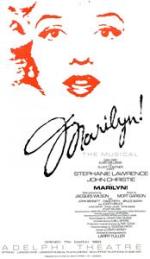
88) Marilyn!
Type : Original
Joué durant 4 mois 2 semaines
Première : jeudi 17 mars 1983
Dernière : samedi 30 juillet 1983
Compositeur : Mort Garson
Parolier : Jacques Wilson
Librettiste : Jacques Wilson
Metteur en scène : Larry Fuller
Avec : Stephanie Lawrence (Norma-Jean/Marilyn), Clive Carter (Jim Dougherty), Stanley Fleet (Harry Cohn), Chuck Julian (Daryl Zanuck), Margaret Burton (Louella Parsons), Marie Lorraine (Hedda Hopper), Stuart Milligan (Joe Di Maggio), David Firth (Arthur Miller), John Bennett (Lee Strasberg)
Commentaire : Rather waspishly described by Ned Sherrin as: “ an undiscovered recitation of all the well-known landmarks of Monroe’s life, inelegantly expressed to halting, derivative musak” - the foster home, the nude modelling, the “agent who had faith”, vulgar Hollywood moguls, mother’s madness, husbands DiMaggio and Miller, and finally death with telephone dangling.
Notes: Stephanie Lawrence was praised for making the best of a
bad job.

87) Annie
Type : UK Revival
Joué durant 1 mois 3 semaines
Première : lundi 20 décembre 1982
Dernière : samedi 12 février 1983
Compositeur : Charles Strouse
Parolier : Martin Charnin
Librettiste : Thomas Meehan
Metteur en scène : Peter Walker
Avec : Ursula Smith (Miss Hannigan), Charles West (Oliver War bucks), Peter Honri, Lorrain Grey, Neil Fitzwilliam, Petra Siniawski.
Commentaire : This production has been on a UK tour and had played Bristol Hippodrome instead of a pantomime in 1981/2
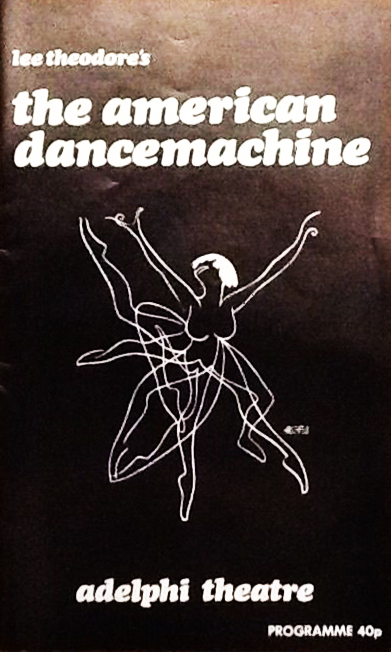
86) American Dance Machine (The)
Joué durant 1 mois 3 semaines
Première : mercredi 20 octobre 1982
Dernière : samedi 11 décembre 1982
Librettiste : Lee Becker Theodore
Metteur en scène : ???? ????
Chorégraphe : ???? ????
85) D'Oyly Carte Season
Type : Original
Joué durant 3 mois 2 semaines
Première : mercredi 11 novembre 1981
Dernière : samedi 27 février 1982
Compositeur : Arthur Sullivan
Parolier : W.S. Gilbert
Librettiste : W.S. Gilbert

84) My Fair Lady
Type : UK Revival
Joué durant 2 ans 1 semaine
Nombre de représentations : 891
Première : jeudi 25 octobre 1979
Dernière : samedi 31 octobre 1981
Compositeur : Frederik Loewe
Parolier : Alan Jay Lerner
Librettiste : Alan Jay Lerner
Metteur en scène : Robin Midgley
Chorégraphe : Gillian Lynne
Avec : Tony Britton (Henry Higgins), Liz Robertson (Eliza Doolittle), Peter Bayliss (Alfred P. Doolittle), Richard Caldicott (Colonel Pickering), Anna Neagle (Mrs Higgins), Peter Land (Freddy Eynsford-Hill)
Commentaire : This production was created at Leicester Haymarket under the management of Cameron Mackintosh who, with Arts Council support, was determined to created regional touring product of the highest quality—so that “West End shows” would be available to provincial theatres with no drop in standards. When the show arrived in the West End the critics felt it was equally as good as first time round.
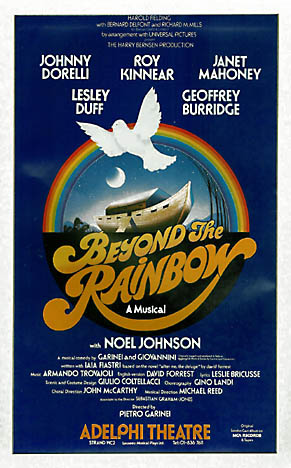
83) Beyond the rainbow
Type : Original London
Nombre de représentations : 238
Première : jeudi 09 novembre 1978
Dernière : Inconnue
Compositeur : Armando Trovaioli
Parolier : Leslie Bricusse
Librettiste : David Forrest
Metteur en scène : Pietro Garinei
Chorégraphe : Gino Landi
Avec : Johnny Dorelli (Father Silvestro), Roy Kinnear (Mayor Enrico), Lesley Duff (Clementina), Geoffrey Burridge (Toto), Janet Mahoney (Consolation), Dorothy Vernon, Franco Ricchio
Commentaire : This was adapted from the English novel “After Me the Deluge” by David Forrest (the pseudonym used by Robert Forrest-Webb and David Eliades). The adaptors, Garinei and Giovannini had a previous production entitled “When in Rome” at the Adelphi in 1959, and they also wrote popular songs including "Volare" and "Arriverderci Roma!"

82) Irene
Type : Revival
Nombre de représentations : 974
Première preview : mardi 15 juin 1976
Première : mardi 15 juin 1976
Dernière : Inconnue
Compositeur : Harry Tierney
Parolier : Joseph McCarthy
Librettiste : James Montgomery
Metteur en scène : Freddie Carpenter
Chorégraphe : Norman Maen
Avec : Julie Anthony (Irene Dare), Eric Flynn (Donald Marshall), Jon Pertwee (Mme Lucy), Jessie Evans (Mrs O’Dare), Jenny Logan (Helen)
Commentaire : La production originale londonienne a été présentée à l'Empire Theatre le 7 avril 1920, avec Edith Day, qui avait également joué dans la première de Broadway l’année précédente. Le spectacle est relancé aux Etats-Unis en 1973 avec Debbie Reynolds et est d’abord dirigé par Sir John Gielgud qui est remplacé en répétition par Gower Champion. Gower Champion lui-même a été remplacé lorsqu’il a refusé de désigner Jane Powell comme remplaçante de Debbie Reynolds.
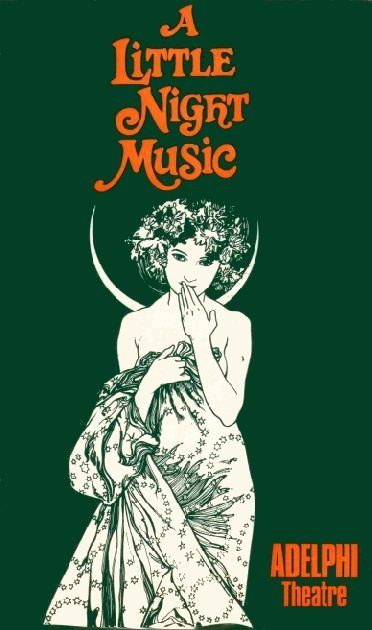
81) A Little Night Music
Type : Original London
Joué durant 11 mois 3 semaines
Nombre de représentations : 406
Première preview : mardi 15 avril 1975
Première : mardi 15 avril 1975
Dernière : samedi 03 avril 1976
Compositeur : Stephen Sondheim
Parolier : Stephen Sondheim
Librettiste : Hugh Wheeler
Metteur en scène : Harold Prince
Chorégraphe : Patricia Birch
Avec : Mr. Lindquist - John J. Moore / Mrs. Nordstrom - Chris Melville / Mrs. Anderssen - Liz Robertson / Mr. Erlanson - David Bexon / Mrs. Segstrom - Jacquey Chappell / Fredrika Armfeldt - Christine McKenna / Madame Armfeldt - Hermione Gingold [replaced by Angela Baddeley] / Frid, her butler - Michael Harbour / Henrik Egerman - Terry Mitchell / Anne Egerman - Veronica Page / Fredrik Egerman - Joss Ackland / Petra - Diane Langton / Desiree Armfeldt - Jean Simmons [replaced by Virginia McKenna] / Bertrand, a page - Christopher Beeching / Count Carl-Magnus Malcolm - David Kernan / Countess Charlotte Malcolm - Maria Aitken / Osa - Penelope Potter

80) King and I (The)
Type : Revival
Joué durant 7 mois 2 semaines
Nombre de représentations : 260
Première preview : mercredi 10 octobre 1973
Première : mercredi 10 octobre 1973
Dernière : samedi 25 mai 1974
Compositeur : Richard Rodgers
Parolier : Oscar Hammerstein II
Librettiste : Oscar Hammerstein II
Metteur en scène : Roger Redfarn
Chorégraphe : Sheila O'Neill
Avec : Peter Wyngarde (King), Sally-Ann Howes (Anna), Moyna Cope (Lady Thiang), Pauline Antony (Tuptim), Valentine Palmer (Lun Tha), Stephen Grover (Louis), David Morris (Chululongkorn), David Davenport (The Kralahome)

79) Show Boat
Type : Revival
Joué durant 2 ans 2 mois
Nombre de représentations : 910
Première preview : vendredi 09 juillet 1971
Première : jeudi 29 juillet 1971
Dernière : samedi 29 septembre 1973
Compositeur : Jerome Kern
Parolier : Oscar Hammerstein II
Librettiste : Oscar Hammerstein II
Metteur en scène : Wendy Toye
Chorégraphe : Wendy Toye
Avec : Cleo Laine (Julie), Andre Jobin (Ravenal), Lorna Dallas (Magnolia), Thomas Carey (Joe), Kenneth Nelson, Derek Royles, Pearl Hackney, Jan Hunt, Ena Cabayo, John Larsen
Commentaire : The first London production featured Edith Day, Cedric Hardwicke and Paul Robeson. The first revival in London was in 1943 with Gwyneth Lascelles and Bruce Carfax. This second revival was the longest running of them all so far.
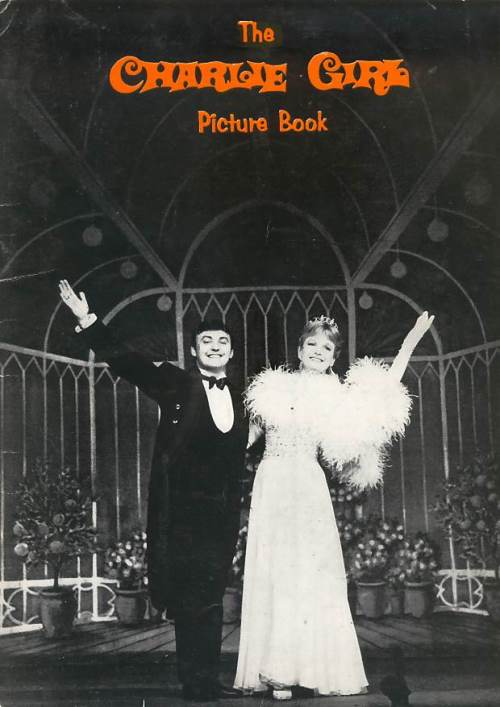
78) Charlie Girl
Type : Original
Joué durant 5 ans 3 mois 1 semaine
Nombre de représentations : 2202
Première preview : mercredi 15 décembre 1965
Première : mercredi 15 décembre 1965
Dernière : samedi 27 mars 1971
Compositeur : David Heneker • John Taylor
Parolier : David Heneker • John Taylor
Librettiste : Hugh Williams • Margaret Williams • Ray Cooney
Metteur en scène : Wallace Douglas
Chorégraphe : Alfred Rodrigues
Avec : Anna Neagle (Lady Hadwell), Joe Brown (Joe Studholme),
Derek Nimmo (Nicholas Wainwright), Christine Holmes (Charlie),
Hy Hazell (Kay Connor), Stuart Damon (Jack Connor)
Commentaire : This show was expected to have wide appeal, with Anna Neagle making a musical come-back to the West End after 12 years, and the stage debut of the young pop-star, Joe Brown. The critics hated it, and it opened to what were described as “the worst notices since Judas Iscariot”. In spite of universal damnation, the show caught on with the public, and went on to run for over 2,000 triumphant performances. Except for holiday cover, when Evelyn Laye took over temporarily, Anna Neagle stayed with the show throughout its long run.
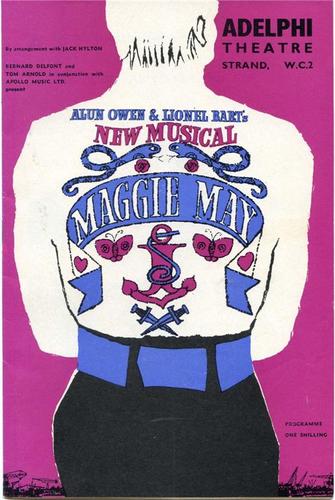
77) Maggie May
Type : Original
Première : mardi 22 septembre 1964
Dernière : Inconnue
Compositeur : Lionel Bart
Parolier : Lionel Bart
Librettiste : Alun Owen
Metteur en scène : Ted Kotcheff
Chorégraphe : Paddy Stone
Avec : A Balladeer ... Barry Humphries / Young Priest ... Stephen Taylor / Mrs. O'Brien ... Janette Gail / Mrs. Casey ... Margo Cunningham / Mother Monica ... Charlotte Howard / Maggie May (as a child) ... Margaret Howe / Sister Mary ... Janet Webb / Patrick Casey (as a child) ... Malcolm Collingham / Mrs. Nugent ... Marie Conmee / Parish Priest ... Vernon Rees / Willie Morgan ... Andrew Keir / Margaret Mary Duffy (Maggie May) ... Rachel Roberts (i) / Maureen O'Neill ... Diana Quiseekay / 1st Chinese Sailor ... Vincent Mansi / 2nd Chinese Sailor ... Stanley Fleet / Milkman ... Fred Evans / Children ... Carol Bird, Jacqueline Lewis, Terry Brooks, Peter Newton / Old Dooley ... Paul Farrell / Eric Dooley ... John Junkin / Cogger Johnston ... Michael Forrest / T.C. (Terry Collins) ... Billy Boyle / Gene Kiernan ... Geoffrey Hughes / Patrick Casey ... Kenneth Haigh / Stevedore ... Joe Sealy / Crane Driver ... Geof L'Cise / Nora Mulqueen ... Marie Conmee / Ned ... Stanley Fleet / Miss Singleton ... Paula Bell / Police Sergeant ... Shaun Curry / The Nocturns ... David Wilcox, David Foley, David Elias (i), Francis Sloan, Keith Draper / Police Inspector ... Vernon Rees / Sergeant Corporal ... Vincent Mansi
Commentaire : This was another success for Lionel Bart, who by this time was riding high as one of the most successful musical theatre composers of his generation. The run itself was beset with difficulties, many stemming from Rachel Robert’s personal traumas and alcohol problems. Her young understudy, Julia McKenzie, took over on several occasions. The leading role was later taken by Georgia Brown and then Judith Bruce.
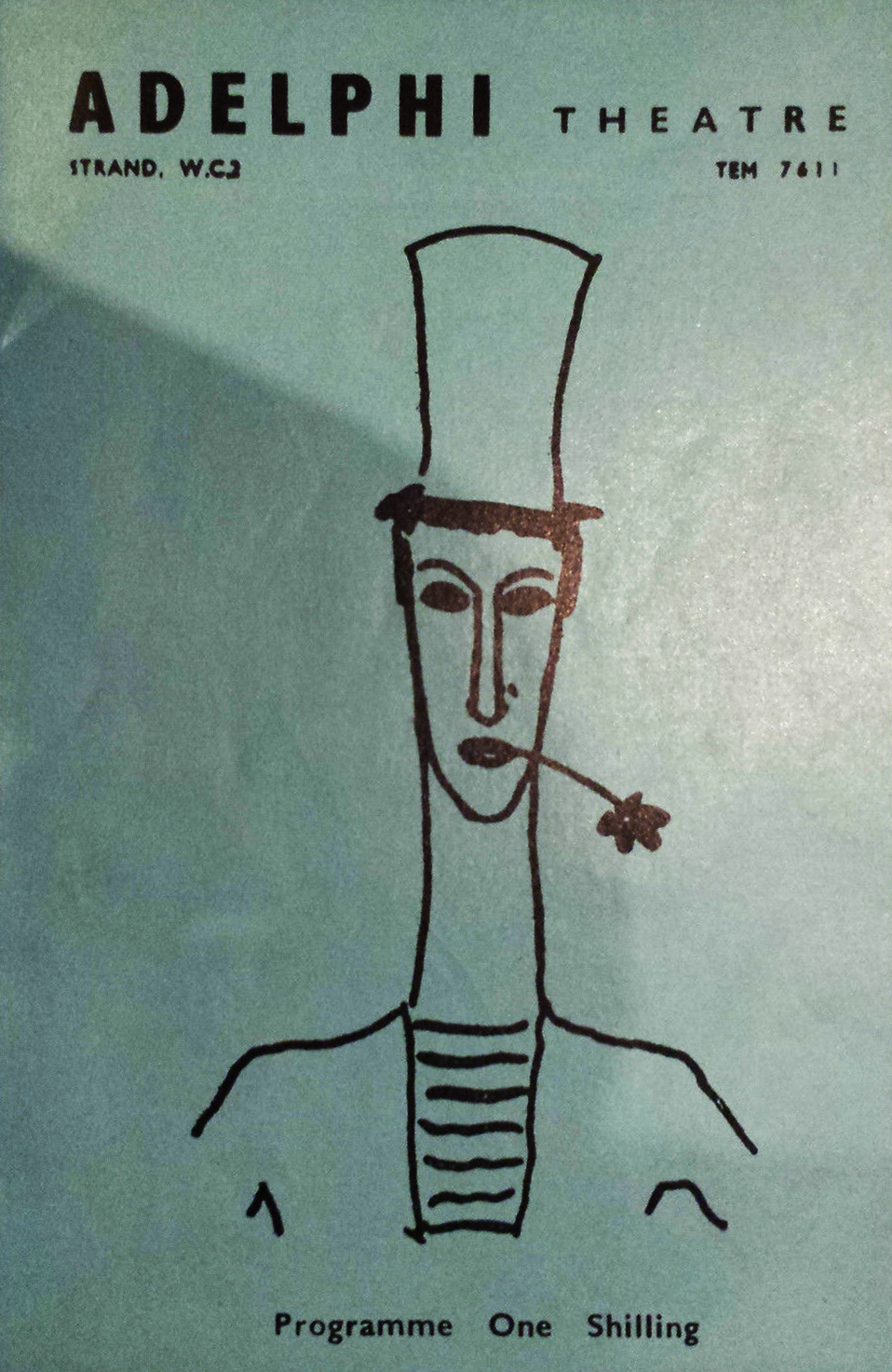
76) Exercises de Style et Pantomimes de Bip
Première : 1964
Dernière : Inconnue
Avec : Marcel Marceau, Pierry Verry
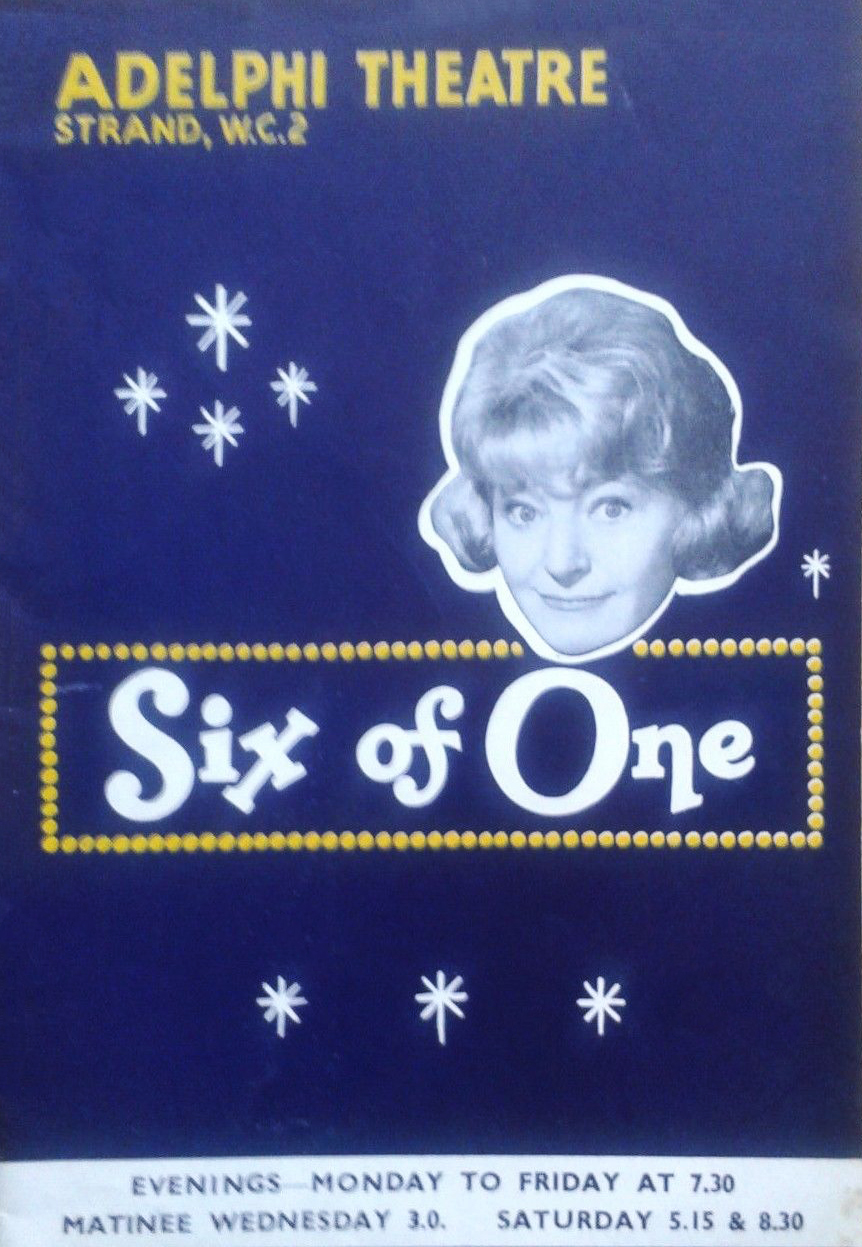
75) Six of One
Type : Original
Première preview : jeudi 26 septembre 1963
Première : jeudi 26 septembre 1963
Dernière : Inconnue
Metteur en scène : William Chappell
Avec : Dora Bryan
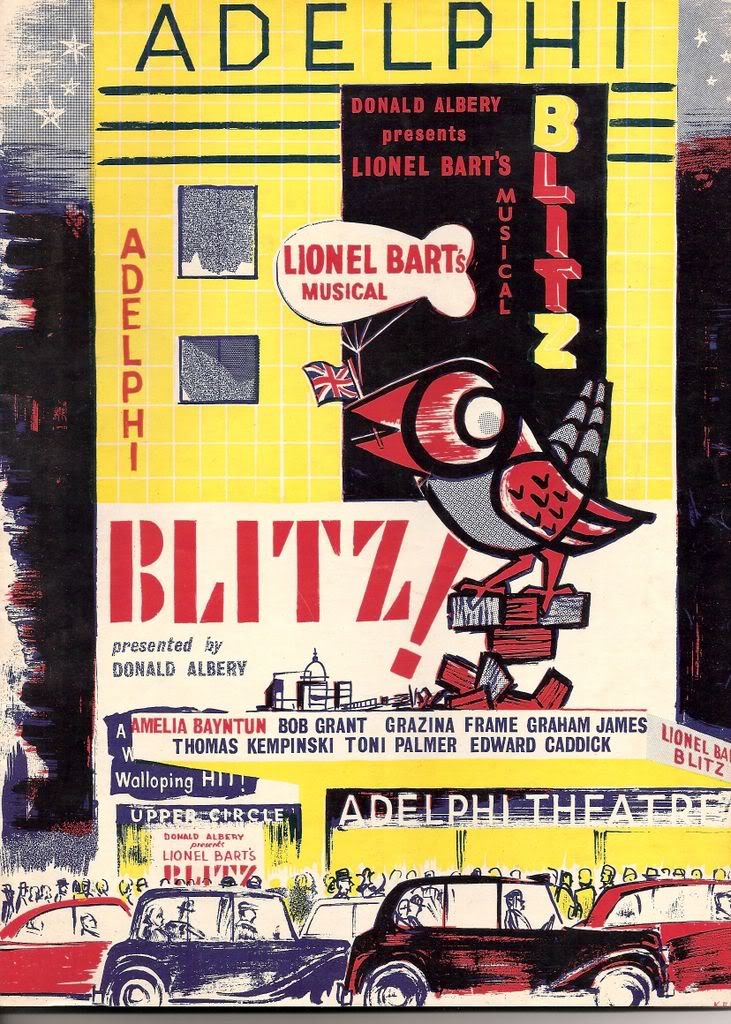
74) Blitz
Type : Original
Nombre de représentations : 568
Première : mardi 08 mai 1962
Dernière : Inconnue
Compositeur : Lionel Bart
Parolier : Lionel Bart
Librettiste : Joan Maitland • Lionel Bart
Metteur en scène : Lionel Bart
Chorégraphe : Peter Wright
Avec : Amelia Bayntun (Mrs Blitzstein), Grazina Frame (Carol Blitzstein),
Tom Kempinski (Harry Blitzstein), Bob Grant (Alfred Locke),
Graham James (Georgie Locke), Toni Palmer (Elsie), Anna Tzelniker,
Kaplan Kaye, Rose Hill, Julie Cohen.
Commentaire : Because of Sean Kenny's scenery, the show was spectacular and much praised. Noel Coward described it as “twice as long and twice as loud as the real thing”. It was another hit for Lionel Bart. One scene featured a “radio broadcast” with Vera Lynn singing “The Day After Tomorrow” - which she specially recorded for the show.
73) Scapa
Type : Original
Nombre de représentations : 44
Première preview : jeudi 08 mars 1962
Première : jeudi 08 mars 1962
Dernière : Inconnue
Metteur en scène : George Carden
Avec : David Hughes (Dusty), Edward Woodward (Haggis), Pete Murray (Badger), Timothy Gray (Sprog), Leon Peers (Herbert)
Commentaire : Based on Hugh Hasting’s play “Seagulls Over Sorrento”, none of the critics seemed to pick up on an underlying gay theme – even though the sailors go into drag and cavort about at the end of Act 1 in a number called “Bella”. The original play was an enormous success and made a great deal of money. Hugh Hastings invested it all in this musical version and ended up seriously out of pocket.

72) Music Man (The)
Type : Original London
Nombre de représentations : 395
Première preview : jeudi 16 mars 1961
Première : jeudi 16 mars 1961
Dernière : Inconnue
Compositeur : Meredith Willson
Parolier : Meredith Willson
Librettiste : Meredith Willson
Metteur en scène : Robert Merriman
Chorégraphe : Onna White
Avec : Van Johnson (Harold Hill), Patricia Lambert (Marian Paroo), C. Denier Warren (Mayor Shinn), Ruth Kettlewell (Mrs Paroo), Bernard Spear (Marcellus Washburn), Denis Waterman (Winthrop Paroo)
Commentaire : This was a very early West End appearance for Denis Waterman in a juvenile role.
71) Once Upon a Mattress
Type : Original London
Nombre de représentations : 38
Première : mardi 20 septembre 1960
Dernière : Inconnue
Compositeur : Mary Rodgers
Parolier : Marshall Barer
Librettiste : Dean Fuller • Jay Thompson • Marshall Barer
Metteur en scène : George Abbott
Chorégraphe : Joe Layton
Avec : Jane Connell / Peter Grant / Robin Hunter / Bill Kerr / Patricia Lambert / Bill Newman / Thelma Ruby / Max Wall
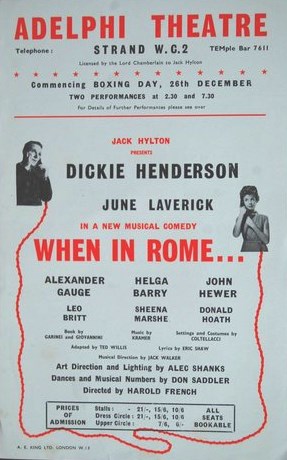
70) When in Rome
Type : Original
Nombre de représentations : 298
Première preview : samedi 26 décembre 1959
Première : samedi 26 décembre 1959
Dernière : Inconnue
Compositeur : "Kramer"
Parolier : Pietro Garinei • Sandro Giovannini
Librettiste : Ken Ferrey • Ted Willis
Metteur en scène : Harold French
Chorégraphe : ???? ????
Avec : Dickie Henderson (Andy Persichetti), June Laverick (Nicky), Frank Leighton (Andy’s Father), Eleanor Summerfield (Nicky’s Mother)
Commentaire : Described as entertainment for the tired businessman it managed a ten month run.
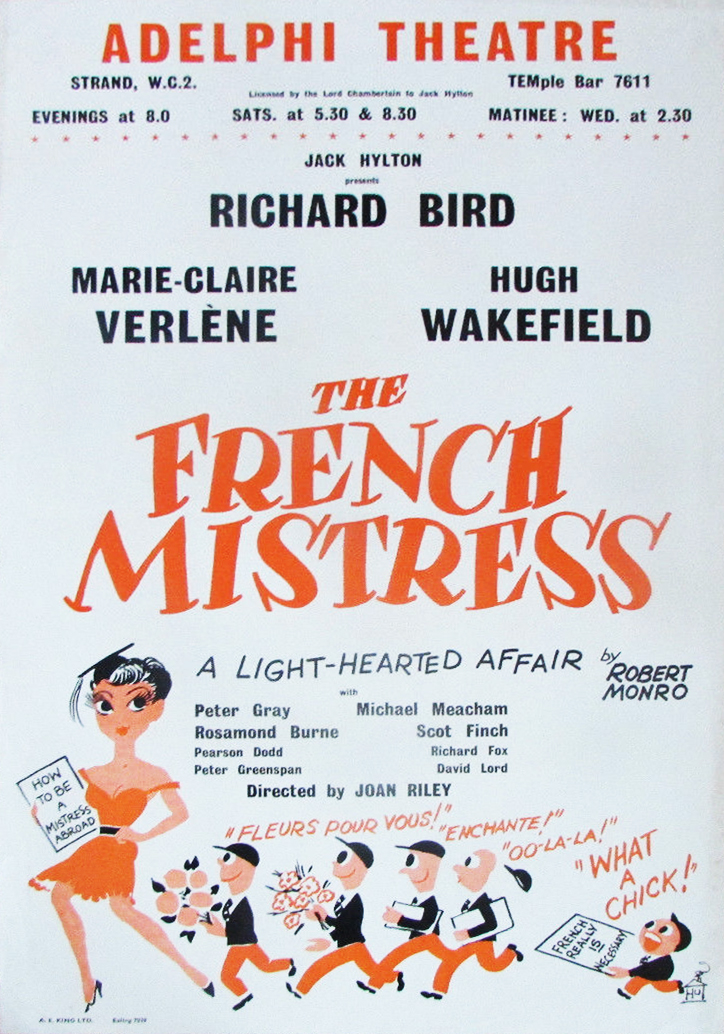
69) French Mistress (The)
Première : 1959
Dernière : Inconnue
Metteur en scène : Joan Riley
Avec : Richard Bird, Rosamond Burne, Peter Gray, Scot Finch, Michael Meacham, Marie-Claire Verlene, Pearson Dodd, Richard Fox, Peter Greenspan, David Lord, Hugh Wakefield
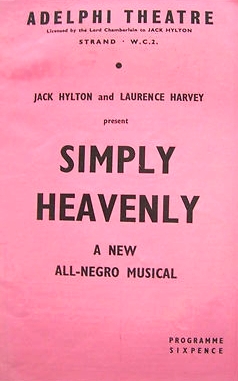
68) Simply Heavenly
Type : Original London
Joué durant 1 semaine
Nombre de représentations : 16
Première preview : mardi 20 mai 1958
Première : mardi 20 mai 1958
Dernière : samedi 31 mai 1958
Compositeur : Margaret Martin
Parolier : Langston Hughes
Librettiste : Langston Hughes
Metteur en scène : Joshua Shelley
Chorégraphe : ???? ????
Avec : Bertice Reading (Miss Mamie) , Ilene Day (Zara), Melvin Stewart (Simple), Marpessa Dawn (Joyce Lane)
Commentaire : The problem with a poor show called “Simply Heavenly” is that it clearly invited critical headlines like "Simply Isn't" and "Simply Awful".
It duly received such a press.
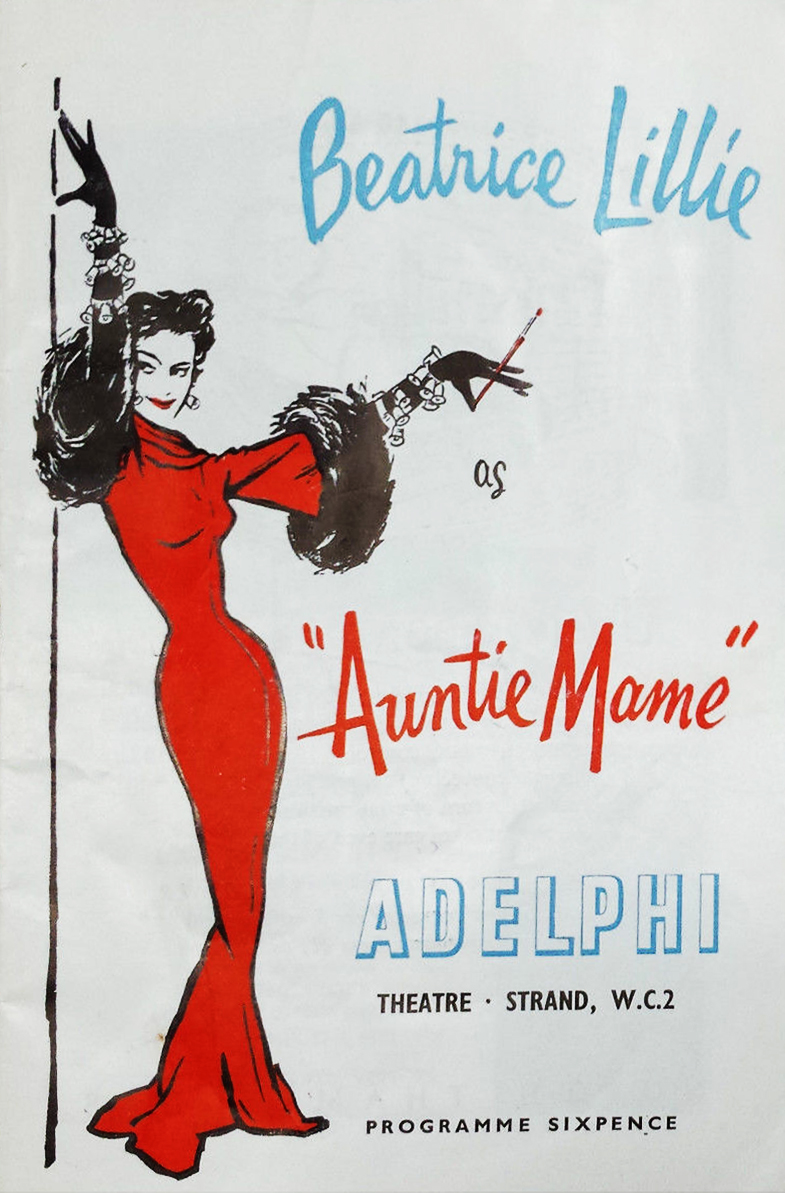
67) Auntie Mame
Première : 1958
Dernière : Inconnue
Avec : Natalie Kent, John Hall, John A. Tinn, Brenda Duncan, Florence Desmond, John Ireland Wood, Tom Gill, Barrington Hunt, Gerald Welch, Beatrice Lillie, Michael Browning, David Bird, Peter Carlisle, Barrington Hunt, Allan Casley, Joan Peart, Nicholas Stevenson, Bruce Morton, Raymond Lennox, Joan Peart, Martin Pierce, John Ireland Wood, Geoffrey Toone, Michael Browning, Rosemary Davis, Peter Carlisle, Helen Horton, Martin Pierce, Natalie Lynn, John Ireland Wood, Nicholas Stevenson, Bruce Morton, Barrington Hunt, Dinsdale Landen, Rosamund Greenwood, Patrick Holt, Jacqueline Ellis, Pamela Simpson, Donald Stewart, Jill Melford, Ronald Raymond
Commentaire : Beatrice Lillie, billed as ‘the funniest woman in the world’, grew up in Toronto and made her West End debut in 1914. She appeared in revue, on radio, and in television, films, and one-woman shows, and won an international reputation for her vivacity, wit, and use of parody.
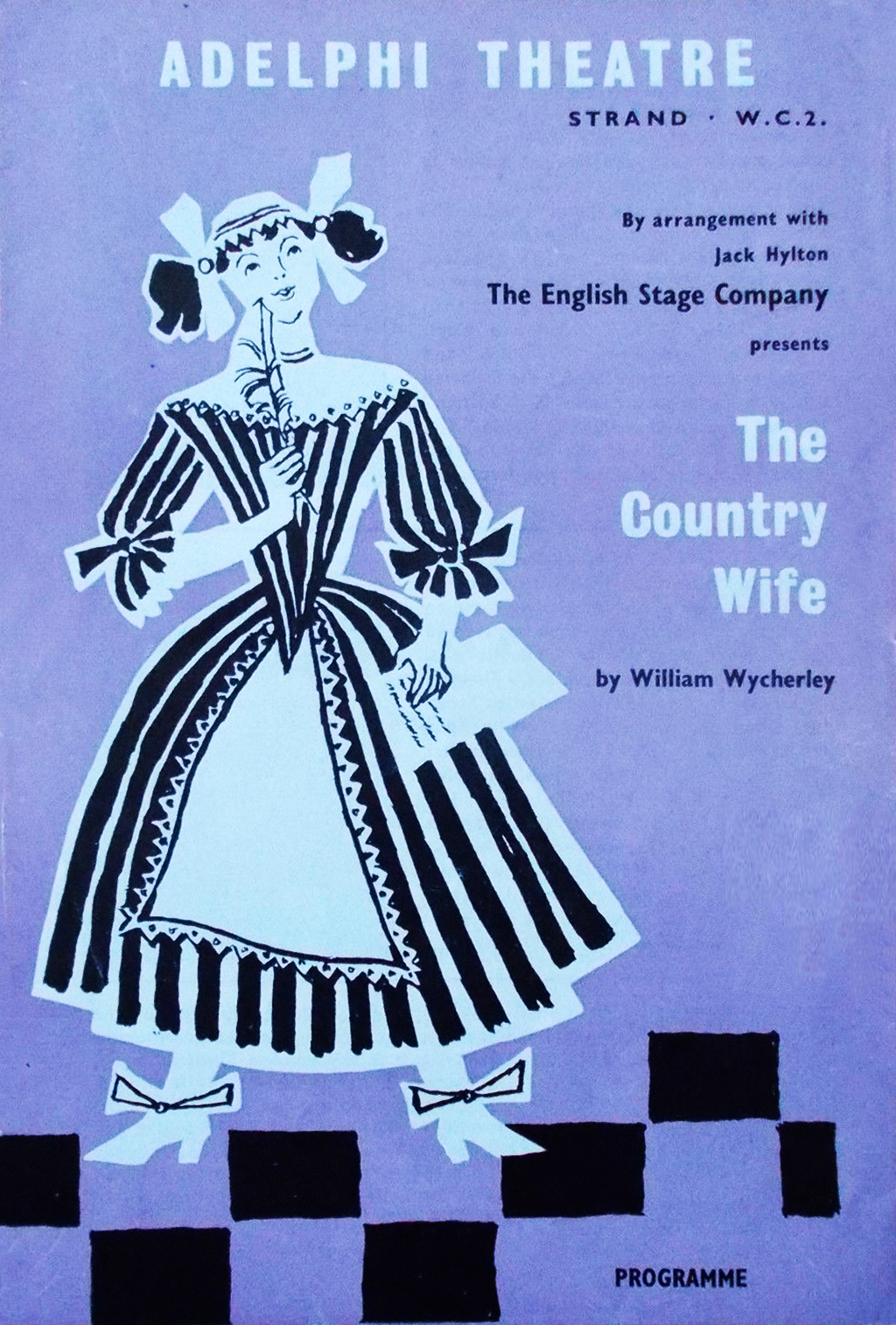
66) Country Wife (The)
Première : 1957
Dernière : Inconnue
Metteur en scène : George Devine
Avec : Stephen Dartnell, Esme Percy, Diana Churchill, Sheila Ballantine, Alan Bates, Frederick Treves, John Moffatt, George Devine, Joan Plowright, Maureen Quinney, Moyra Fraser, Margaret Ashcroft, Margery Caldicott, Brian Hankins, Skippo
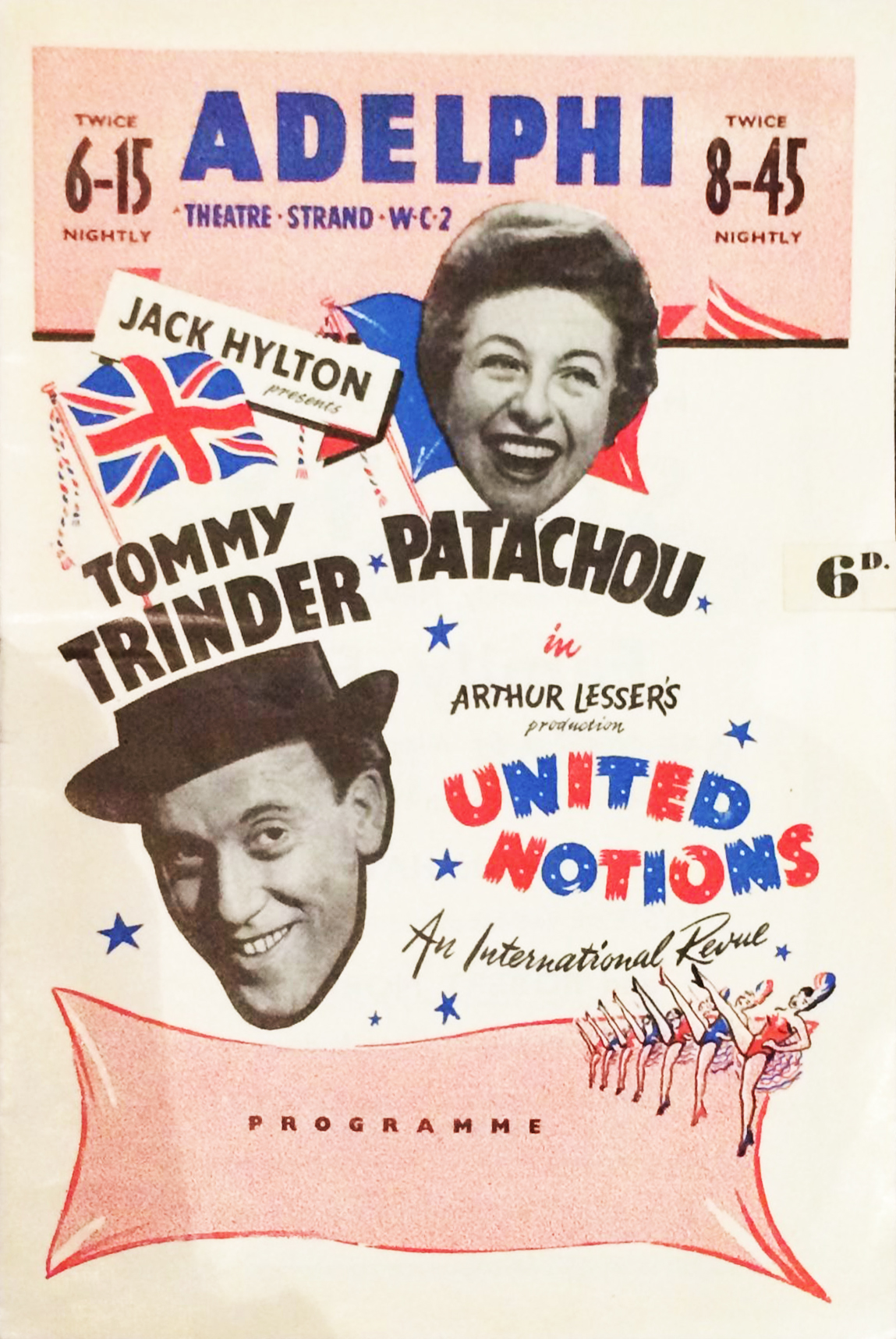
65) United Notions
Type : Original
Première preview : mercredi 28 novembre 1956
Première : mercredi 28 novembre 1956
Dernière : Inconnue
Metteur en scène : Arthur Lesser
Avec : Pinky Lee, Patachou, George Tapps, Tommy Trinder
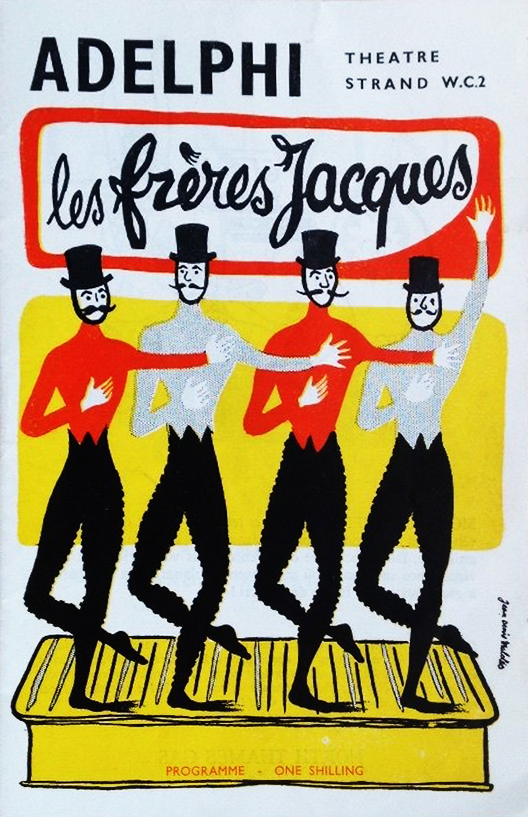
64) Frères Jacques (Les)
Première : dimanche 28 octobre 1956
Dernière : Inconnue
Avec : Andre Bellac, Georges Bellac, Francois Soubeyran, Paul Tourenne, Pierre Philippe (pianist).
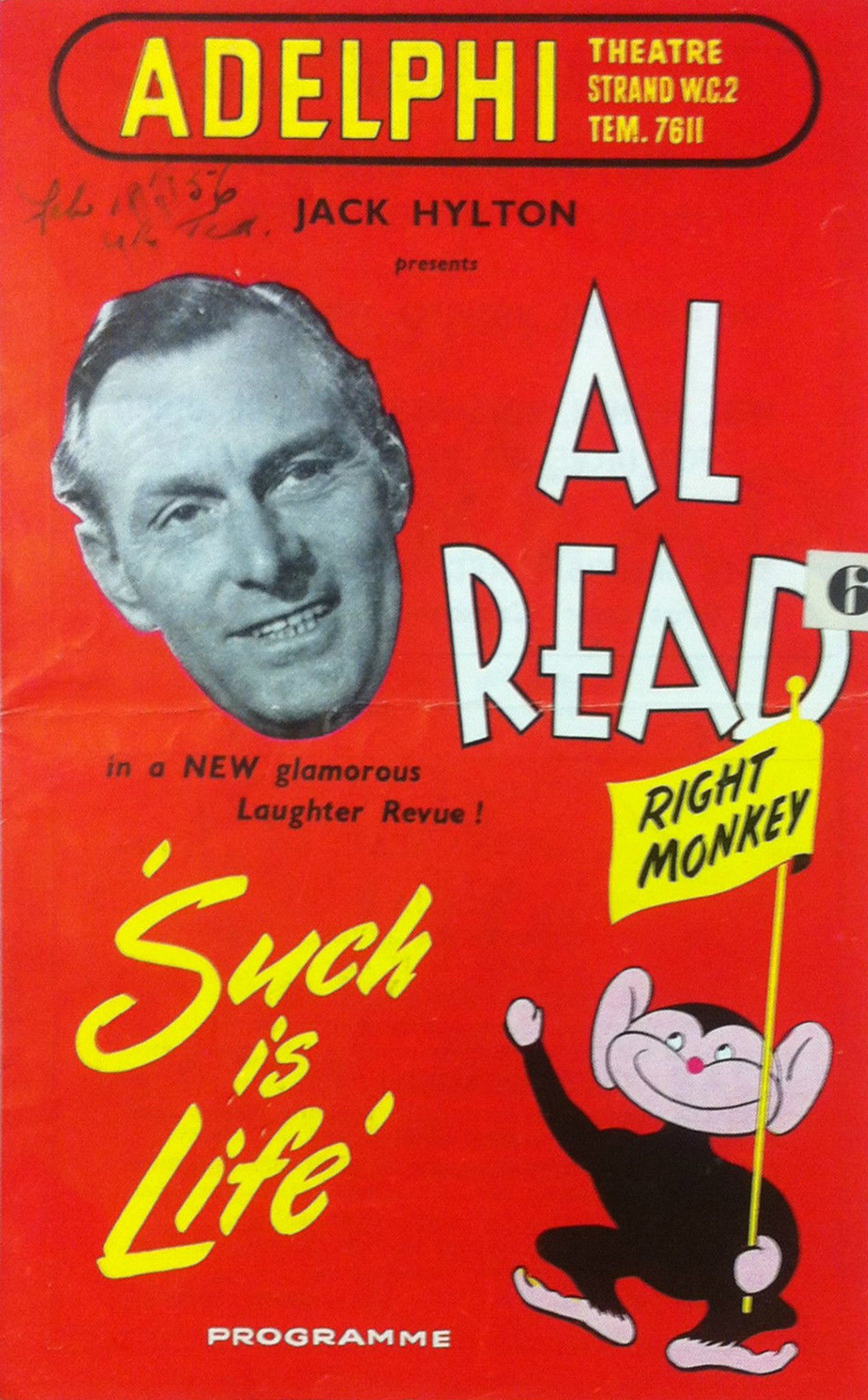
63) Such Is Life
Type : Original
Première preview : mercredi 14 décembre 1955
Première : mercredi 14 décembre 1955
Dernière : Inconnue
Metteur en scène : Jo Davies • Alec Shanks
Avec : Al Read, Jack Tripp, Shirley Bassey, Aud Johansen, Odette Crystal, Pat Hill and Lenny Delma, Bob and Marion Konyot, Allen Christie, Richard Lancaster, The John Tiller GIrls and the George Mitchell Chorus
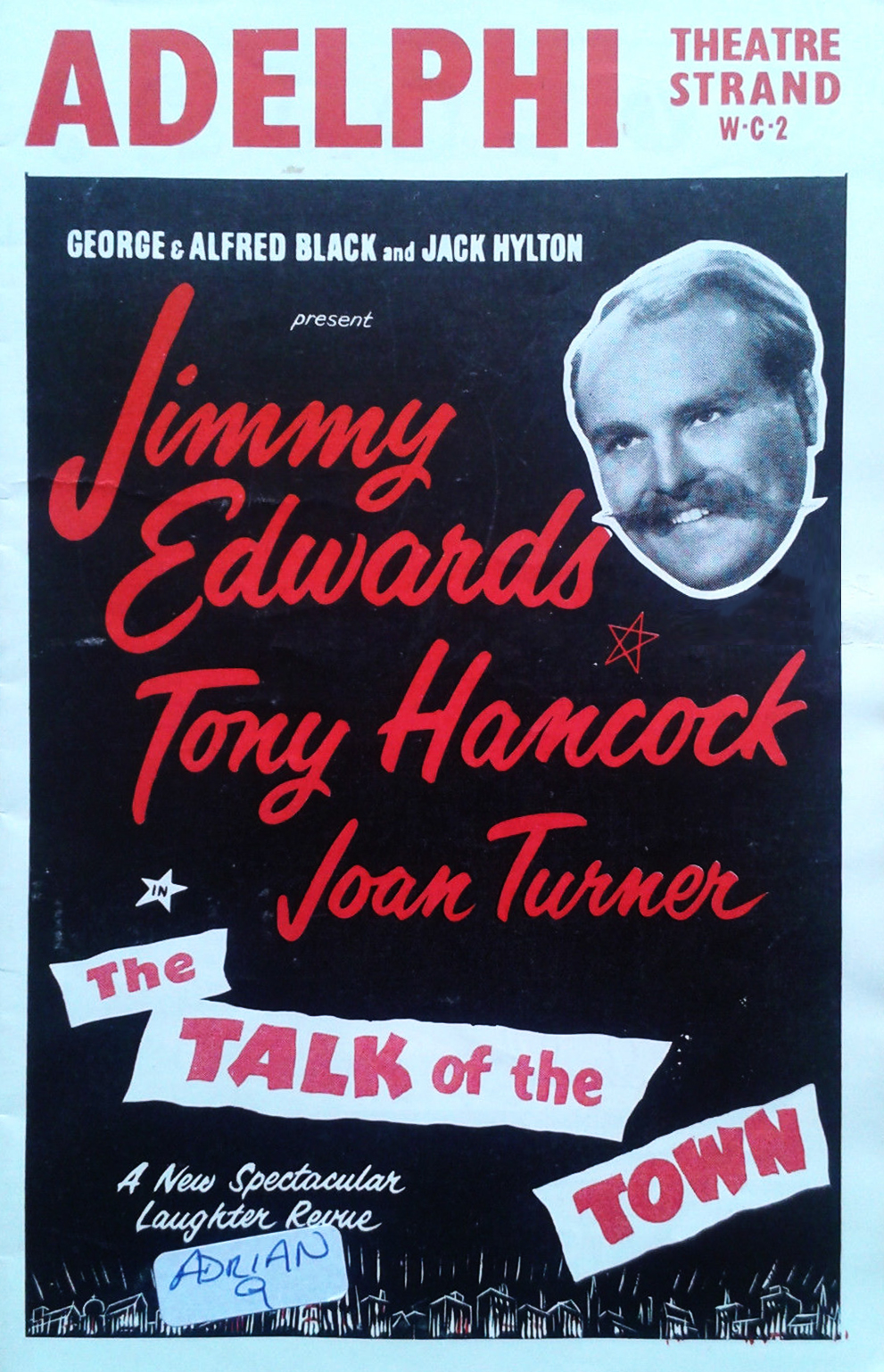
62) Talk of the Town (The)
Type : Original
Première preview : mardi 16 novembre 1954
Première : mardi 16 novembre 1954
Dernière : Inconnue
Metteur en scène : Jo Davies • Alec Shanks
Avec : Jimmy Edwards, Tony Hancock, Joan Turner, The Trio Bassi, Page and Bray, Lucienne and Astor, The John Tiller Girls, Kathryn Moore, Billy McCormack, Reg O'List, Charles Holford, Denver Thornton, Ted Hyde, Glen Blake.
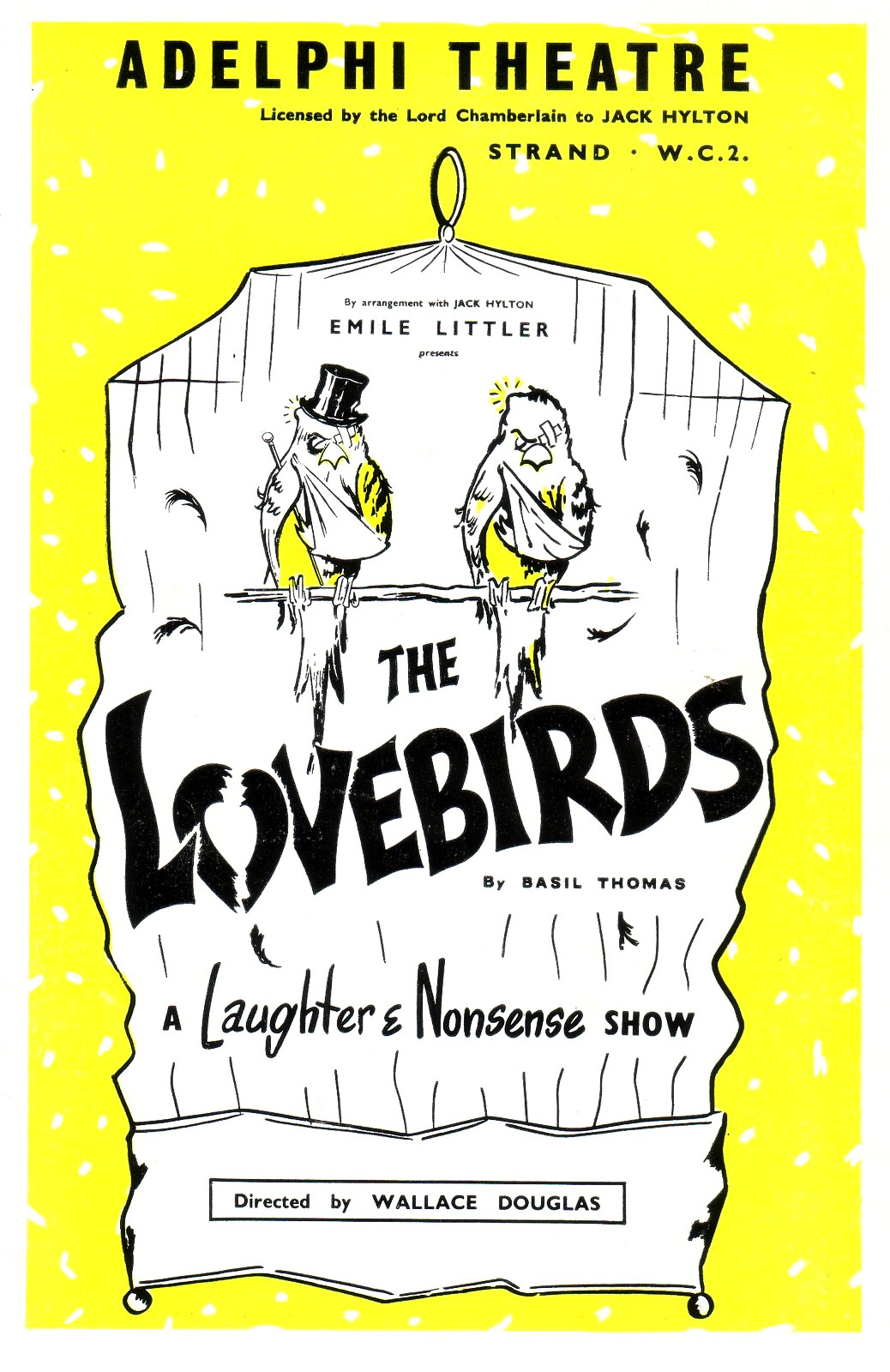
61) Lovebirds (The)
Première : mardi 20 avril 1954
Dernière : Inconnue
Metteur en scène : Wallace Douglas
Avec : Dora Bryan, Jean Aubrey, John Scott, Billie Hill, James Sharkey and Dorothy Blythe.
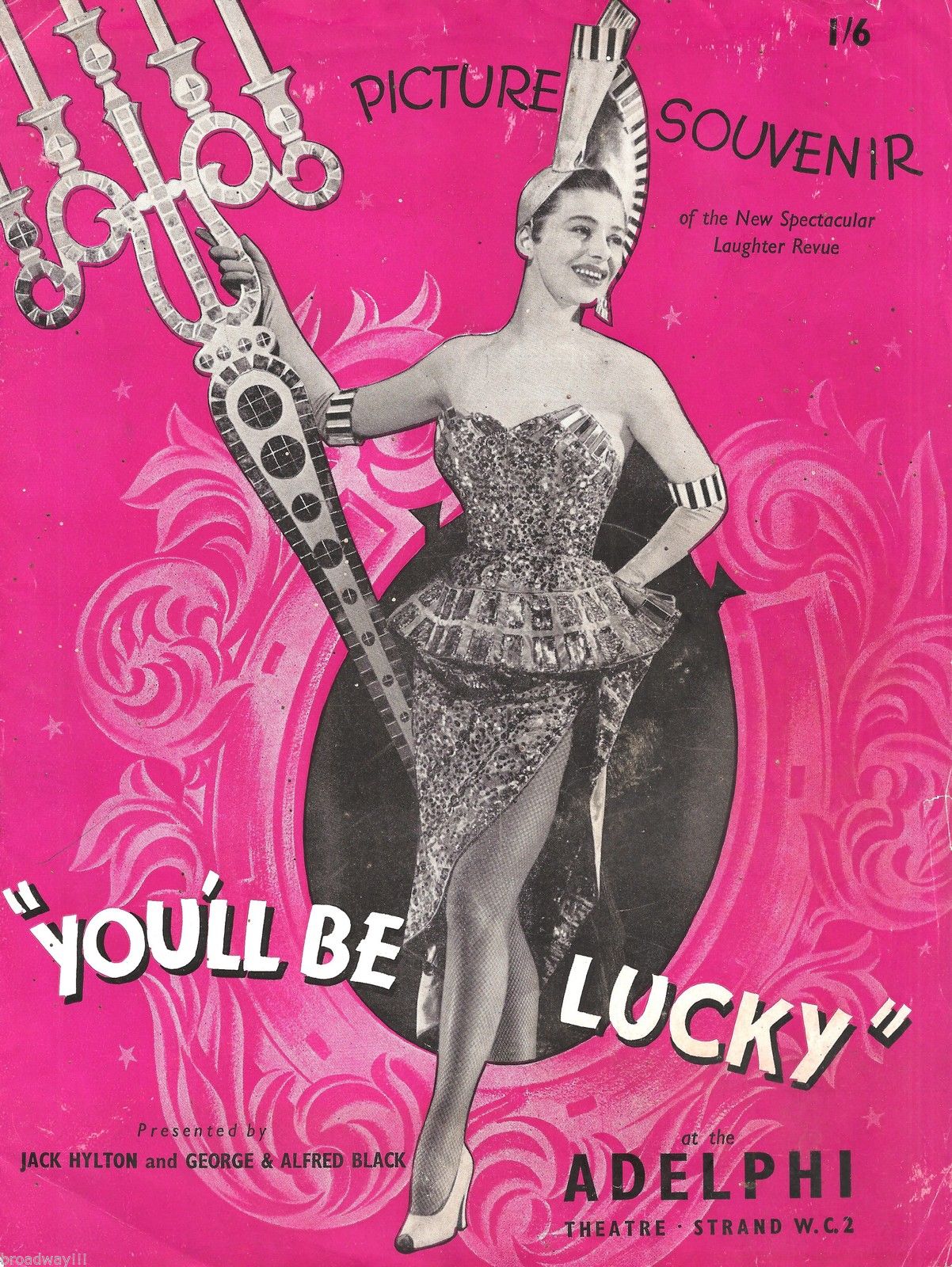
60) You'll Be Lucky
Type : Original
Nombre de représentations : 436
Première preview : jeudi 25 février 1954
Première : jeudi 25 février 1954
Dernière : Inconnue
Avec : AL READ, SHANI WALLIS, LAURI LUPINO LANE, GEORGE TRUZZI, ANN TYRELL, JOSEPHINE BLAKE, MARIAN LANE,, TREVOR GRIFFITHS, JOHN OXLEY, PETER GILMORE, JOHN McCULLOCH, GEORGE GILES, BRYAN MARLEY, MICHAEL MILLER and DAVID SPURLING .
59) You'll Be Lucky
Type : Original
Première preview : jeudi 25 février 1954
Première : jeudi 25 février 1954
Dernière : Inconnue
Metteur en scène : Jo Davies • Alec Shanks
Avec : Al Read. Sally Barnes, Lauri Lupino Lune. George Truzzi, Josephine Anne. Ann Tyrell, Josephine Blake, John Oxley. Trevor Griffiths, Peter Gilmore, John McCulloch, The Regency Singers. The John Tiller Girls, The Lucky Lovelies and The Berkeley Dancers
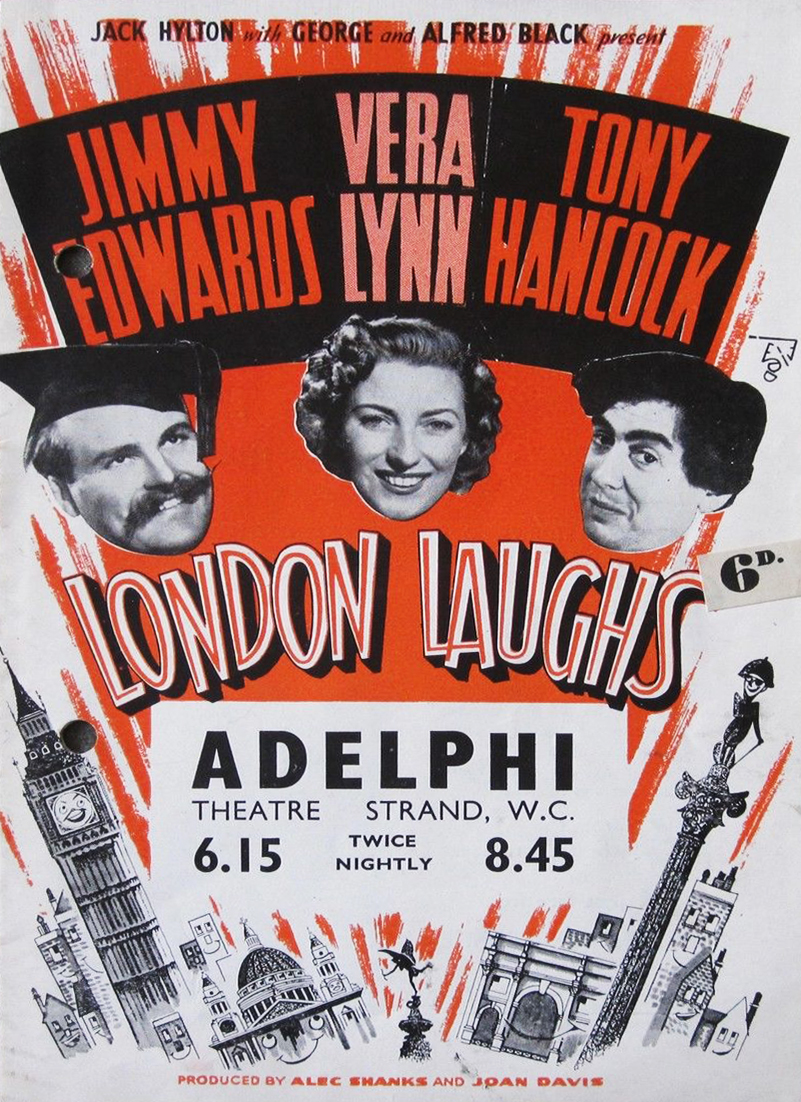
58) London Laughs
Type : Original
Joué durant 1 an 10 mois
Première preview : samedi 12 avril 1952
Première : samedi 12 avril 1952
Dernière : samedi 06 février 1954
Avec : Jimmy Edwards, Vera Lynn, Tony Hancock, The Jack Billings Trio, Natalie Raine, Erica York, The Hppy-Go-Lovelies, Derek Rosen, Jane Shorem The Cavendish Singers, the John Tiller Girls, Pauline Johnson, The Bedini Troupe, Michael Dalton, The Adelphi Theatre Orchestra
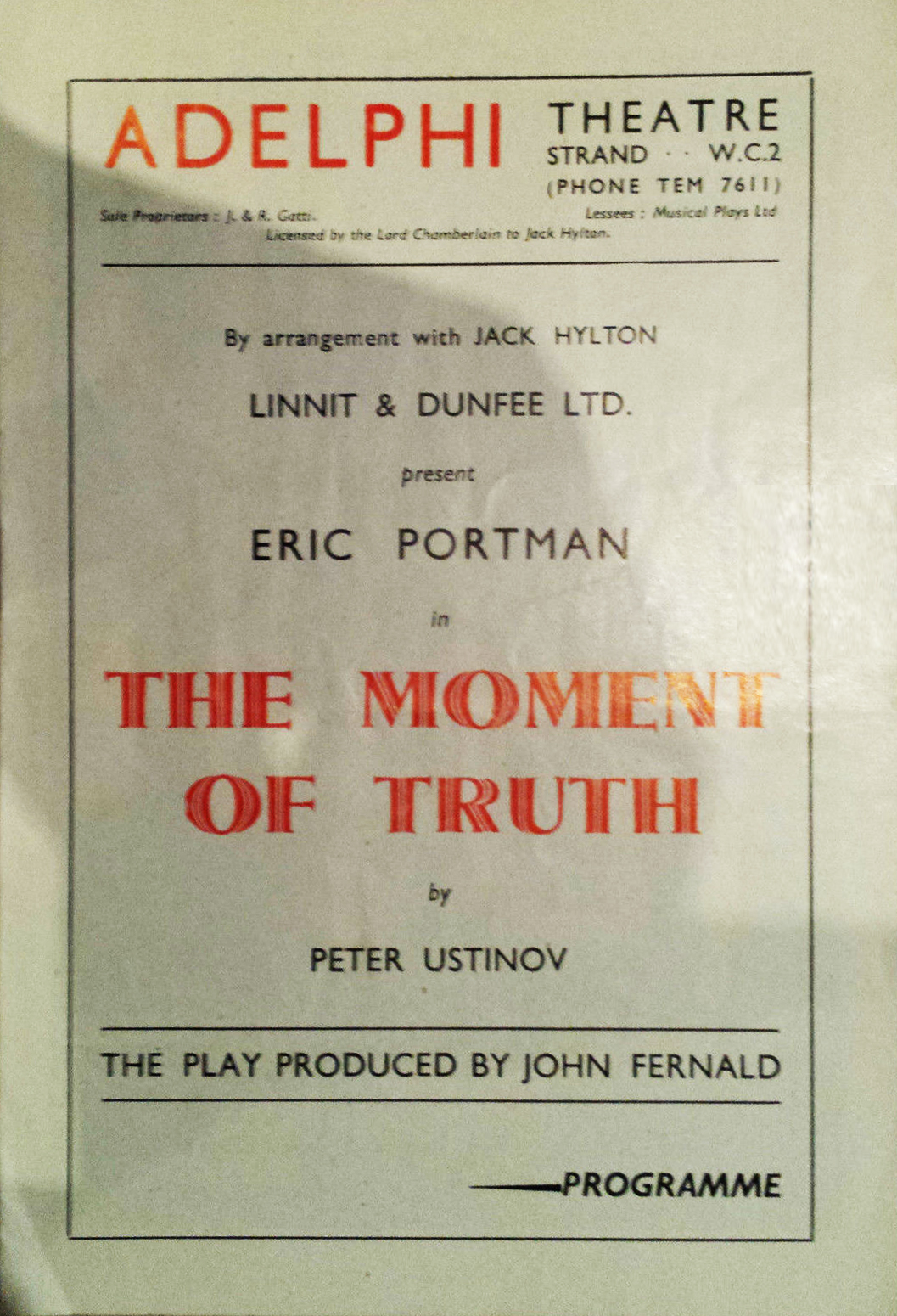
57) Moment of Truth (The)
Type : Original
Première : 1951
Dernière : Inconnue
Metteur en scène : John Fernald
Avec : Anthony Marlowe, Donald Eccles, Charles Goldner, Josephine Griffin, Noel Hood, Eric Portman, Brian Wilde, Cyril Luckham, Harry Gwyn-Davies
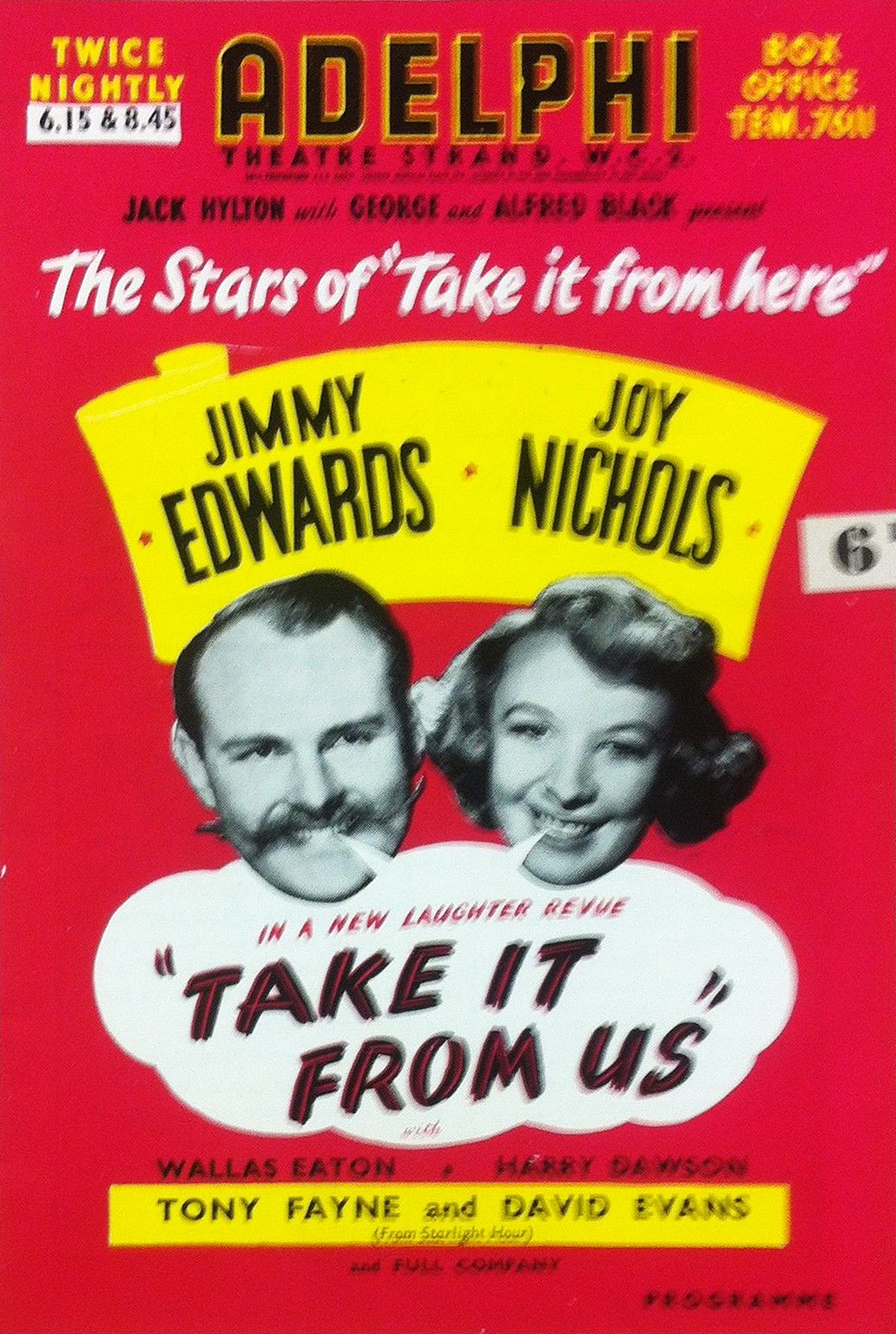
56) Take It From Us
Type : Original
Première preview : lundi 30 octobre 1950
Première : lundi 30 octobre 1950
Dernière : Inconnue
Avec : Jimmy Edwards, Joy Nichols, Dick Bently, Wallas Eaton, Harry Dawson, Patricia Hartley, Maurice St. Clair and Gloria Day, The Costello Twins, Count le Roy, Annettes 16 Dancettes, The Strand Steppers, Donald Craig, John Vicars, John Fothergill and Frank Brown
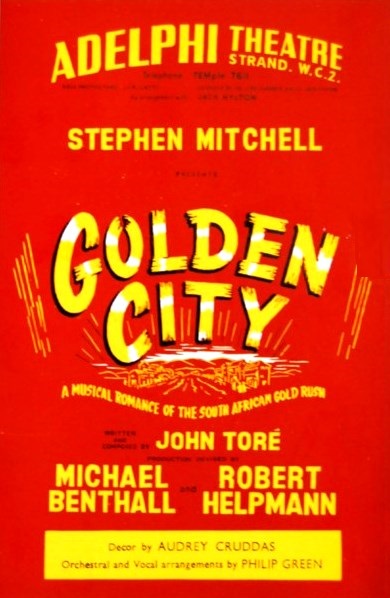
55) Golden City
Type : Original
Nombre de représentations : 140
Première preview : jeudi 15 juin 1950
Première : jeudi 15 juin 1950
Dernière : Inconnue
Compositeur : John Toré
Parolier : John Toré
Librettiste : John Toré
Metteur en scène : Michael Benthall
Chorégraphe : Robert Helpmann
Avec : Moyra Fraser, Julia Shelley (Sarie van Seim), Judith Whitaker (Anna) Eleanor Summerfield (Mabel Page), Muriel Brunskill (Tante de Villiers) , Norman Lawrence (Danny Martin), Ray Buckingham (Dirk), Edmund Purdom, Mako Hlubi
Commentaire : The composer, John Toré, was a 30 year old Rhodesian. In June 1959 his second musical “Charlie Boy”, about Kentish hop-pickers, was about to go into production when he suddenly died at the age of 35. The show was abandoned…
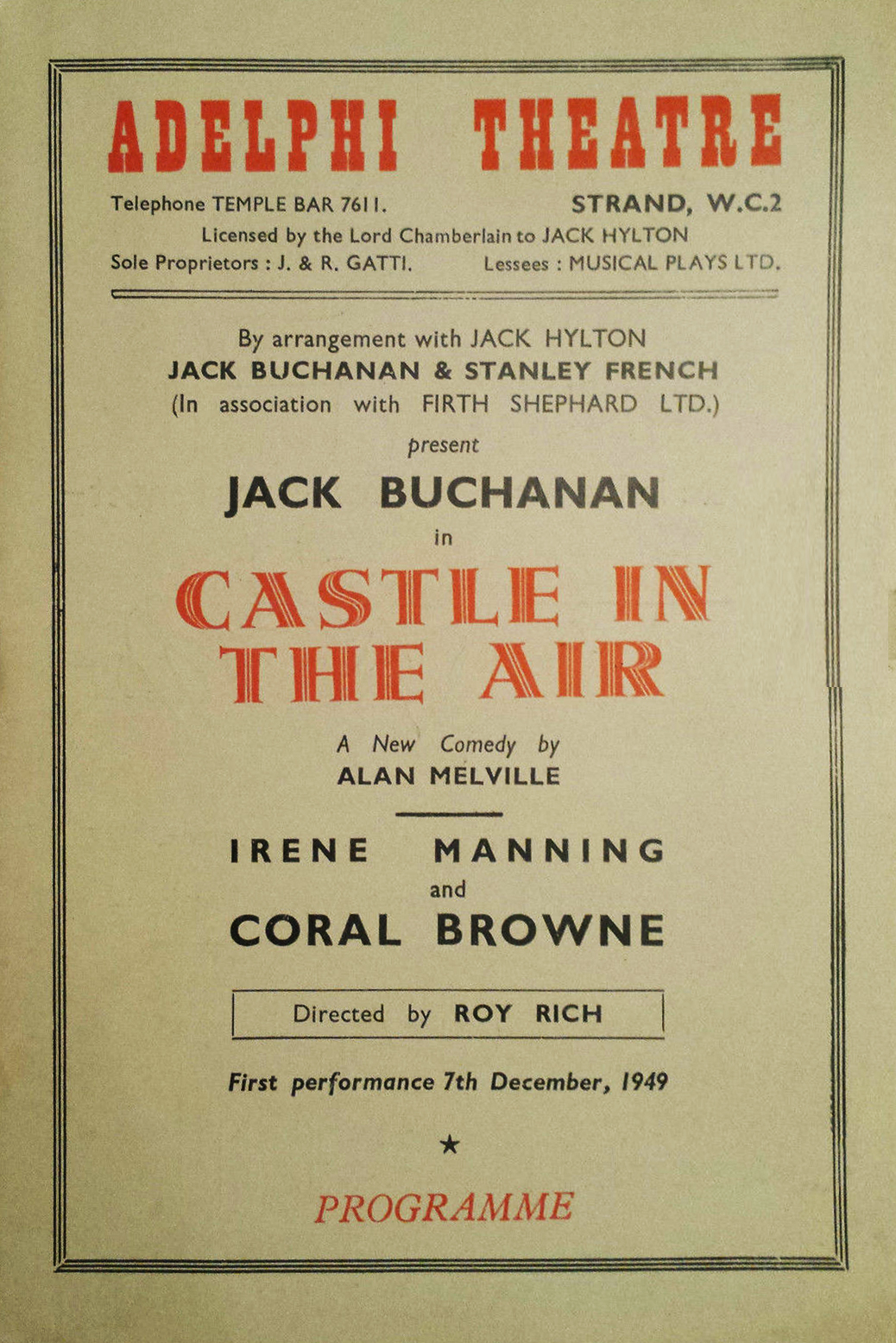
54) Castle in the Air
Première : mercredi 07 décembre 1949
Dernière : Inconnue
Metteur en scène : Roy Rich
Avec : Ewan Roberts, Coral Browne, Jack Buchanan, William Kendall, Irene Manning

53) Tough at the Top
Type : Original
Nombre de représentations : 154
Première preview : vendredi 15 juillet 1949
Première : vendredi 15 juillet 1949
Dernière : Inconnue
Compositeur : Vivian Ellis
Parolier : A.P. Herbert
Librettiste : A.P. Herbert
Metteur en scène : Wendy Toye
Chorégraphe : Wendy Toye
Avec : Berly Kaye, Jean Telfer, Kyle Adair, Keith Beckett, Peter Darrell, Clive Stock, Felix Kent, Peter Morton, Geoffrey Bayldon, Maria D'Attili, Carol Raye, Pearl Newman, Gwen Nelson, Brian Reece, George Tozzi, Eddie Byrne, Stanley Rose, Peter Morton, Richard Dunn, Vincent Charles, Peter Lupino, Tommy Linden, Alex Dignam, Paddy Ryan, Joe Powell, Queenie Taylor, Anita Bolster. The ballet: Beryl Kaye, Tommy Linden, Claudine Goodfellow, Tamara Kirova, Barbara Pearce, Mary Reynolds, Margaret Tate, Keith Beckett, Maurice Boyle, Peter Darrell, Edward Elders, Donald Gillies. Singers: June Bishop, Phyllis Bridgwater, Dorothy Caston, Muriel Cooke, Janet Crawford, Hilary Gordon, Leonie Hodge, Joan Kaye, Mimi Piper, Joan Ryan, Queenie Taylor, Mary Turner, Sheila Williams, Richard Aubrey, Day Buckingham, Vincent Charles, Andrew Cole, Gil Cornwall, Richard Dunn, Herbert Garry, Philip Livesey, Walter Myerson, Terence O'Donohue, Brian Tebbit, Cyril Turnidge, Ridgway West.
Commentaire : Charles Cochran imported Maria d’Attili from Bolivia and George Tozzi from New York to head his latest Vivian Ellis production. This was intended to top the glory of “Bless the Bride” - but it was too long, too unexciting, and too improbable, despite its magnificent Edwardian costumes and lavish settings. Sadly it would be the last of C. B Cochran’s West End shows. He died in January 1951, aged 78, having been a major force in British theatre since the 1920s.

52) Bless the Bride
Type : Original
Nombre de représentations : 886
Première preview : samedi 26 avril 1947
Première : samedi 26 avril 1947
Dernière : Inconnue
Compositeur : Vivian Ellis
Parolier : A.P. Herbert
Librettiste : A.P. Herbert
Metteur en scène : Wendy Toye
Chorégraphe : Wendy Toye
Avec : Lizbeth Welch (Lucy Veracity Willow), Georges Guetary (Pierre Fontaine), Brian Reece (Thomas Trout), Betty Paul (Suzanne Valois)
Commentaire : This was Lizbeth Welch’s first leading role, and the show itself the very best of the series of collaborations between Vivian Ellis, A.P. Herbert and the producer C.B. Cochran. In spite of the huge success of the “new” American shows like “Oklahoma” and “Annie Get Your Gun”, “Bless the Bride” became a great favourite, running for two years.

51) Big Ben
Type : Original
Nombre de représentations : 172
Première preview : mercredi 17 juillet 1946
Première : mercredi 17 juillet 1946
Dernière : Inconnue
Compositeur : Vivian Ellis
Parolier : A.P. Herbert
Librettiste : A.P. Herbert
Metteur en scène : Wendy Toye
Chorégraphe : Wendy Toye
Avec : Carole Lynne (Grace Green), Trefor Jones (Henry Hope), Eric Palmer (George Hume), David Davies (Benjamin Green), Gabrielle Brune (Juniper Joy), Lizbeth Webb (Miss Sylvester)
Commentaire : This was a very competent and well-written combination of political humour and a dose of patriotism for a Britain that had survived the war with its democracy and its spirit intact. However its “preachy” quality tended to overwhelm the comedy and fun. It managed a five month run. Shortly after opening Carole Lynne (Mrs Bernard Delfont) dropped out of the show due to pregnancy, and was replaced by Lizbeth Webb. Then Gabrielle Brune dropped out for the same reason, replaced by Noele Gordon.
50) Can-Can (version Max Catto)
Type : Original
Nombre de représentations : 76
Première preview : mercredi 08 mai 1946
Première : mercredi 08 mai 1946
Dernière : Inconnue
Compositeur : Jacques Offenbach
Parolier : Fred F. Tysh
Librettiste : Max Catto
Metteur en scène : William Mollison
Chorégraphe : Pauline Grant
Avec : Clifford Mollison (Paul Latour), Elizabeth French (Angela), Charles Doming (Count Simon), Leo Franklyn (Alphonse), Noel Morris (Due de Chambreau), Margaret Davison (Colette), Doreen Duke (Lolita), William March (Alfred), John Marquand (Claude)
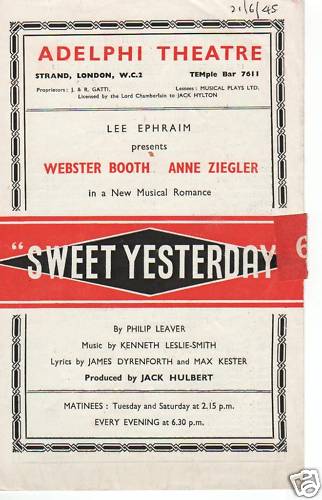
49) Sweet Yesterday
Type : Original
Joué durant 5 mois 2 semaines
Nombre de représentations : 196
Première preview : jeudi 21 juin 1945
Première : jeudi 21 juin 1945
Dernière : samedi 08 décembre 1945
Compositeur : Kenneth Leslie Smith
Parolier : James Dyrenforth • Max Kester • Philip Leaver
Librettiste : Philip Leaver
Metteur en scène : Jack Hulbert
Chorégraphe : Frank Staff • Cleo Nordi
Avec : Reginald Tate (Sir John Manders), Anne Ziegler (Louise Varennes), Doris Hare (Madame Sans-Gene), Webster Booth (Captain Labouchere), Mark Daly (Cabouchon)
Commentaire : This began life as a 1941 radio play as a war propaganda exercise, and was expanded into a musical to showcase the enormously popular husband and wife singing team, Anne Ziegler and Webster Booth. It was an unhappy show from the start of its pre-London tour in Edinburgh. The experienced director Esmé Church was new to musicals, whilst the choreographer, Frank Staff was expert at ballet but not at dances for actor-singers. After a series of complaints from the stars, Jack Hulbert was brought in as replacement director, and Cleo Nordi was added to the choreography team. Then Hugh Morton, the original Sir John, was replaced with Reginald Tate, causing Ziegler and Booth to announce they were walking out in protest. However, the producer Lee Ephraim, told them this would be a breach of contract and he would be prepared to sue. In this really unhappy atmosphere the show opened in London to mixed notices. However, the star names meant the show was extremely successful at the box office and ran six months up to December, when the Adelphi was pre-booked for the pantomime season. Lee Ephraim wanted to arrange a transfer to another theatre, but this required the agreement of Anne Ziegler and Webster Booth. They did not agree, and took
the opportunity to leave the show. Without its stars there was no realistic prospect of it continuing.
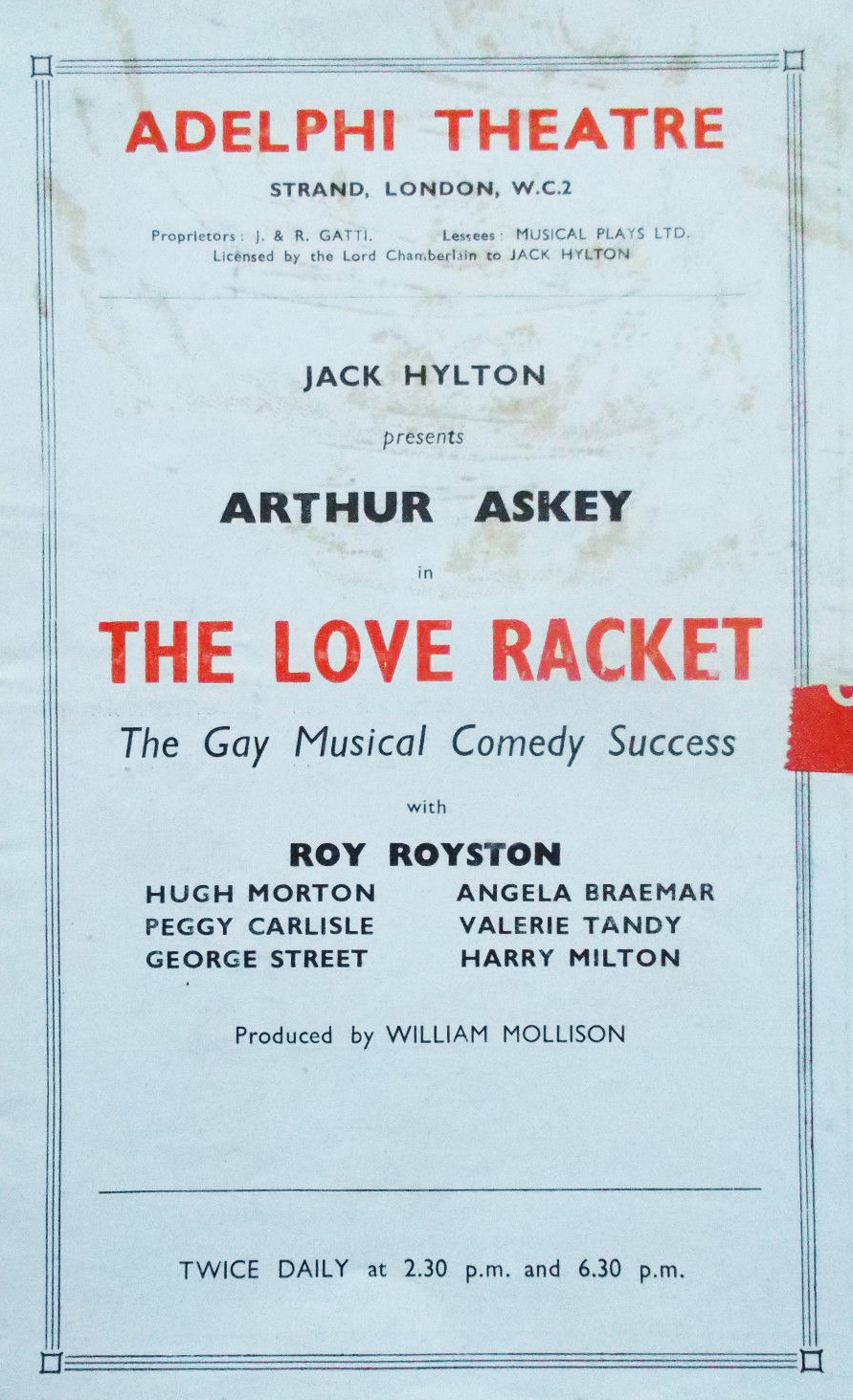
48) Love Racket (The)
Type : Original
Nombre de représentations : 36
Première preview : samedi 23 décembre 1944
Première : samedi 23 décembre 1944
Dernière : Inconnue
Compositeur : Noel Gay
Parolier : Barbara Gordon • Basil Thomas • Frank Eyton • Leslie Gibbs
Librettiste : Stanley Lupino
Metteur en scène : William Mollison
Chorégraphe : Freddie Carpenter
Avec : Harry Milton (Johnnie Stanton), Carol Raye (Jane Denver), Roy Royston (Jimmie), Valerie Tandy (Minnie), Arthur Askey (Tony Merrick), Peggy Carlisle (Bonnie), Finlay Currie (Samuel T. Kelly), Hugh Morton (The Stranger)
Commentaire : Se jouera au Victoria Palace Theatre, au Princes Theatre puis à l'Adelphi Theatre.

47) Dancing Years (The)
Type : Revival
Joué durant 2 ans 3 mois 3 semaines
Nombre de représentations : 969
Première : samedi 14 mars 1942
Dernière : samedi 08 juillet 1944
Compositeur : Ivor Novello
Parolier : Christopher Hassall
Librettiste : Ivor Novello
Metteur en scène : Leontine Sagan
Chorégraphe : Freddie Carpenter
Avec : Ivor Novello (Rudi Kleber), Muriel Barron (Maria Zeigler), Roma Beaumont (Grete Schöne), Olive Gilbert (Cäcile Kurt), Peter Graves (Franzi), Victor Bogetti (Prince Charles Metternich)
Commentaire : This first revival followed its long provincial tour, after it was forced to leave London because of the outbreak of war. This time it ran for 969 performances, again forced to close in July 1944 because of increased bombing activity.
Earlier in 1944 Ivor Novello had to leave the show, having been sentenced to eight weeks imprisonment.
46) Bobby get your Gun
Type : Original
Nombre de représentations : 92
Première preview : vendredi 07 octobre 1938
Première : vendredi 07 octobre 1938
Dernière : Inconnue
Compositeur : Jack Waller • Joseph Tunbridge
Parolier : Bert Lee • Clifford Grey • Desmond Carter
Librettiste : Bert Lee • Fred Thompson • Guy Bolton
Metteur en scène : William Mollison
Chorégraphe : Freddie Carpenter
Avec : Bobby Howes (Bobby Lockwood), Wylie Watson (Pettick), Bertha Belmore (Aunt Prunella), Gertrude Niesen (Lupe), Diana Churchill (Rita), David Bums (Flash Tomkins), Max Oldaker, Carl Bernard, The Four Franks.
Commentaire : It was possible that by now the tried-and-tested formula of the Howes-Watson-Belmore partnership was beginning to run out of steam. Although the performers themselves were welcomed back into the West End, the material itself came in for criticism, and the show came off on New Year’s Eve, less than three months.
45) Happy Returns
Première preview : jeudi 19 mai 1938
Première : jeudi 19 mai 1938
Dernière : Inconnue
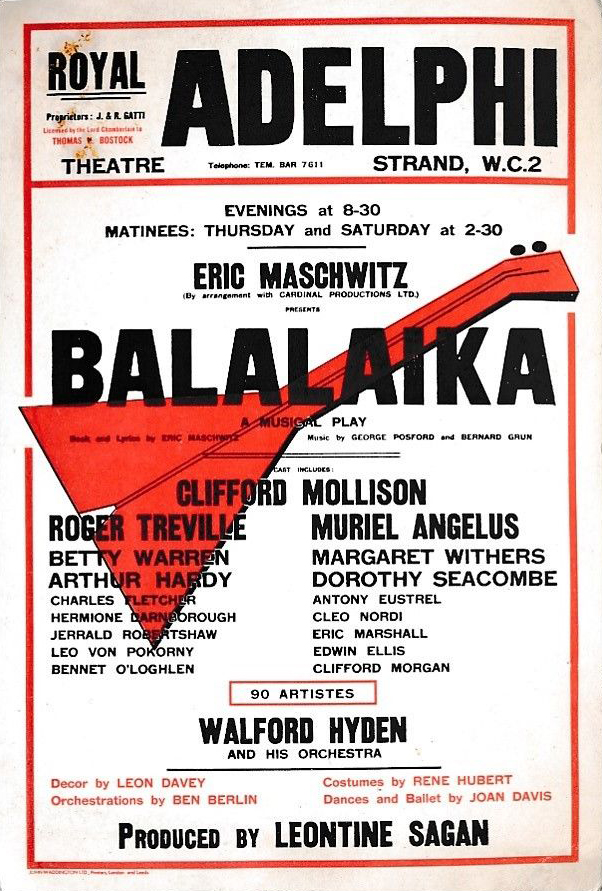
44) Balalaika
Type : Original
Nombre de représentations : 569
Première preview : samedi 19 février 1938
Première : samedi 19 février 1938
Dernière : Inconnue
Compositeur : Eric Maschwitz
Parolier : Bernard Grun • George Posford
Librettiste : Bernard Grun • George Posford
Metteur en scène : Leontine Sagan
Chorégraphe : Joan Davis
Avec : Eric Marshall (Colonel Balakirev), Dorothy Seacombe (Mrs Morrison), Bennett O’Loughlan (Randall P. Morrison), Roger Treville (Peter Karagin), Muriel Angelus (Lydia Marakova), Jerrold Robertshaw (Prince Karagin), Arthur Hardy (Marakov), Clifford Mollinson (Nicki), Betty Warren (Masha)
Commentaire : This is a revised version of the 1933 play “The Great Hussar”. With gipsy songs and dances, a major ballet performance, dramatic revolution scenes, and Cossack dancing it was a great critical and popular success.
An MGM film version was made in 1939 starring Nelson Eddy and Ilona Massey using a new score made up of songs by Sigmund Romberg. Only one song, “At the Balalaika” remained from the original stage show.
London Run: Adelphi Theatre 22/12/1936 - Transferred to His Majesty's 6/2/1937 - Transferred to Adelphi 19/2/1938.
43) Laughing Cavalier (The)
Type : Original
Nombre de représentations : 38
Première preview : mardi 19 octobre 1937
Première : mardi 19 octobre 1937
Dernière : Inconnue
Compositeur : Wainwright Morgan
Parolier : Reginald Arkell • Stafford Byrne
Librettiste : Reginald Arkell • Stafford Byrne
Metteur en scène : William Mollison
Chorégraphe : Hedley Briggs
Avec : Arthur Margetson (Don Juan), John Garrick (Franz Hals), Irene Eisinger (Lysbeth), Nora Swinburne (Maryka), Charles Heslop (Burgomaster), Viola Tree (Burgomaster’s wife).
Commentaire : With some beautiful scenes re-creating Flemish paintings, Dutch songs, Dutch dances, dancing cavaliers, and even lute solos, this was a lavish treat for the eye and ear, but with such a thin plot that it failed to hold an audience and came off within five weeks.
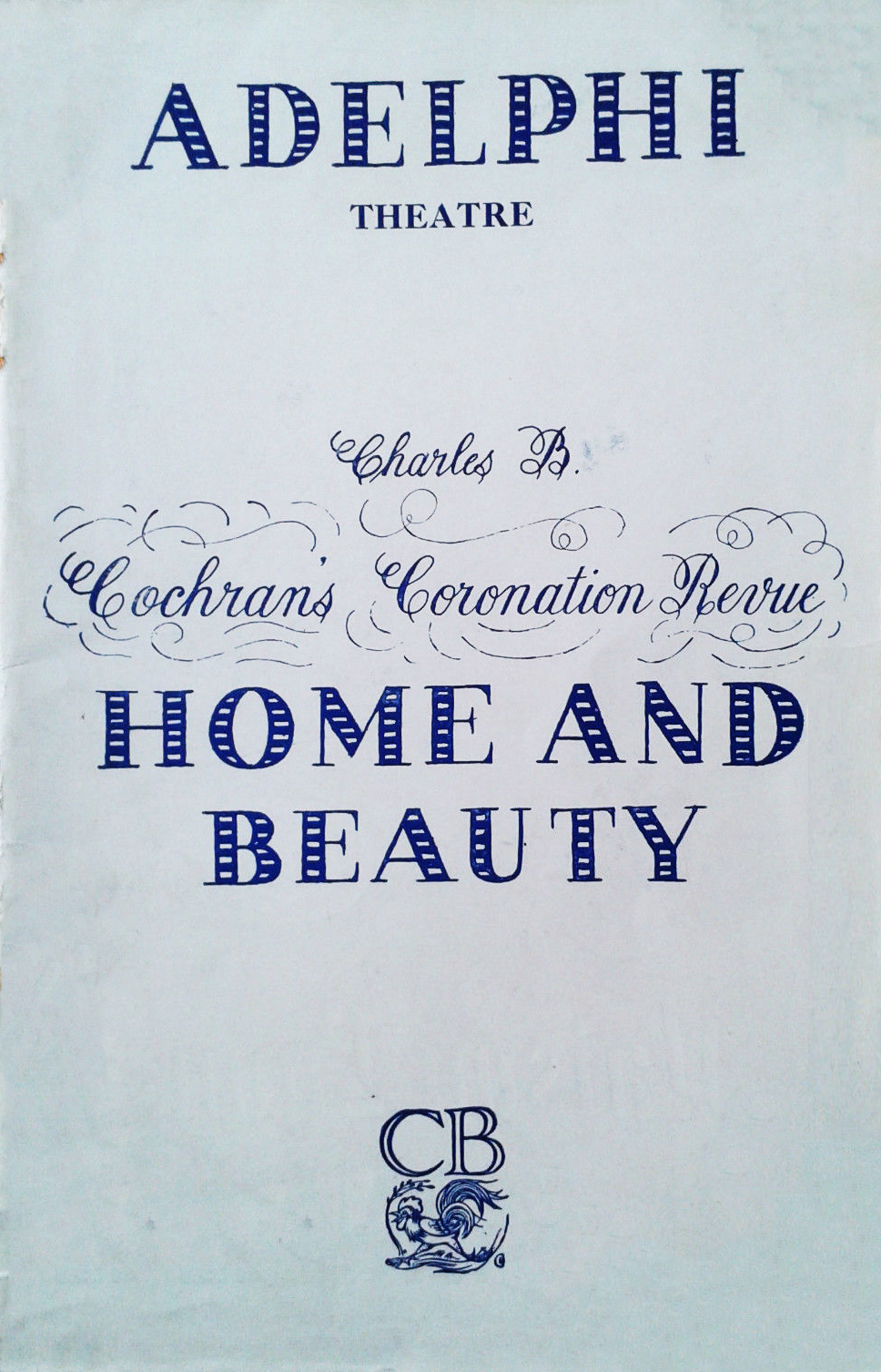
42) Home and Beauty
Type : Original
Première preview : mardi 02 février 1937
Première : mardi 02 février 1937
Dernière : Inconnue
Avec : Miss Minnie Hale, Mr. Nelson Keys
Commentaire : THE CORONATION REVUE
H0ME AND BFAUTY at the Adelphi, is a revue which contains Miss Minnie Hale and Mr. Nelson Keys; therefore it is a good revue. It has been written by Mr. A. O. Herbert, with music by Mr. Brodzky, which means that the words and tunes are always worth hearing, if late-comers. coughers, and conversationalists will give you a chance. Mr. Herbert's wit is apt to be a bit too good for the theatre, especially for a musical show, whose patrons may easily miss the neatness of the verbal play amid the general hurly-burly.
Presse : "H0ME AND BFAUTY at the Adelphi, is a revue which contains Miss Minnie Hale and Mr. Nelson Keys; therefore it is a good revue. It has been written by Mr. A. P. Herbert, with music by Mr. Brodzky, which means that the words and tunes are always worth hearing, if late-comers, coughers, and conversationalists will give you a chance. Mr. Herbert's wit is apt to be a bit too good for the theatre, especially for a musical show, whose patrons may easily miss the neatness of the verbal play amid the general hurly-burly.
However, so Iong as the patrons like paying for the wit that goes over their hearts and Mr Herbert draws the appropriate proceeds, there seems to be no cause for grumbling. Perhaps Mr. Herbert will note, for future use, that jokes about the Stock Exchange and trousers coming down appeal a great deal more than does clever allusion to political and psycho-analytical detail. Certainly the funniest sketch in the show was that in which Mr Nelson Keys, as a multi-millionaire who had collected a repulsive cold and had also lost his braces, continued to "play the market” and support his menaced trousers single-handed. This was superbly done.
“Home" in this revue is represented by baronial halls to which all and very sundry come for a week-end. For beauty there art numerous "lovelies," one or two enchantmgly lit scenes of ballet, costume, and fantasy, and the top-notes of Miss Citta Alpar, who brings an operatic virtuosity to enliven the stately homes of England. Miss Binnie Hale manages to be admirably everything and everywhere when fun is wanted; while Mr. Nelson Keys gets in and out of hunting pink, farmer's brown, and plumber's blue, sharing Miss Hale's magnificent ability to be everything by turns and nothing long. The stately home is well supported bv Mr. Norman Williams and Miss Xorah Howard, as owners or lessees: it is nice to think that anybody in these days can support so many footmen and other menials without having to be a multiple-store owner in order to keep them in buttons and boot polish.
Mr. John Murray Anderson has devised and staged this Coronation Revue for Mr. Cochran, and has done it with great efficiency. It is now the business of the revue not to fade out before the Coronation, which means lasting three-and-a-half months. That does not seem very much to ask of a Cochran-Herbert-Hale-Keys entertainment. But the second half of the show seemed to me to go a bit limp on the first night. Might not the sketch about the modern children go? Though its idea is good it somehow jarred a bit, and the show is amply long enough, anyway. The Coronation is saluted with a royal toast and there are occasional symptoms of Cavalcadish sentiment. But the transition from loyalty to laughter is usually quick and tactful. Mr. Brodzky has given us one tune about love which will be loved by everybody in the land. This 'll make us whistle.
" BKHIN'D YOUR BACK." by Mr diaries I-andstone. now on view at the Strand Theatre, belongs to a class of play which usually interests me—that is to say. the type which Polonius might have called " industnal-comical ” or “ industnal-comical-tragical,” for. prudently, there is pathos as well as satire; it is always wise to lace your laughter with a little grief. The recipe here is to take a form of commerce or industry and. without bothering too much about a plot, to reveal the trade’s daily or even hourly troubles, follies, relaxations, and crises of all kinds. Arnold Bennett used to do this sort of thing in novel form with the utmost fascination : luxury catering was his special industry. Then Mr. and Mrs. Stuart in " Nine Till Six ” made a most popular piece about the dressmaking trade ; while Miss Dodie Smith, in “Service,” took us round a great store. Mr. I .andstone knows the theatre, especially as a " front-of-the-house ” manager, and his play shows us the adventures or tribulations of those who work there in a managerial or humbler capacity.
Of course, in order to get theatrical shape, the dramatist has to condense into a single evening a series of love* affairs and minor calamities which might happen to various people over the course of a year. You may conclude that all this could not possibly occur during a couple of hours in a dress-circle bar. But surely that is not an objection which need worry us to any considerable extent. What matters is that the people concerned should be likely, their affairs plausible, and their dialogue and actions vivid, significant and true to life. Here Mr. I.andstonc has succeeded amply, and Mr Shiner's light and nimble production of his piece successfully wards off any sensation of monotony.
The obvious remark to make is that, if life “ behind one’s back “ is so dramatic, why remain in the dress-circle to watch the actors ? Let us turn backward to the bar and sample real life in the much-vexed company of the manager. Certainly Mr. Landstone has created some excellent types for our entertainment, not least the bar manageress (Miss Kathleen Boutall) and the harassed manager (Mr. Jack Melford). The cream of the jest, however, is the appearance of Mr. Esm4 Percy as a demonstrative actor-manager who comes to everybody's rescue in the hour of failure His performance is a grand piece of mischief, burlesqueing all the flamboyance and the fudge of a second-rate mummer.
To anyone also who knows the theatre from inside, the desperate efforts to keep a failing play on its legs and the menace of unemployment which a failure involves are really moving. It is not only a case of “ Laugh, clown, laugh'". Let us remember that a programme-girl may have visions of to-morrow's hunger as she serves the tea and cake of the final matinee. We think only of broken-hearted author and of actors who have toiled in vain ; but a "flop“ scatters distress far wider afield than that. It is well for playgoers to be reminded." Ivo Brown - The Sketch - 10/2/1937
41) Balalaika
Type : Original
Nombre de représentations : 569
Première : mardi 22 décembre 1936
Dernière : Inconnue
Compositeur : Eric Maschwitz
Parolier : Bernard Grun • George Posford
Librettiste : Bernard Grun • George Posford
Metteur en scène : Leontine Sagan
Chorégraphe : Joan Davis
Avec : Eric Marshall (Colonel Balakirev), Dorothy Seacombe (Mrs Morrison), Bennett O’Loughlan (Randall P. Morrison), Roger Treville (Peter Karagin), Muriel Angelus (Lydia Marakova), Jerrold Robertshaw (Prince Karagin), Arthur Hardy (Marakov), Clifford Mollinson (Nicki), Betty Warren (Masha)
Commentaire : This is a revised version of the 1933 play “The Great Hussar”. With gipsy songs and dances, a major ballet performance, dramatic revolution scenes, and Cossack dancing it was a great critical and popular success.
An MGM film version was made in 1939 starring Nelson Eddy and Ilona Massey using a new score made up of songs by Sigmund Romberg. Only one song, “At the Balalaika” remained from the original stage show.
London Run: Adelphi Theatre 22/12/1936 - Transferred to His Majesty's 6/2/1937 - Transferred to Adelphi 19/2/1938.
40) Blackbirds of 1936
Type : Original
Joué durant 2 semaines
Nombre de représentations : 23
Première preview : lundi 09 novembre 1936
Première : lundi 09 novembre 1936
Dernière : jeudi 26 novembre 1936
Avec : Batie and Foster, Emmett Wallace, Emery Smith, Nicholas Brothers, Tim Moore, Aland, Danny, Gelli Smith, Tiny Ray, Gus Simmons, Attles, McDaniels, James Skelton, Johnson, White, John Garth, Simons, Gordon, Rogers. Lavaida Carter, Eunice Wilson, Fela Sowande, Gallie de Gaston, Anise, Edith, Katie Hall, Mildred Marshall, Famous J. Rosamond Johnson Choir, Blackbirds Beauty Chorus, Hall, Marshall, King, Ross, Sade McGill, Marie Robbinson, Wicks, Cue, Ellis, Cooper.
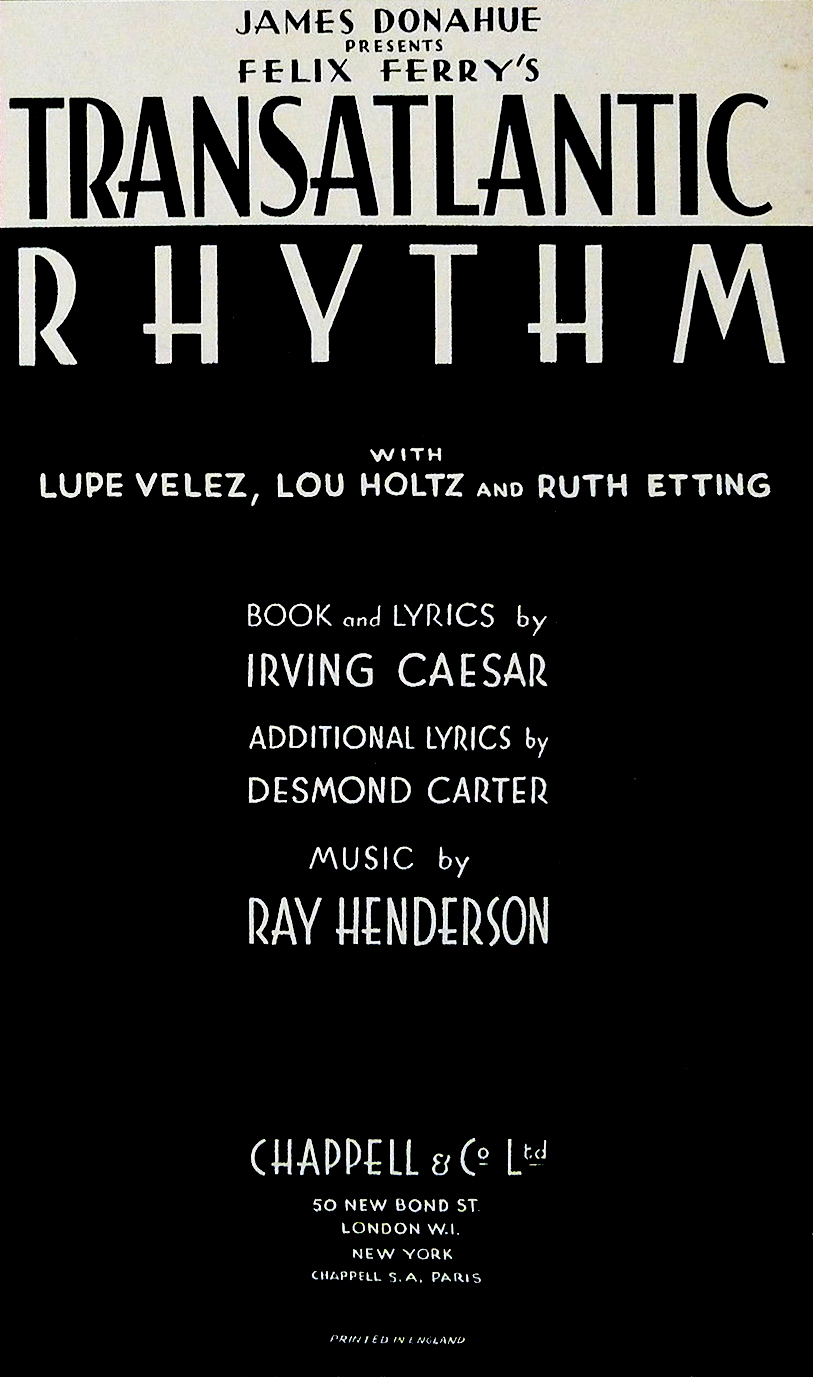
39) Transatlantic Rhythm
Type : Original
Première preview : jeudi 01 octobre 1936
Première : jeudi 01 octobre 1936
Dernière : Inconnue
Avec : Lupe Velez, Lou Holtz, Ruth Etting
38) Follow the Sun
Type : Original
Première preview : mardi 04 février 1936
Première : mardi 04 février 1936
Dernière : Inconnue
Commentaire : Programme complet disponible dans la version longue de ce commentaire.
37) Fritzi
Type : Original
Première preview : vendredi 20 décembre 1935
Première : vendredi 20 décembre 1935
Dernière : Inconnue
Compositeur : Karl Tucker
Parolier : Arthur Stanley
Librettiste : Edward Royce • Sydney Blow
Metteur en scène : John Wyse
Chorégraphe : Marianne Sergei • Peter Sergei
Avec : Rosalinde Fuller (Fritzi), Ivan Wilmot (André Sorbier), Madeleine Seymour (Paulette Leclaire), Alfred Wellesley (Gendarme Chief), Leslie French Charles), Betty Frankis (Desirée), Bruce Winston (Paul DuPortal)
Commentaire : Se crée puis se joue à l'Adelphi Theatre à partir du 20 décembre 1935
Transféré au Prince's Theatre (Shaftesbury actuel) à partir du 13 janvier 1936.
Carl Tucker (the composer) was heavily promoted as being “from Vienna”, and the leading lady, Rosalinde Fuller, a well known classical actress, was promoted as having begun her career at the Folies Bergère. It was this mish-mash of musical styles that made the show heavy-going - dance sequences such as “South Sea Idyll” and a Valse Scena, acrobats and a mouth-organ speciality didn’t really fit alongside its romantic story. It ran its contracted month at the Adelphi and then transferred for a further six weeks at the Prince’s Theatre (Shaftesbury) - but never really caught on. (When Rosalinde Fuller died in 1982, aged 90, it was discovered that she had had an affair in 1920 with the author F.Scott Fitzgerald and was the inspiration for the chorus girl character in his novel “Head and Shoulders”)
36) Mr Whittington
Type : Original
Première preview : lundi 17 septembre 1934
Première : lundi 17 septembre 1934
Dernière : Inconnue
Compositeur : Jack Waller • John W. Green • Joseph Tunbridge
Parolier : Jack Waller • John W. Green • Joseph Tunbridge
Librettiste : Clifford Grey • Douglas Furber • Greatrex Newman
Metteur en scène : Jack Buchanan
Chorégraphe : Jack Buchanan
Avec : Jack Buchanan (Dick Whittington), Elsie Randolph (Betty Trotter), Alfred Drayton (Sir Timothy Hawkins), Kathleen Gibson (Ena Hawkins), Fred Emney (Lord Leatherhead), Richard Harris (Emperor of Morocco), William Kendall.
Commentaire : Créé au London Hippodrome le 1er février 1934
Transféré à l’Adelphi Theatre le 17 septembre 1934
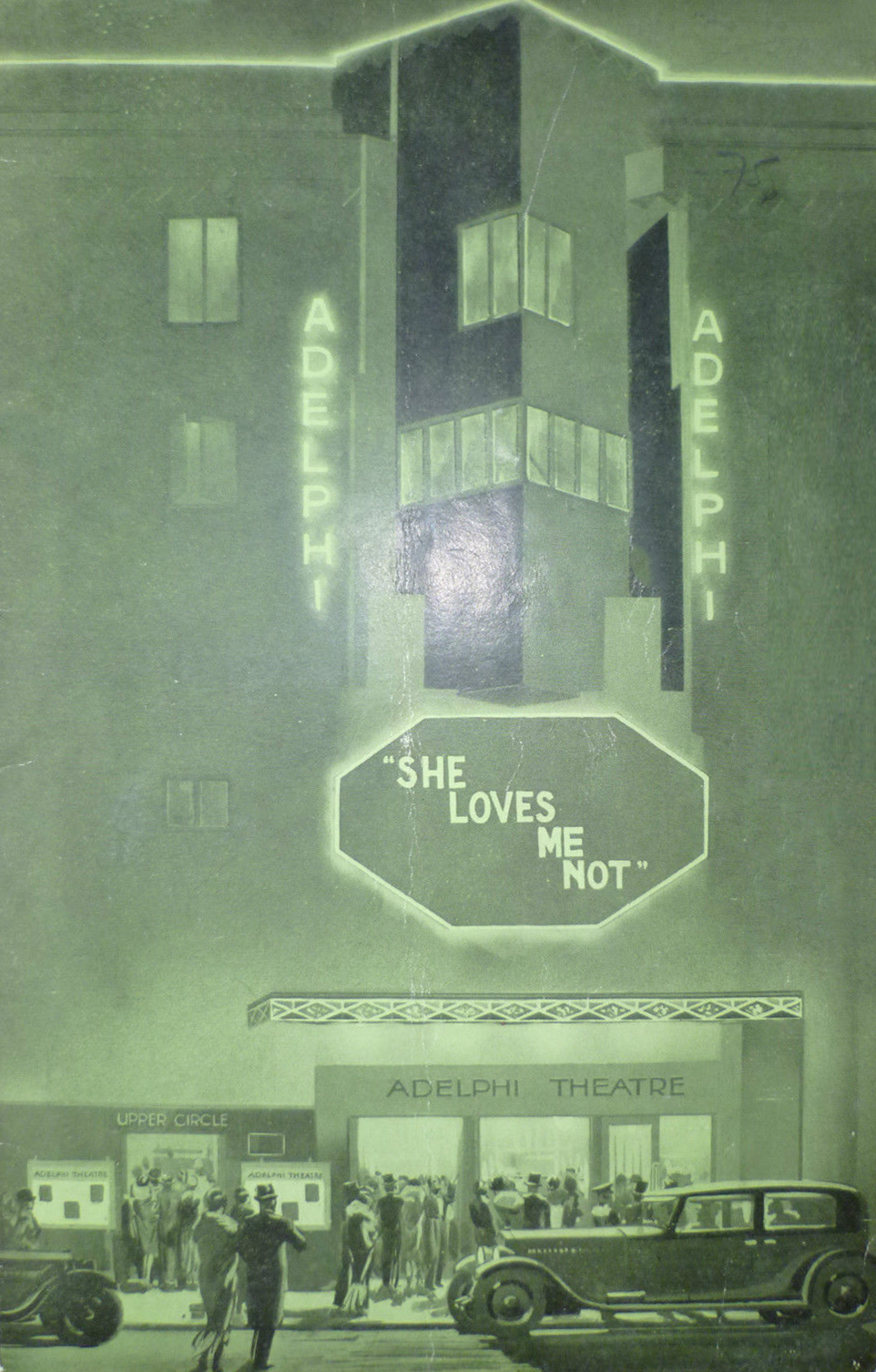
35) She loves me not
Première : 1934
Dernière : Inconnue
Avec : Vera Marshe, Victor Kilian, Howard Phillips, Betty Field, Roberta Beatty, Geoffrey Bryant, George Dillon, Broderick Crawford, Clinton Sundberg, Edmund Dalby, Wilma Vanne, Arthur Finn, Molly Johns, Zvee Scooler, Edward H. Robins, William Harrigan, Elizabeth Love, Jessie Belmore, Edward Fielding, Peter Mather, Will Lansdowne, Robert Sears, Joshua Logan, Eric Bass

34) Nymph Errant
Type : Original
Joué durant 4 mois 2 semaines
Nombre de représentations : 154
Première preview : vendredi 06 octobre 1933
Première : vendredi 06 octobre 1933
Dernière : samedi 17 février 1934
Compositeur : Cole Porter
Parolier : Cole Porter
Librettiste : Romney Brent
Metteur en scène : Romney Brent
Chorégraphe : Agnès de Mille
Avec : Gertrude Lawrence (Evangeline Edwards), Iris Ashley (Madeleine), Doris Carson (Henrietta Bamberg), Walter Crisham (Ben Winthrop), Austin Trevor (Andre de Croissant), David Burns (Constantine), Elisabeth Welch (Haidee Robinson), Queenie Leonard (Clarissa Parks), Moya Nugent (Miss Pratt), Ralph Roberts (Dr. Sandford, Kassim), Alexander Ivo (Alexei), Morton Selten (Count Hohenadelborn-Mantalini), Edward Underdown (Joe the gardener), Hella Kurty (Bertha), Norah Howard (Joyce Arbuthnot-Palmer), Margaret Emden (Aunt Ermyntrude), Winifred Oughton (Edith Sandford), Wilfred Caithness (Reverend Pither), May Agate (Mme. Arthur), Jean Davaut (Hercule), Jessie Busley (Mrs. Bamberg), Bruce Winston (The Eunuch), Betty Hare, Gerald Nodin, Annabel Gibson, and Kenneth Ware (Tourists)
Commentaire : Pre-London try-out: à l'Opera House de Manchester à partir du 11 septembre 1933 prendant trois semaines, produit par C. B. Cochran
33) Words and Music
Type : Original
Joué durant 4 mois 3 semaines
Nombre de représentations : 164
Première preview : vendredi 16 septembre 1932
Première : vendredi 16 septembre 1932
Dernière : samedi 04 février 1933
Compositeur : Noël Coward
Parolier : Noël Coward
Librettiste : Noël Coward
Metteur en scène : ???? ????
Chorégraphe : ???? ????
Avec : Ivy St Helier, Phyllis Harding, Betty Hare, Moya Nugent, Ann Coddrington, Naomi Waters, Steffi Duna, Doris Hare, John Mills, Joyce Barbour, Thea Camacho, Eileen Clifton, Elizabeth Corcoran, Dorothy Cooper, Elizabeth Jenns, Eileen Moore, Clifford Seagrave, Edward Underdown, Kenneth Carten, Norah Howard, Effie Atherton, Millie Sim, Gerald Nodin, Romney Brent, Rita Lyle, Joy Spring, Jack Spurgeon, Graham Payn, Gladys Lincoln, Elizabeth Jenns, Cyril Butcher, Bill Ham, Leslie Roberts, Tony Hulley, Jack Beaumont, Tom Rees, Frank Evans, Betty Wedgewood, Clifford Seagrave, Cyril Wells, Peter Crawford, Jimmy Carney, Kenneth Carten, Eddie Latimer, Edward Britten, Warren Dalmayne, Tommy Hayes plus a girsl and boys chorus.
Commentaire : A revue written by Noël and starring Ivy St. Helier, John Mills and Joyce Barbour. The film below, shot by Coward, records parts of the show and gives a rare glimpse of Noël's hands writing and playing at the piano. Charles B. Cochran first presented this revue at the Opera House, Manchester on 25 August 1932 - it ran until 10 September. It transferred to the Adelphi Theatre, London on the 16 September, 1932 and ran for 164 performances.
Presse : The Manchester Guardian wrote of the show: "Mr. Coward has never sharpened his quill to better purpose than here. In many of the numbers his neatly polished libretto has more than mere verbal ingenuity, and his musical score, though by this time its conventions are familiar, shows a wide and diverting range both in parody and in construction... an acid Anglo-Indian scene with a chorus of sahibs declaiming that 'no matter how much we sozzle and souse, the sun never sets upon Government House', leads to a swinging mock-heroic number with the refrain 'But mad dogs and Englishmen go out in the midday sun' that has a true Gilbertian flavour."
The Times wrote: "Mr. Coward has the gift of attack... he had the audience cheering before the opening chorus was spent.... Mr. Coward has, above all else, the gift of satire, and this revue, being primarily satirical, is his best work in the musical kind... the active fierceness which is the distinction between genuine satire and empty sneering." The paper thought "Something to do with Spring" the only failure in the show, praised "Mad About the Boy", "Midnight Matinée" and the parodies of Casanova and Journey's End, and was undecided about "Let's Say Goodbye." It praised the performances of St Helier, Brent, Hare, Barbour, Steffi Duna and Nora Howard.[4] The Daily Mirror commented, Words and Music "bears the stamp of genius.... 'Mad Dogs and Englishmen' is another song that goes with such snap and sparkle that it is bound to be heard wherever there are gramophones and pianos.... Words and Music has nothing in common with the average revue. Mr Coward, indeed, lifts it far above the ordinary".
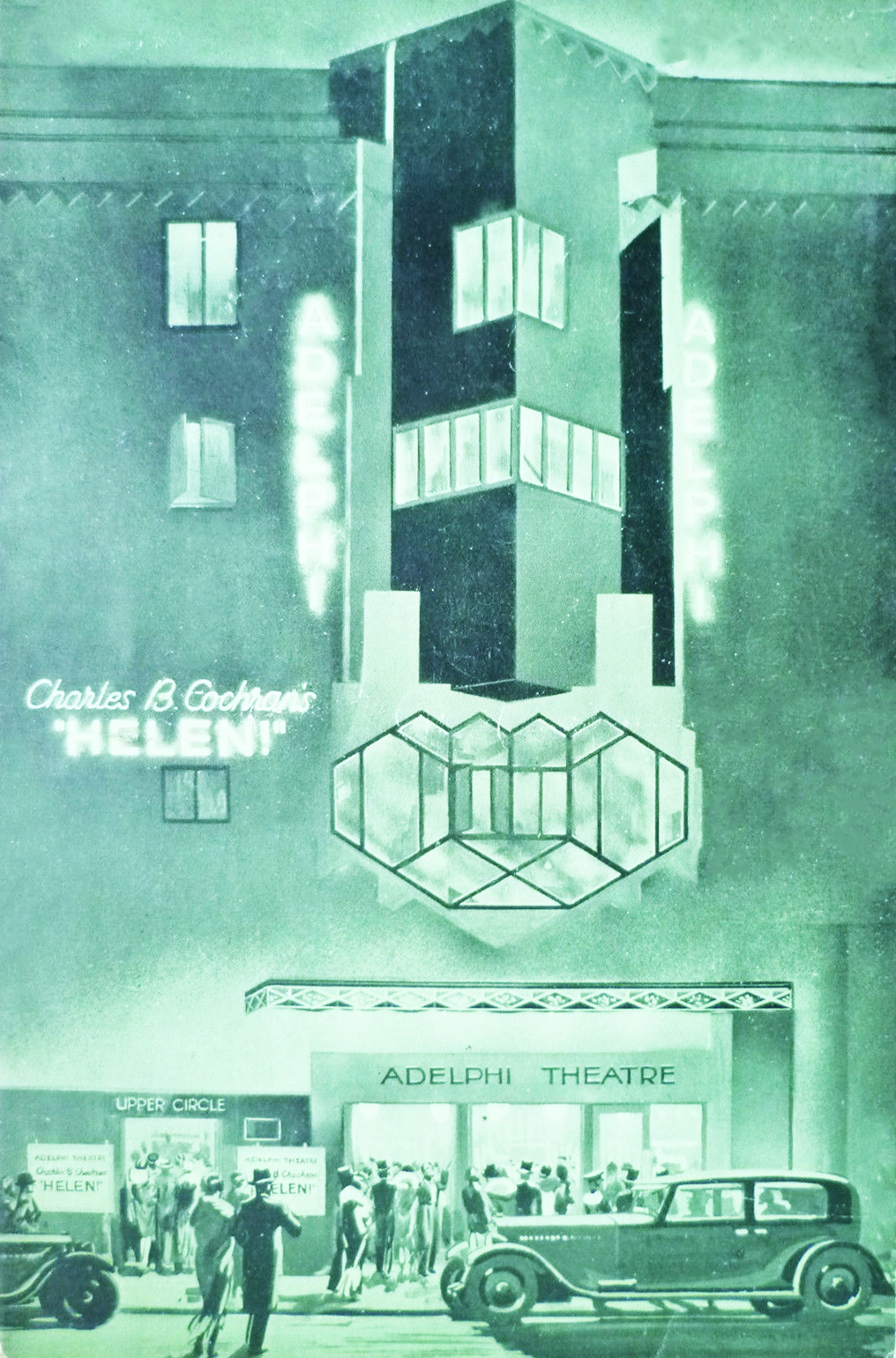
32) Helen!
Type : Original
Nombre de représentations : 194
Première preview : samedi 30 janvier 1932
Première : samedi 30 janvier 1932
Dernière : Inconnue
Compositeur : Jacques Offenbach
Parolier : Henri Meilhac • Ludovic Halévy
Librettiste : Henri Meilhac • Ludovic Halévy
Metteur en scène : Max Reinhardt
Chorégraphe : Leonide Massine
Avec : Helen (Evelyn Laye), George Robey (Menelaus), Bruce Carfax (Paris), W.H. Berry (Calchas), Winifred Davis (June), Shirley Dale (Minerva), Desiree Ellinger (Orestes), Joy Spring (Pylades), Hay Petrie (Mercury), Roy Russell (Achilles), Leslie Jones (Agamemnon)
Commentaire : This was an updated revision of Offenbach’s “La Belle Helene" first performed in Paris in 1864 and in London in 1866. The re-written version was a parody of the original, which was itself a parody of Homer’s poem. As such it did not please everyone, with some finding it “too silly for words”. However, all agreed it had spectacular scenery and costumes and superb dancing - though some felt it was more a variety show and revue rather than a musical comedy.
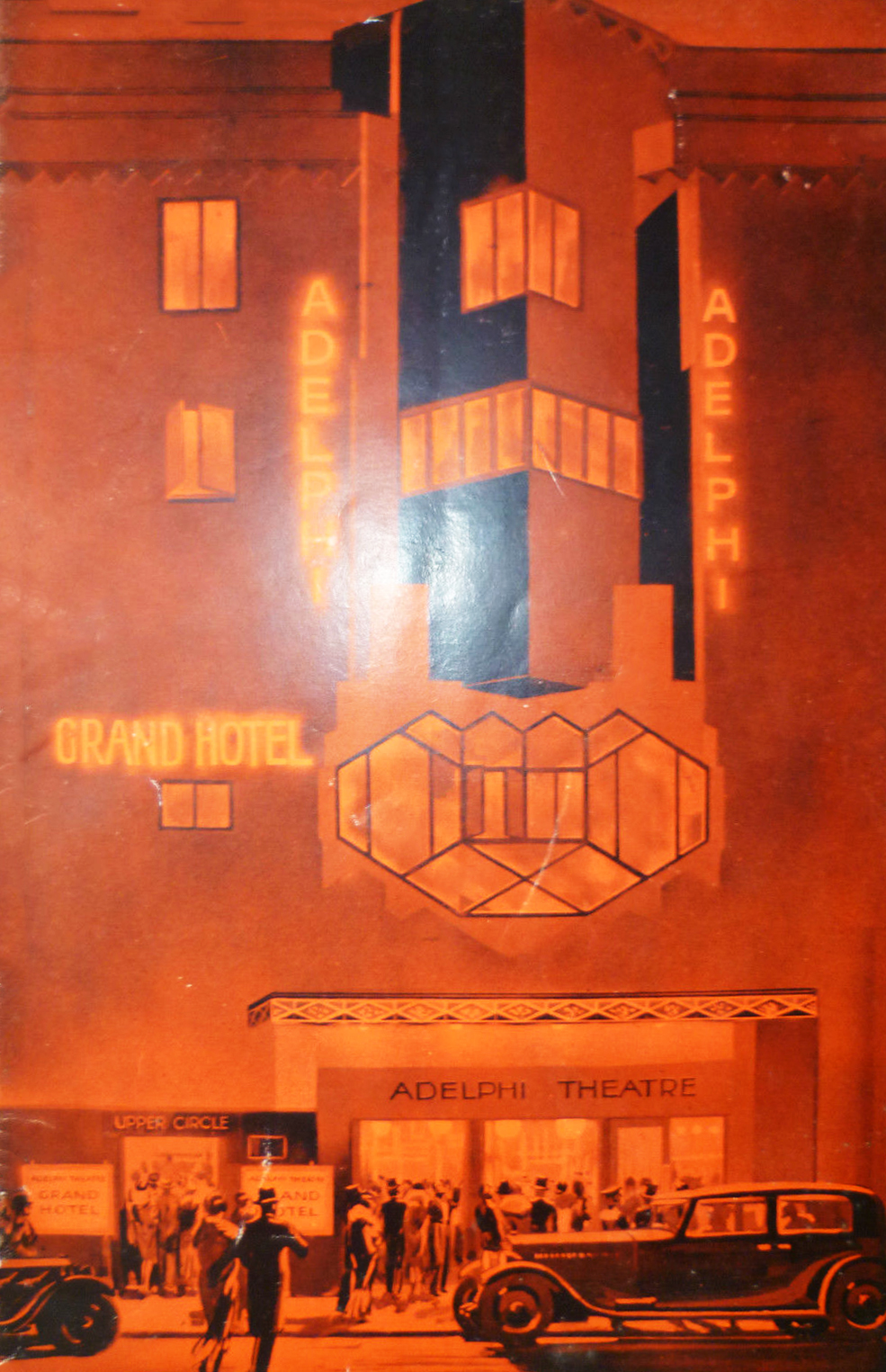
31) Grand Hotel (Baum)
Première : septembre 1931
Dernière : Inconnue
Metteur en scène : Raymond Massey
Avec : Lisaveta Andrejewna Grusinskaja (Elena Miramova), Ursula Jeans (Christine Flamm), Ivor Barnard (Otto Kringelein), Hugh Williams (Baron von Gaigern), Lyn Harding (Director Preysing), Ernest Milton (Doctor Otternschlag), Marjorie Gabain (Suzanne), Harold Scott (Witte), George Merritt (Meierheim), Griffith Humphries (Zinnowitz), Cyril Fairlie (Gerstenkorn), Philip Brandon (Schweimann), Leonard Shepherd (Doctor Waitz), Basil Loder (Reception Clerk), Reginald Atkinson (Assistant Reception Clerk), Vincent Holman (Senf (Hotel Porter)), Gerald Case (Assistant Porter), Betty Lynne (Anne (Chambermaid)), Edward Dagnall (Professor Krauss), Everley Gregg (Telephone Girl), Betty Freeman (Telephone Girl), Drelincourt Odlum (Valet), Tom Woods (Head Waiter), Alexander Sarner (Chauffeur), David Homan (Journalist)

30) Ever Green
Type : Original London
Nombre de représentations : 254
Première preview : mercredi 03 décembre 1930
Première : mercredi 03 décembre 1930
Dernière : Inconnue
Compositeur : Richard Rodgers
Parolier : Lorenz M. Hart
Librettiste : Benn Levy
Metteur en scène : Frank Collins
Chorégraphe : Buddy Bradley • Billy Pierce
Avec : It starred dancer Jessie Matthews (who played both the mother and the daughter) and comedian Sonnie Hale, who married her the following year. It also featured Joyce Barbour and Jean Cadell.
Commentaire : C'est avec ce spectacle que le nouveau théâtre Adelphi (quatrième du nom) a ouvert sur le Strand.

29) House that Jack built (The)
Type : Original
Nombre de représentations : 270
Première preview : vendredi 08 novembre 1929
Première : vendredi 08 novembre 1929
Dernière : Inconnue
28) Mr Cinders
Type : Original
Première preview : lundi 11 février 1929
Première : lundi 11 février 1929
Dernière : Inconnue
Compositeur : Richard Myers • Vivian Ellis
Parolier : Clifford Grey • Greatrex Newman
Metteur en scène : George D. Parker
Chorégraphe : Max Rivers
Commentaire : After a tryout in Blackpool in September 1928 and three-month provincial tour, the musical opened in London at the Adelphi Theatre on 11 February 1929 and moved to the London Hippodrome on 15 July 1929. It ran for 528 performances.

27) Clowns in Clover
Type : Original
Nombre de représentations : 508
Première preview : jeudi 01 décembre 1927
Première : jeudi 01 décembre 1927
Dernière : Inconnue
Avec : Bobbie Comber, Cicely Courtneidge, Dennis Cowles, Chick Endor, Jack Hulbert, June, Irene Russell, Jack Wright
26) Up With the Lark
Type : Original
Joué durant 2 mois 2 semaines
Nombre de représentations : 92
Première preview : jeudi 25 août 1927
Première : jeudi 25 août 1927
Dernière : samedi 12 novembre 1927
Compositeur : Philip Braham
Parolier : Douglas Furber
Librettiste : Douglas Furber • Hartley Carrick
Metteur en scène : George Grossmith
Chorégraphe : Max Rivers • Ethel Heliwell
Avec : Leslie Sarony, Adrienne Ash, Henry Wenman, Diana Wilson, Billie Hill, Austin Melford, Allen Kearns, Anita Elson, Robert Michaelis, W.A. Haines, Charles King et Harry Pringle.
25) Broadway
Nombre de représentations : 252
Première : 1927
Dernière : Inconnue
Avec : Walter Armin, Roy Lloyd, Eleanor Hicks, Olga Hanson, Ben Welden, Josephine Evans, Olive Blakeney, Karen Peterson, Lilian Lyndon, Bunty O'Nolan, Violet Dunn, Bernard J. Nedell, Carlo De Angelo, Joseph Crehan, Gerald Lundegard, Hartley Power, Victor Tremaïne, Cliffman Jewell, Alec Harford
Commentaire : It was Abbott's first big hit on his way to becoming "the most famous play doctor of all time" after he "rejiggered" Dunning's play. The crime drama used "contemporary street slang and a hard-boiled, realistic atmosphere" to depict the New York City underworld during Prohibition. It opened on September 16, 1926, at the Broadhurst Theatre and was one of the venue's greatest hits, running for 603 performances.
24) Merely Molly
Type : Original
Nombre de représentations : 85
Première preview : mercredi 22 septembre 1926
Première : mercredi 22 septembre 1926
Dernière : Inconnue
23) Betty in Mayfair
Type : Original
Joué durant 5 mois 2 semaines
Nombre de représentations : 182
Première preview : mercredi 11 novembre 1925
Première : mercredi 11 novembre 1925
Dernière : samedi 24 avril 1926
Compositeur : Harold Fraser-Simon
Parolier : Harry Graham
Librettiste : John Hastings Turner
Metteur en scène : Fred J. Blackman
Avec : Evelyn Laye (Betty), Mary Leigh (Kitty), Leslie Faber (The Rev. John Head), Lillian Mason (Mrs Brooke Walter), Arthur Margetson (Barnaby Haddon) Jack Hobbs (Bryan Ropes)
Commentaire : Adelphi Theatre: 11 Nov 1925 - 27 Mars 1926
Transféré au Shaftesbury Theatre: 3 Avril - 24 Avril 1926
22) Love's Prisoner
Type : Original
Nombre de représentations : 26
Première preview : samedi 28 février 1925
Première : samedi 28 février 1925
Dernière : Inconnue
Avec : Russell Macaulay, Fred Withers, Albert Hayzen, Kathleen Beldon, Dorothy Lane, Fred Vigay, Betty Faire, Ewart Scott, Helen Gilliland, James Lindsay, Harry Welchman, Dimitre Vetter
21) Love's Prisoner
Type : Original
Nombre de représentations : 26
Première preview : samedi 28 février 1925
Première : samedi 28 février 1925
Dernière : Inconnue
Avec : Russell Macaulay, Fred Withers, Albert Hayzen, Kathleen Beldon, Dorothy Lane, Fred Vigay, Betty Faire, Ewart Scott, Helen Gilliland, James Lindsay, Harry Welchman, Dimitre Vetter
20) Green Hat (The)
Première : 1925
Dernière : Inconnue
Metteur en scène : Nigel Playfair
Avec : Beatrix Lehman, Ronald Sinclair, Herman De Lange, Frederick Leister, Eric Maturin, Leonard Upton, Norman McKinnel, Julian Royce, Tallulah Bankhead, Barbara Dillon, Geoffrey Wincott, Harold Anstruther, Beryl Freeman, Mignon O’Doherty, Beryl Freeman, J. W. Mason, Cyril Nash
Presse : The Green Hat vexed the critics. Ralph Wright, reviewing it for the New Statesman, found Michael Arlen ‘an irritating writer’. Wright was particularly irritated by the ‘smart and thin style’ of Arlen’s prose, the boastful parade of knowledge about modern literature, and, last but not least, by the self-assurance of the man-about-town on matters related to women and sex:
There is a sort of epigrammatic cocksureness on all the details of love-making that I find particularly unpleasant: an assumption that love has something to do with silk underclothing at one moment and at the next a rhetoric outburst on almost Wellsian lines of optimism. I do wish he [Arlen] would be a little more modest and show a little better taste when dealing with the subject.1
19) Head Over Heels
Type : Original
Joué durant 3 mois 1 semaine
Nombre de représentations : 113
Première preview : samedi 08 septembre 1923
Première : samedi 08 septembre 1923
Dernière : samedi 15 décembre 1923
Compositeur : Harold Fraser-Simon
Parolier : Adrian Ross • Harry Graham
Librettiste : Seymour Hicks
Metteur en scène : Seymour Hicks
Avec : W.H. Berry (Alf Wigg), Alfred Beers (Gisardi), Marston Garsia (Chevalier Sanguinetti), Arthur Pusey (Dick Bythesea), Mary Ellis (Jenny), Mabel Sealby (Little Bounce)
18) Island King (The)
Type : Original
Nombre de représentations : 160
Première preview : mardi 10 octobre 1922
Première : mardi 10 octobre 1922
Dernière : Inconnue

17) Golden Moth
Type : Original
Nombre de représentations : 281
Première preview : mercredi 05 octobre 1921
Première : mercredi 05 octobre 1921
Dernière : Inconnue

16) Naughty Princess (The)
Type : Original
Joué durant 7 mois 3 semaines
Nombre de représentations : 280
Première preview : jeudi 07 octobre 1920
Première : jeudi 07 octobre 1920
Dernière : samedi 28 mai 1921
Commentaire : The piece, adapted from the 1912 opéra bouffe "La reine joyeuse" (also known as La reine s'amuse) by Cuvillier and André Barde, was presented under the management of George Grossmith, Jr. and Edward Laurillard at the Adelphi Theatre, London, on 7 October 1920, and ran until 28 May 1921,[2] 280 performances.
A production toured Australia in 1922, under the J.C. Williamson management.
Presse : The Observer praised Grossmith's subtlety of performance, but thought "Mr. Cuvillier's music will make the play go, Mr. Berry's humour will make the play go, Miss Lily St. John's clear voice, and her delightful embarrassment at the applause she gets, will make the play go – and the setting and the costumes were thought tremendously fine." The Times praised the production: "As a riot of fantastic colour it was one of the most exhilarating that we have seen on the London stage for a long time." Of the music, the paper commented, "The official label of The Naughty Princess is opéra bouffe. Now and again certainly Cuvillier's music seemed to justify the description. … The waltz song and its Egyptian splendours will carry it far."[6]
15) Who's Hooper?
Type : Original
Nombre de représentations : 349
Première preview : samedi 13 septembre 1919
Première : samedi 13 septembre 1919
Dernière : Inconnue
14) Who's Hooper?
Type : Original
Nombre de représentations : 349
Première preview : samedi 13 septembre 1919
Première : samedi 13 septembre 1919
Dernière : Inconnue
Avec : W.H. Berry (Horatio Meebles), Maisie Gay (Millicent Meebles), Donald Calthrop (Hughie Cavanagh), Nellie Taylor (Diana Fairlie), C.M. Lowne (Colonel Bagot), Heather Thatcher (Katie Muirhead), W.H. Rawlins (Mr. Burridge), André Randall (Juniori Fratti), T. Del Lungo (Napoleon), George Elton (Mr. Honeyball), F. Russell (Inspector Eason), W. Matthews (Sergeant Dix), George Wilson (Constable Styles), Eddie Garr (Cash), Dorothy Munroe (Turner), R.G. Sydney (Cuthbert Sutton), H.B. Lane (Lyall Hewson-Galway), Marie Clavering (P. Madgewick), Gwen Hughes (Doris Cuddley), Dora Fraser (Winnie Sweet), Betty Blake (Principal Dancers),
13) Boy (The)
Type : Original
Nombre de représentations : 801
Première preview : vendredi 14 septembre 1917
Première : vendredi 14 septembre 1917
Dernière : Inconnue
Compositeur : Howard Talbot • Lionel Monckton
Parolier : Adrian Ross • Percy Greenbank
Librettiste : Fred Thompson • Percy Greenbank
Avec : W.H. Berry (Horatio Meebles), Maisie Gay (Millicent Meebles), Donald Calthrop (Hughie Cavanagh), Nellie Taylor (Diana Fairlie), C.M. Lowne (Colonel Bagot), Peter Gawthorne (Albany Pope), Heather Thatcher (Katie Muirhead), W.H. Rawlins (Mr. Burridge), André Randall (Juniori Fratti), T. Del Lungo (Napoleon), George Elton (Mr. Honeyball), F. Russell (Inspector Eason), W. Matthews (Sergeant Dix), George Wilson (Constable Styles), Eddie Garr (Cash), Dorothy Munroe (Turner), R.G. Sydney (Cuthbert Sutton), H.B. Lane (Lyall Hewson-Galway), Marie Clavering (P. Madgewick), Gwen Hughes (Doris Cuddley), Dora Fraser (Winnie Sweet), Betty Blake (Principal Dancers)
12) High Jinks
Type : Original London
Première preview : jeudi 24 août 1916
Première : jeudi 24 août 1916
Dernière : Inconnue
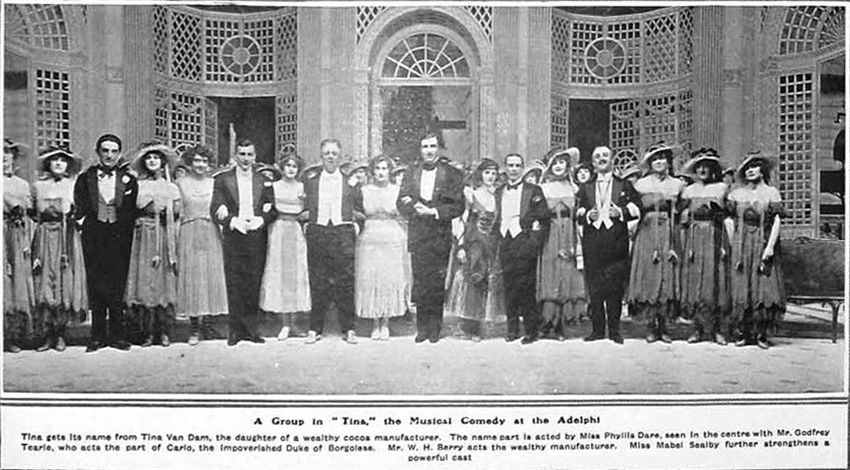
11) Tina
Type : Original
Première preview : mardi 02 novembre 1915
Première : mardi 02 novembre 1915
Dernière : Inconnue
Metteur en scène : Phyllida Lloyd
Chorégraphe : Anthony Van Laast
Avec : Mr. Godfrey Tearle, Mr. Fred Wright, Mr. Ben Osbome, Mr. Rohan Clensy, Mr. Harry Drummond, Mr. J an Oyra, M. T. Del Lungo, Mr. Martin King, M. Leon, M. Lion, Mr. W. H. Berry, Miss Mabel Sealby, Miss Yvonne Reynolds, Miss Luna Love, Miss Dorothy Waring, Miss Chloe O'Hara, Miss Jessie Fraser, Miss Rosie Campbell, Miss Dolly Balfe, Miss Claire Lynch, Miss Gracie Sinclaire, Miss Connie Stuart, Miss Phyllis Dare
10) Belle of Bond Street (The)
Type : Original London
Première preview : lundi 08 juin 1914
Première : lundi 08 juin 1914
Dernière : Inconnue
Commentaire : Créé à Broadway : Shubert Theatre, (30/3/1914 - 9/5/1914), 48 représentations

9) Girl from Utah (The)
Type : Original
Joué durant 6 mois 3 semaines
Première preview : samedi 18 octobre 1913
Première : samedi 18 octobre 1913
Dernière : samedi 09 mai 1914
Compositeur : Paul Rubens • Sidney Jones
Parolier : Adrian Ross • Percy Greenbank
Librettiste : James T. Tanner
8) Dancing Mistress (The)
Type : Original
Nombre de représentations : 242
Première preview : samedi 19 octobre 1912
Première : samedi 19 octobre 1912
Dernière : Inconnue
Compositeur : Lionel Monckton
Parolier : Adrian Ross • Percy Greenbank
Librettiste : James T. Tanner
Avec : James Blakeley (Widdicombe (butler at "Down House")), F. Pope Stamper (Lord Lyndale (otherwise Mr. Viner)), D. J. Williams (Dubois (an adventurer financing the Baron)), G. Carvey (Baron Montalba), Ivan Berlyn (Berchili (manager of Grand Hôtel des Alpes)), Ernest A. Douglas (M. Rosemblum (a Banker)), Joseph Coyne (Teddy Cavanagh (an aeroplanist)), Gracie Leigh (Jeanie McTavish ("tuckwoman" at "Down House")), Mlle. M. Caumont (Mlle. Virginie Touchet (French mistress at "Down House")), Elsie Spain (Bella Peach (daughter of an Argentine millionaire)), Agnes Thomas (Miss Pindrop (Principal of "Down House")), Maud Cressall (Lady Margrave), Gina Palerme (Lili (a Parisienne)), Gertie Millar (Nancy Joyce (dancing mistress of "Down House"))
7) Autumn Manœuvres
Type : Original
Première preview : samedi 25 mai 1912
Première : samedi 25 mai 1912
Dernière : Inconnue
6) Quaker Girl (The)
Type : Original
Nombre de représentations : 536
Première preview : samedi 05 novembre 1910
Première : samedi 05 novembre 1910
Dernière : Inconnue
Compositeur : Lionel Monckton
Librettiste : James T. Tanner
Metteur en scène : J.A.E. Malone
5) Virgin Goddess (The)
Première : mardi 23 octobre 1906
Dernière : Inconnue
Avec : Mr. Alfred Brydone, Miss Lily Brayton, Miss Geneviève Ward, Mr. Oscar Asche, Mr. Charles Rock, Miss Madge McIntosh, Mr. G. Kay Souper, Mr. H. R. Hignett, Miss Florence Gretton, Mr. Walter Hampden, Miss Agnes Brayton.
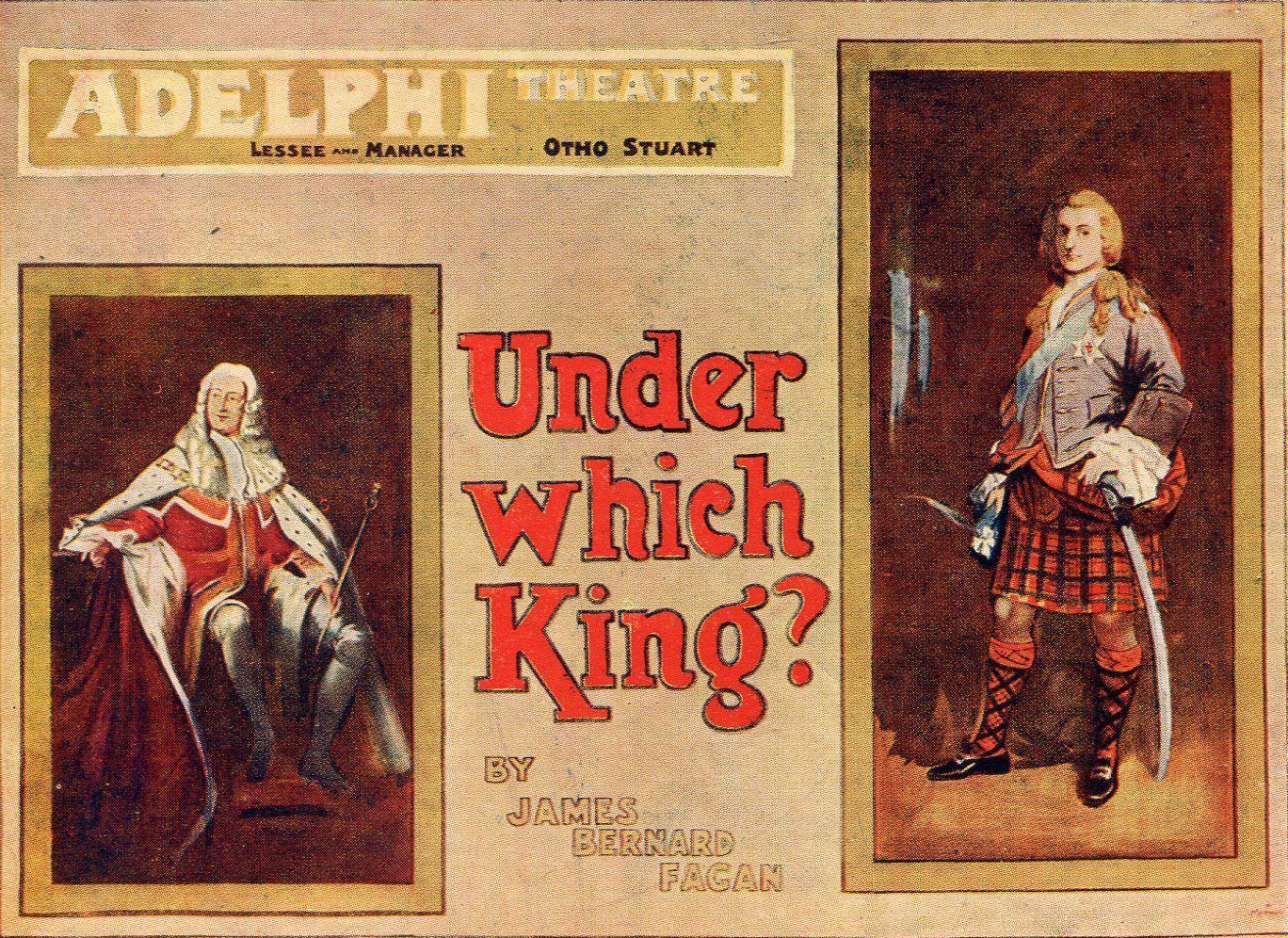
4) Under Which King?
Première : 1905
Dernière : Inconnue
Avec : Oscar Asche, Walter Hampden, E. Lyall Swete, Alfred Brydone, Charles Rock, Mrs. Edward Saker, Lily Brayton.

3) Earl and the Girl (The)
Type : Original
Première preview : jeudi 10 décembre 1903
Première : jeudi 10 décembre 1903
Dernière : Inconnue
Compositeur : Ivan Caryll
Parolier : Percy Greenbank
Librettiste : Seymour Hicks
Avec : Walter Passmore, Henry Lytton, Robert Evett, M. R. Morand, Reginald Crompton, Powis Pinder, Charles Childerstone, Alec Fraser, Ernest Torrence, Rudolph Lewis, Agnes Fraser, and Louie Pounds.
The original London cast included a number of performers who had recently appeared in productions of the D'Oyly Carte Opera Company, which was no longer performing at the Savoy Theatre at the time of the premiere of The Earl and the Girl.
Commentaire : It opened at the Adelphi Theatre in London on 10 December 1903. It transferred to the Lyric Theatre on 12 September 1904, running for a total of 371 performances.
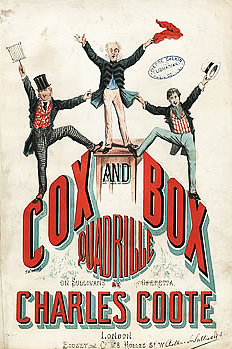
2) Cox and Box
Type : Original
Nombre de représentations : 300
Première preview : samedi 11 mai 1867
Première : samedi 11 mai 1867
Dernière : Inconnue
Compositeur : Arthur Sullivan
Librettiste : F. C. Burnand
Avec : du Maurier (Box), Quintin Twiss (Cox), Arthur Cecil (Bouncer)
1) Belle Hélène (La)
Type : Revival
Première preview : samedi 30 juin 1866
Première : samedi 30 juin 1866
Dernière : Inconnue
Compositeur : Jacques Offenbach
Parolier : Henri Meilhac • Ludovic Halévy
Librettiste : Henri Meilhac • Ludovic Halévy